
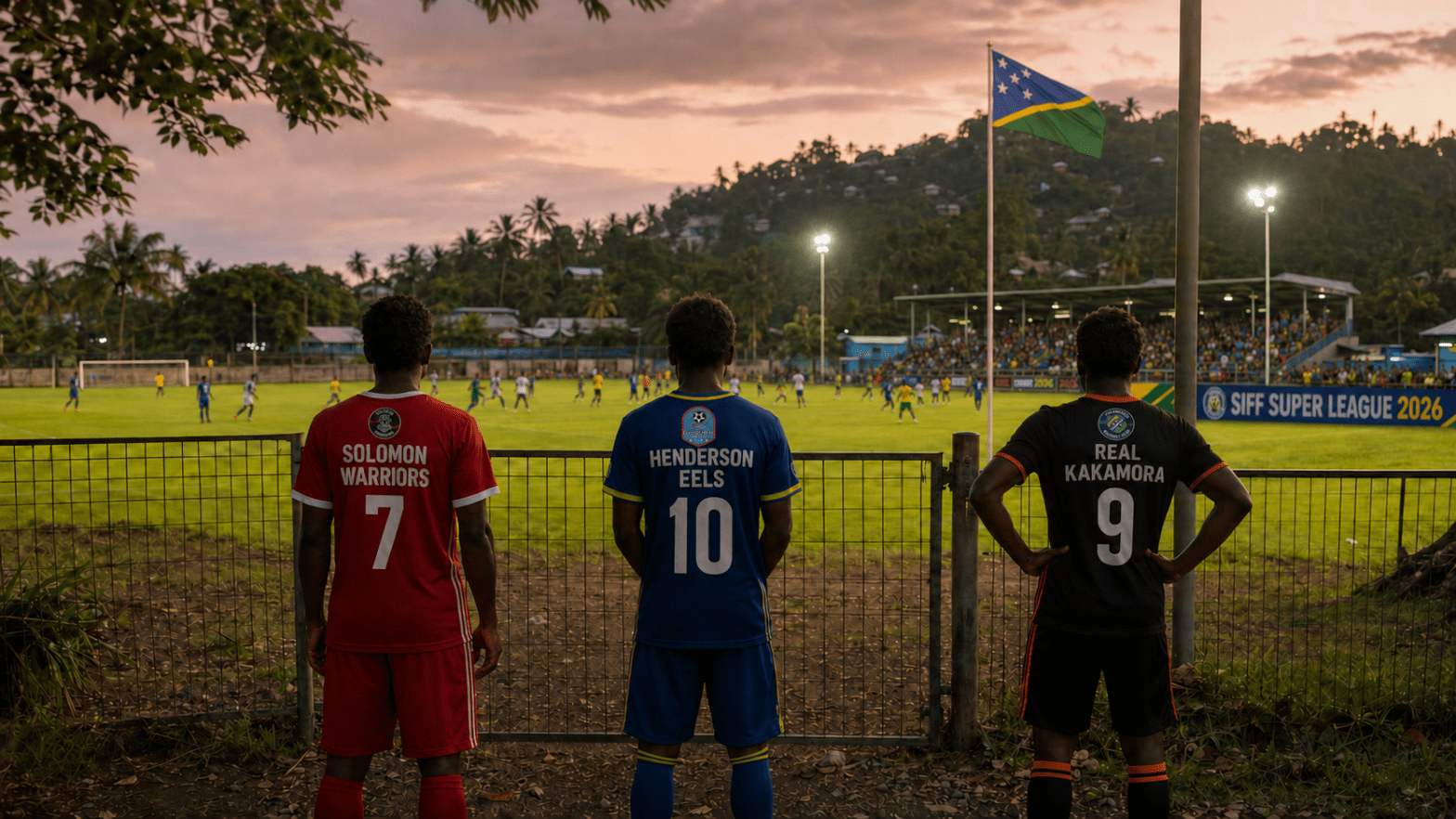
The SIFF Super League returns this weekend after a lengthy delay, but the beginning of a new season cannot conceal a difficult question for football in Solomon Islands: how can the country’s leading domestic competition move forward without several of the clubs that defined its recent history?
Central Coast will begin their title defence as the strongest team in the competition. Malaita Kingz, Green Shield and Honiara City are expected to provide the principal opposition, while KOSSA, Marist, Laugu United, SOSA, Southern United and newcomers Ghupo complete the ten-team field.
However, Solomon Warriors, Henderson Eels and Real Kakamora are all missing. FC Juniper Tree and Waneagu United have also been excluded. Their situations are not identical, but together they expose the financial and administrative fragility surrounding the national league.
Solomon Warriors are the most successful club of the S-League era. They won seven championships between 2011 and 2023, including three consecutive titles from 2017 to 2020 and another two in 2022/23 and 2023. For more than a decade, any discussion about the championship usually began with Warriors.
Henderson Eels were the team that interrupted that period of dominance. After emerging as Warriors’ principal challengers and finishing second in 2019/20, Eels captured their first S-League title in 2020/21. Their squad included some of the country’s most important players, with Raphael Lea’i, Joses Nawo and other Solomon Islands internationals helping establish the club as a major domestic force.
Central Coast then became the next dominant side. They won their first championship in 2021 before returning to the top in 2024 and retaining the title in 2025. Their success means the reigning champions remain in the league, but two of the three clubs responsible for every S-League title from 2017/18 until 2023 are now absent.
Warriors and Eels withdrew before the 2025 season amid difficulties securing the sponsorship and funding required to operate at national-league level. Neither club was included among the ten teams declared administratively compliant for 2026.
Their absence shows that sporting strength alone does not guarantee survival in the S-League. Clubs need to finance registration, player payments, transportation, preparation and daily operations in an environment where commercial opportunities remain limited. Even historically successful teams can quickly disappear from the competition when their financial backing changes.
Real Kakamora represent a different and considerably more controversial case.
After losing all 22 matches and conceding 116 goals in 2023, Kakamora rebuilt their squad through an arrangement involving Green Shield’s management. They subsequently produced one of the most remarkable turnarounds in Solomon Islands football, challenging near the top of the table for much of 2024 before finishing third.
At the same time, the club developed an international following through an unconventional Instagram account. Kakamora embraced their previous struggles and used sarcastic posts, memes and interactions with football pages around the world to attract an audience rarely seen by an Oceanian club outside New Zealand.
Their online presence gave international supporters a reason to follow not only Kakamora, but also the S-League. Players such as Paul Francis and Gordon Iro became recognisable to people who previously knew little about domestic football in Solomon Islands.
Despite finishing third and contributing significantly to the league’s international exposure, Kakamora were not granted a new licence for the 2025 season. The explanation presented publicly was non-compliance with league requirements, but the precise requirements the club failed to meet were not fully detailed.
Kakamora said the problems began when the club and Green Shield submitted separate licence applications after working together during the previous season. Green Shield was admitted independently, while Kakamora were left outside. According to the club, attempts to appeal the decision did not change the outcome.
The matter became even more contentious when Kakamora sought to return in 2026. The club said it was informed that no additional teams could enter until the current three-year licensing cycle expires, potentially leaving it outside the S-League until 2028.
A licensing system can provide stability. It can ensure that clubs have adequate administration, finances and organisational structures before being permitted to compete. SIFF also has a responsibility to prevent situations in which teams enter the competition without the resources to complete a season properly.
However, such a system also requires transparency. When one of the previous season’s best-performing and most widely followed clubs is excluded, “non-compliance” alone is not a sufficiently informative public explanation. Supporters should be able to understand which criteria were not fulfilled, whether the club was given an opportunity to correct them and how the appeal process operated.
The cases of Juniper Tree and Waneagu are more clearly documented. SIFF said both clubs were penalised for failing to pay their registration fees for the 2025 season. The federation subsequently reduced the league from 12 to ten teams and announced that all remaining participants had satisfied their financial and administrative obligations.
Yet even that decision illustrates the underlying problem. Exclusion may enforce the regulations, but it does not solve the financial conditions that repeatedly leave clubs unable to comply with them. A national competition loses sporting value when established teams disappear not through relegation, but because they cannot secure sponsors or meet administrative costs.
The creation of Solomon Kings for the OFC Professional League adds another layer to the situation. The new professional side provides leading Solomon Islands players with access to a higher-level regional competition, but it also concentrates talent and attention outside the domestic league.
The S-League therefore begins its new season in an unusual position. It remains the highest domestic competition in a country where football is the national sport, but it does not currently include the country’s most successful S-League club, the 2020/21 champions or the team that produced its most internationally visible social-media story.
There is still considerable sporting interest. Central Coast are pursuing a third consecutive championship, Malaita Kingz came within one match of winning the 2025 title, and Green Shield’s rapid development offers another compelling story. The return of Malaita Kingz and the inclusion of new clubs also demonstrate that the competition is capable of producing new challengers.
Nevertheless, new teams cannot immediately replace the history, support and identity associated with Warriors, Eels and Kakamora. Their absence makes the competition administratively compliant, but not necessarily representative of the strongest and most recognisable club football available in Solomon Islands.
For the S-League to grow, regulations and financial standards are necessary. So are communication, accessible appeals and a clearer pathway through which excluded clubs can return. Otherwise, supporters may continue to see major football institutions disappear through decisions made away from the pitch—and the league will continue losing some of the clubs people are most interested in watching.
Discover more from Oceania Football Center
Subscribe to get the latest posts sent to your email.

