
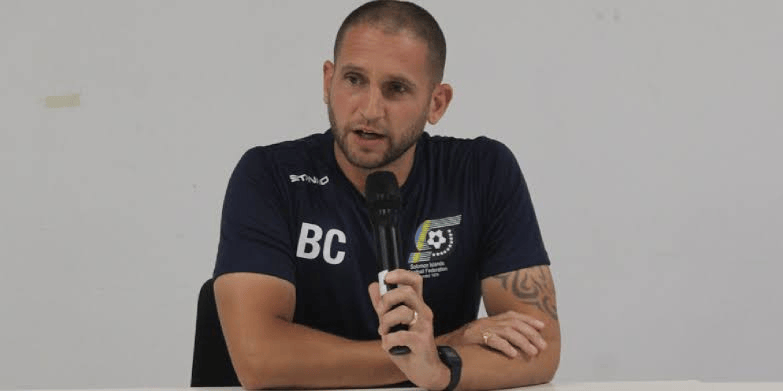
Ben Cahn will take charge of Solomon Islands in his first competitive tournament as senior national team head coach when the Bonitos begin their campaign at the 2026 MSG Prime Minister’s Cup in Fiji, and the Australian-English coach has made clear that the immediate target is not simply development.
Solomon Islands are travelling to Fiji to win.
Cahn first worked with the national team earlier this year as interim coach during the FIFA Series international friendlies in Indonesia, but the MSG Cup will be his first competitive assignment since formally taking charge. Speaking to the Island Sun in Honiara ahead of the tournament, the Solomon Kings FC coach placed the competition within a much wider national-team project while insisting that the short-term objective remains clear.
“We go to the MSG Cup and the aim is to win. This competition is our first step towards our national team project and it is something we take seriously. We’ve put a lot of work in over the last few months,” Cahn told the Island Sun.
The longer-term ambition is considerably bigger. Cahn openly identified qualification for the 2030 FIFA World Cup as the project’s ultimate goal, with Solomon Islands looking to build a deeper and more competitive national-team structure over the next four years.
“The long-term goal and the dream is World Cup 2030, so we’re very serious and working very hard towards trying to do everything we can to achieve that dream of qualification,” he said.
Cahn also pointed to the performances of smaller nations at the most recent World Cup as evidence that the gap can be challenged when the correct structures and standards are put in place.
That process has already started with a significant expansion of the national-team selection pool. Nearly 40 players were involved in the recent training programme before the group was reduced ahead of the MSG Cup.
“The first purpose was to have a big training camp. We had nearly 40 players, so we could have a look and try to bring the level up,” Cahn told the Island Sun.
For Fiji, however, Cahn has prioritised players who are ready to perform immediately.
“For the final squad, we go to the MSG Cup, the aim is to win, so we have to take the players that are most ready at the moment.”
The final group is largely made up of familiar and experienced names, but Cahn has also been impressed by several players attempting to break into the senior setup.
“A couple of new players have done really well and really impressed us. We think they can fit into the team and make the team stronger,” he said.
Two players from the Solomon Islands U-19 side are also expected to join the senior squad directly in Fiji after the country narrowly missed World Cup qualification at the recent OFC U-19 Men’s Championship in Samoa.
That pathway between age-group football and the senior team forms an important part of Cahn’s plan. He also praised the Solomon Islands U-16 side that qualified for the FIFA U-17 World Cup in Qatar and confirmed that some of those players have already trained with the senior national team.
“We’ve had a good look at the U-16 boys who obviously did a great job to qualify for the FIFA U-17 World Cup in Qatar. We’re bringing them in, they’ve done really well, it’s been very positive,” Cahn told the Island Sun.
The intention is eventually to create a much broader group of senior international candidates rather than relying on a relatively small core of established players.
“We want to build the pool of players over the next three or four years to be around 50 to 60 players ready for the national team,” he said.
That pool will not be limited to the current squad. Cahn said players in the S-League, Solomon Islands’ national age-group sides, futsal and overseas football will continue to be monitored, including those who were not involved in the latest camp.
His message to them was particularly direct.
“We’re watching. No one gets the shirt because of a name, they have to earn that.”
That principle represents an important part of the new national-team environment Cahn is trying to create. Selection is intended to be based on current level and readiness rather than reputation, with competition for places expected to increase as the player pool grows.
The MSG Prime Minister’s Cup will provide the first real test of that approach.
Cahn expects a difficult tournament, with the standard across Melanesian football continuing to rise.
“I think the standard is going to be really strong. I think it’s going to be a very tough competition. I think every team will be strong,” he told the Island Sun.
For Solomon Islands, the competition therefore serves two purposes at once. It is the first stage of a four-year project aimed at making the national team significantly more competitive by the time 2030 World Cup qualification arrives, but it is also a tournament Cahn expects his players to try to win now.
That distinction is important. The new project is not being presented as an excuse to postpone expectations.
Solomon Islands have traditionally been one of Melanesia’s strongest football nations, but translating technical quality and individual talent into consistent senior international results has remained a recurring challenge. Cahn’s task is to create a broader competitive environment in which more players are genuinely ready for international football and where places in the team are continuously earned.
His role with Solomon Kings adds another layer to that process. Working directly with the country’s professional club gives Cahn regular access to several players who could form the backbone of the senior national side, while the wider national-team camps allow him to assess talent from the S-League, overseas clubs and Solomon Islands’ increasingly successful youth programmes.
The connection between those different levels could become one of the most important elements of the 2030 project.
For now, though, the focus is Fiji.
The Solomon Islands men’s and women’s national teams are expected to travel together for the MSG Prime Minister’s Cup, which begins on September 17. For Cahn, it will mark the beginning of his competitive tenure with the Bonitos and the first measuring point of a project that is already looking four years ahead.
“The future looks great. I’m really happy to be on board and we’re all working together really hard to see if we can achieve the dream of the World Cup in 2030,” Cahn told the Island Sun.
The dream is 2030. The first competitive test comes now.
Discover more from Oceania Football Center
Subscribe to get the latest posts sent to your email.

