
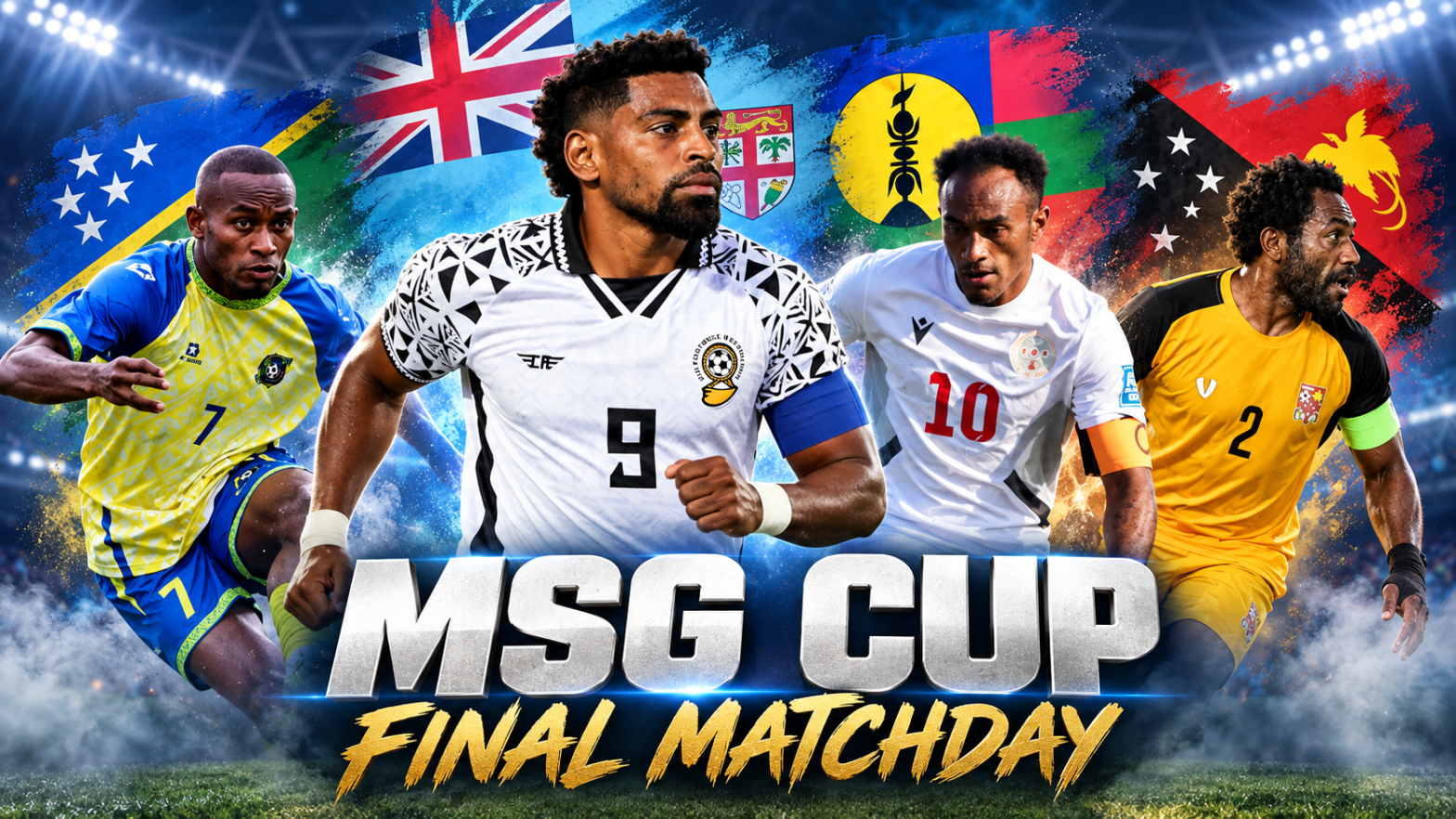
The round-robin stage of the 2026 MSG Prime Minister’s Cup reaches its conclusion on Wednesday at HFC Bank Stadium, with Vanuatu already having completed their schedule and the other four Melanesian nations entering one final day that will determine who advances to Saturday’s grand final.
After four rounds that have produced dramatic comebacks, late goals and repeated changes in the standings, the tournament remains remarkably open. Defending champions Vanuatu currently set the pace with seven points from their four matches, followed by Solomon Islands on five, Fiji on four, while Papua New Guinea and New Caledonia both have three.
Only the leading two teams progress to the October 3 final, meaning Wednesday’s Papua New Guinea-Solomon Islands encounter at 4pm and Fiji-New Caledonia clash at 7pm are effectively interconnected. What happens in the first match will determine precisely how much pressure surrounds the second.
Vanuatu can do nothing more on the pitch. Richard Iwai’s side completed their round-robin campaign on Sunday with a 4-1 victory over New Caledonia, taking their total to seven points and significantly improving their position before the remaining contenders play their fourth matches.
Their route to seven points has been anything but straightforward. Vanuatu began the defence of their title with a painful 2-1 defeat to Papua New Guinea after Tony Kaltack had put them ahead in the 77th minute. Nalau Moses and Ezekiel Vela then scored in the 85th and 87th minutes to completely overturn the match.
Instead of allowing that collapse to define the tournament, Vanuatu responded by defeating hosts Fiji 1-0 through Bill Kaltfer Kaltack. They then led Solomon Islands three separate times but were pegged back on each occasion in a memorable 3-3 draw, before recovering from an early deficit to defeat New Caledonia.
Even that 4-1 scoreline did not tell the entire story. Cédric Decoire had put the Cagous ahead after 15 minutes before Tony Kaltack equalised nine minutes later, and the game remained 1-1 until the 79th minute. Joe Moses eventually broke the resistance, Edward Roqara added another six minutes later and Azariah Soromon completed the result in stoppage time.
Those late goals could become extremely valuable. Vanuatu finish the group with nine goals scored and six conceded, giving them a +3 goal difference. They now wait to discover whether seven points will guarantee another opportunity to defend the title they won against Papua New Guinea last year.
For Solomon Islands, the situation is clearer: Ben Cahn’s team enter the day in second position and remain the only unbeaten side in the men’s competition.
The Bonitos have collected five points from three very different matches, although resilience has been the common feature throughout their campaign.
Against Fiji, Solomon Islands were 3-1 down and facing defeat before Jayroll Patty reduced the deficit and captain Javin Wae scored deep into stoppage time to rescue a 3-3 draw. Against New Caledonia, Raphael Lea’i finally broke a stubborn defensive resistance before Wae appeared once again in added time to complete a 2-0 victory.
Then came another extraordinary 3-3 encounter against Vanuatu. Solomon Islands fell behind through Andrew Malakai, Tony Kaltack and Jayson Bule, but Don Keana, Lea’i and Wae answered each of those goals. They never led the match, yet never allowed the defending champions to escape either.
Wae has consequently become one of the unexpected stars of the tournament. Primarily a defender, the Solomon Islands captain has scored in all three matches, with each goal arriving during the closing stages. Lea’i has added two goals of his own as Cahn’s side have scored eight times in three appearances.
A victory over PNG would take Solomon Islands to eight points and guarantee their place in the final. A draw would move them onto six and leave their qualification dependent on the evening result. Defeat, however, would keep them on five while sending PNG above them on six, completely changing the picture before Fiji and New Caledonia take the field.
That makes the opening game just as important for Papua New Guinea.
The Kapuls entered the tournament with considerable experience and began in perhaps the best possible way by defeating the defending champions. Their late comeback against Vanuatu appeared to place Bob Morris’ team in an excellent early position, particularly after Nalau Moses and Ezekiel Vela transformed a likely defeat into three points within two minutes.
The tournament has moved in the opposite direction since.
New Caledonia defeated PNG 2-1 in the following round despite Ati Kepo cancelling out Brice Dahite’s early goal. Willy Read’s second-half effort, helped by a significant deflection off Daniel Joe, produced the decisive moment.
PNG then suffered another setback against Fiji on Sunday. Roy Krishna converted a penalty after 18 minutes and Sterling Vasconcellos doubled the hosts’ advantage six minutes later, with Fiji protecting the 2-0 lead throughout the second half.
From beating the defending champions on opening day, the Kapuls have therefore fallen to consecutive defeats and enter their final match with no margin left for another setback.
PNG need victory over Solomon Islands to reach six points and keep their final hopes alive. Even then, they will have to watch the evening encounter closely. A Fiji victory would take the hosts to seven points, while a New Caledonia win would also move the Cagous onto six and bring the competition’s tiebreak criteria into play.
For Fiji, Sunday’s response against PNG may have arrived at exactly the right moment.
Stéphane Auvray’s side began their home tournament with only one point from their first two matches. The 3-3 draw against Solomon Islands was particularly painful after Fiji had established a 3-1 advantage through Krishna, 17-year-old Maikah Dau and Thomas Dunn before Tevita Waranaivalu’s dismissal changed the contest.
A 1-0 defeat against Vanuatu followed, putting Fiji under major pressure before facing PNG.
This time, there was no late collapse. Krishna’s penalty was his second goal of the competition and Vasconcellos provided the cushion, while the Bula Boys controlled the advantage after halftime to collect their first victory.
Fiji now enter the final round with four points and a +1 goal difference. Their requirement is straightforward at its most basic level: they need to defeat New Caledonia and reach seven points.
What seven points ultimately mean will depend heavily on the earlier result. If Solomon Islands and PNG draw, a Fiji victory would move the hosts alongside Vanuatu on seven points and ahead of Solomon Islands. If PNG win, Fiji would again move to seven and remain ahead of the Kapuls.
The most complicated scenario comes if Solomon Islands defeat PNG. The Bonitos would then finish on eight, while a Fiji victory would leave the Bula Boys and Vanuatu together on seven. The identity of the second finalist would then be determined by the applicable tournament tiebreak criteria, making Fiji’s performance and winning margin particularly important.
A draw is not enough for Fiji. With Vanuatu already on seven and one of Solomon Islands or PNG guaranteed to finish with at least six points if their match produces a winner — while Solomon Islands themselves would reach six with a draw — the hosts need all three points to keep their path open.
New Caledonia enter with the most difficult equation, but their campaign has shown why they cannot simply be dismissed.
Félix Tagawa travelled to Fiji with a dramatically reshaped squad made up entirely of domestically based players after financial limitations prevented the federation from assembling most of the overseas contingent that had taken New Caledonia to the FIFA intercontinental playoff earlier this year.
The Cagous began with a 2-0 defeat to Solomon Islands but responded impressively by beating PNG 2-1. Against Vanuatu, they were still level at 1-1 with little more than ten minutes remaining before the defending champions scored three late goals.
New Caledonia have three points and therefore need to beat Fiji to reach six. Their realistic route towards the final also requires PNG to defeat Solomon Islands, which would potentially leave PNG and New Caledonia together on six points behind Vanuatu and force the final place to be separated through the competition’s tiebreak process.
Their 2-1 victory over PNG could become extremely significant if direct confrontation is part of that process.
It means that when Fiji and New Caledonia walk onto HFC Bank Stadium at 7pm, both teams will already know the exact consequences of the afternoon result.
A Solomon Islands victory would put the Bonitos safely into the final and turn Fiji’s match into a pursuit of Vanuatu’s seven-point mark. A draw in the first game would leave Solomon Islands on six and give Fiji the opportunity to overtake them with victory. A PNG win would propel the Kapuls to six and create an even more complicated final evening, with Fiji capable of reaching seven and New Caledonia capable of joining PNG on six.
Few tournaments of this size could have asked for a more appropriate final round.
Vanuatu have already done their part and must wait. Solomon Islands have survived every difficult moment thrown at them and remain unbeaten. Fiji have recovered from a poor beginning just in time. Papua New Guinea are attempting to rescue a campaign that started with such promise, while New Caledonia still have one opportunity to turn an experimental tournament into something considerably more meaningful.
After eight matches, no final pairing has yet been confirmed.
By Wednesday night in Suva, two of them will still be standing — and they will return to HFC Bank Stadium on Saturday with the Melanesian title at stake.
Discover more from Oceania Football Center
Subscribe to get the latest posts sent to your email.

