
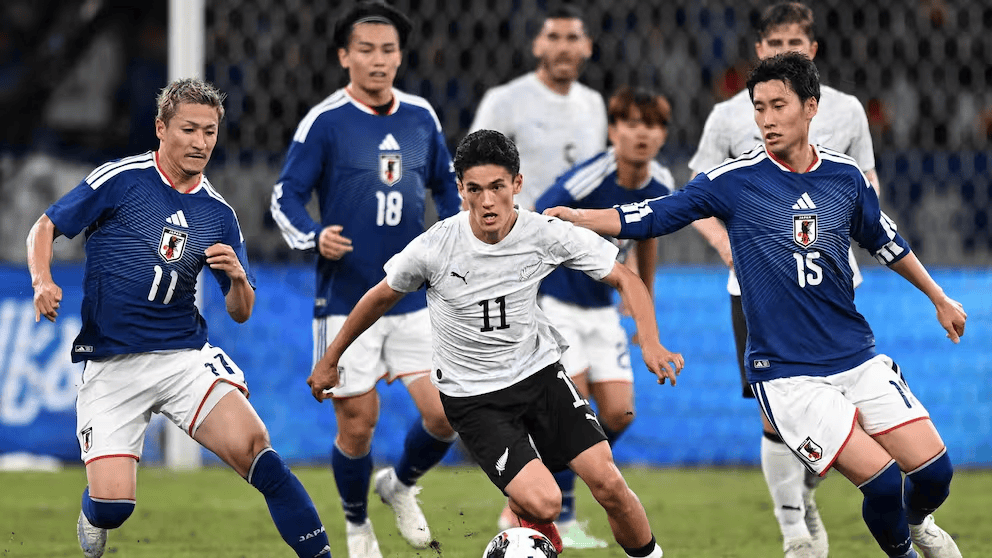
New Zealand came within 20 minutes of taking one of Asia’s strongest national teams into another tense finish, but Ritsu Doan’s second-half goal gave Japan a 2-1 victory over the All Whites in the Kirin Cup final in Tokyo.
Playing in front of more than 60,000 supporters at the National Stadium, Darren Bazeley’s side spent long periods without the ball but remained competitive through a disciplined defensive performance, the goalkeeping of Alex Paulsen and their ability to threaten Japan on the counterattack. Ben Old scored New Zealand’s goal after Ayase Ueda had opened the scoring, before Doan decided the final in the 71st minute.
Japan immediately established control of possession and forced New Zealand into a deeper shape. Bazeley effectively used five players across the defensive line, with Tyler Bindon, Michael Boxall and George Stanger protecting the centre while Dane Ingham and Old operated on the outside. Marko Stamenić, Alex Rufer and Lachlan Bayliss had to cover considerable ground in midfield as Japan circulated the ball around the All Whites’ defensive block.
The hosts eventually broke through in the 28th minute. Japan worked the ball down the right before Shuto Nakano’s delivery took a deflection inside the penalty area, leaving Ueda with the opportunity to attack the loose ball. The striker reacted first and finished powerfully from close range to put the Samurai Blue ahead.
New Zealand’s response, however, was almost immediate and illustrated exactly where Bazeley’s side could hurt Japan.
Only four minutes later, the All Whites recovered the ball and broke quickly. Captain Chris Wood carried possession towards the Japanese defence, drawing attention before releasing Old, who had made an intelligent run inside from the left. The Saint-Étienne player met the pass first time and produced a composed right-footed finish beyond Zion Suzuki to make it 1-1.
It was a particularly impressive moment from Old. New Zealand had been forced to defend for much of the opening half, but when the opportunity arrived, the 24-year-old turned a transition into a goal against a Japanese side containing several players established in major European leagues.
The equaliser allowed New Zealand to reach half-time level, although the balance of the game did not substantially change after the break. Japan continued to dominate possession and progressively increased the pressure around the All Whites’ penalty area.
Ueda came close to restoring the lead shortly after the restart, rising at the far post and sending a header against the crossbar. When Japan did find the target, Paulsen repeatedly stood in their way.
The Motherwell goalkeeper made nine saves over the course of the match and was arguably New Zealand’s outstanding performer. One of his best moments came in the 66th minute when Ao Tanaka fired towards goal and Paulsen reacted sharply to tip the effort over the crossbar.
Japan finished the match with around 78 per cent of possession and 11 shots on target, numbers that underline how much pressure New Zealand were required to absorb. Yet the All Whites remained level until Japan’s depth began to make a decisive difference.
Hajime Moriyasu introduced Keito Nakamura, Junya Ito and Ao Tanaka during the second half, and Nakamura was directly involved in the winning goal. In the 71st minute, he drove down the left and carried the ball into the penalty area before sending a low delivery across goal. Captain Ritsu Doan arrived free at the far post and converted from close range, restoring Japan’s lead.
Ueda appeared to add another shortly afterwards, but the goal was ruled out for offside, keeping New Zealand within one goal of forcing another shootout.
Bazeley had already begun refreshing his side, introducing Callan Elliot, Jesse Randall and Ben Waine for Ingham, Bayliss and Wood. Stipe Ukich and Dalton Wilkins followed later as New Zealand attempted to find a route back into the contest, but Japan managed the final stages well enough to protect their advantage.
The defeat brought an end to an encouraging international window for the All Whites. New Zealand had opened with a 2-2 draw against Palestine, followed that with an impressive 3-0 victory over China, and then reached the Kirin Cup final by beating Panama on penalties following a 1-1 draw, with Stamenić scoring in regulation time.
The final represented a considerable step up. Japan, ranked 17th in the world, controlled most of the contest and ultimately deserved the trophy on the balance of chances and possession. Yet New Zealand avoided being overwhelmed, found a way to score against sustained pressure and remained only one goal behind until the final whistle.
For Bazeley, there were positives despite the defeat. Paulsen once again demonstrated his ability at international level, Old produced a high-quality goal, and a defence containing Bindon, Boxall and Stanger survived prolonged periods against a technically gifted Japanese attack.
There was no trophy at the end of the night, but taking Japan to a 2-1 final in Tokyo provided another demanding test for an All Whites side continuing to measure itself against stronger international opposition.
Discover more from Oceania Football Center
Subscribe to get the latest posts sent to your email.

