
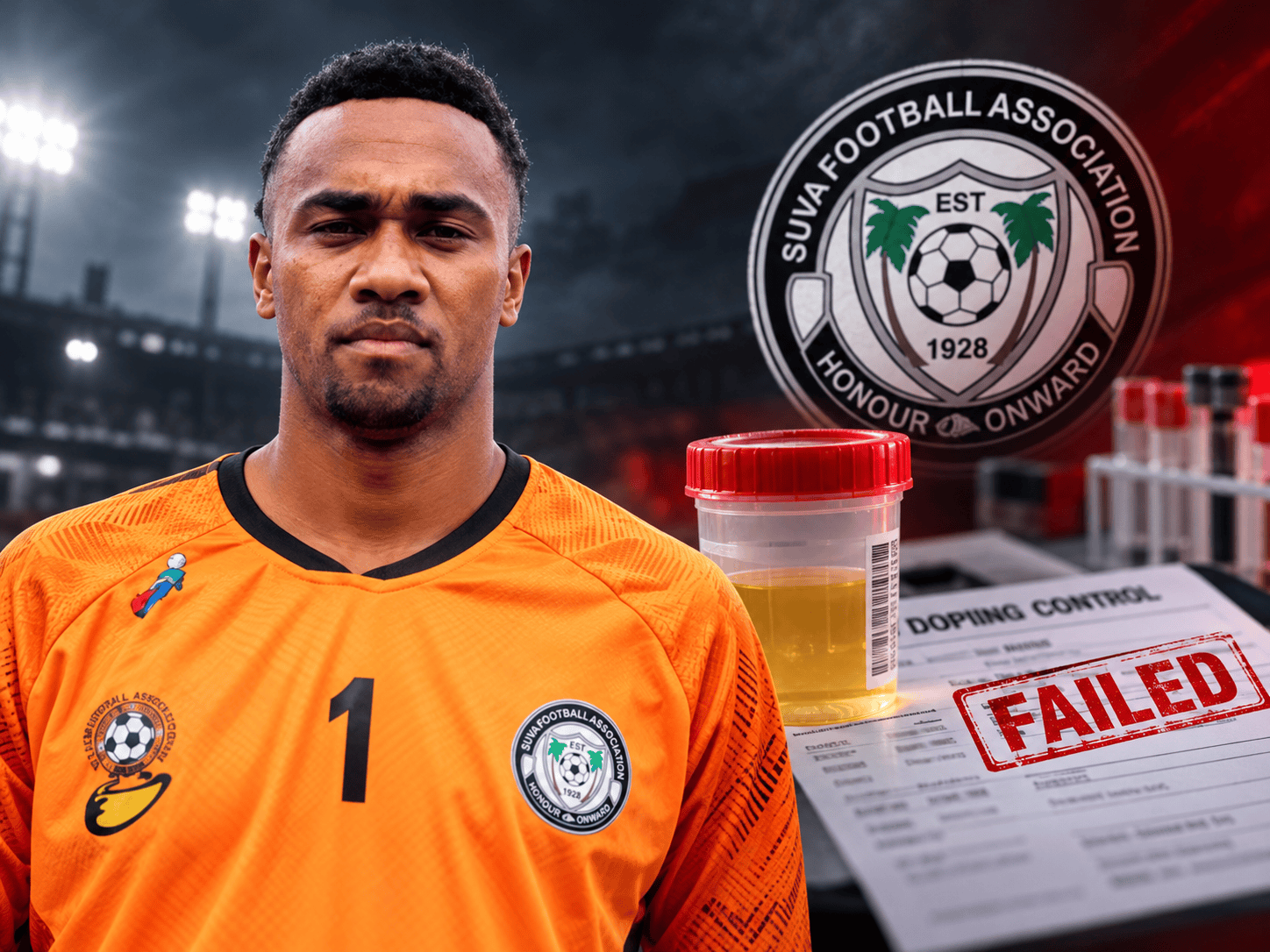
Suva goalkeeper Jason Rokovucake has been suspended after failing a drug test at the 2026 FMF Inter-District Championship, with head coach Pita Rabo confirming the case as Fiji football once again faces questions over a problem that has repeatedly surfaced at its major domestic competitions.
Rokovucake started Suva’s opening Super Premier match against Labasa at the HFC Bank Stadium, playing the full match as the hosts suffered a dramatic 2-1 defeat following Christopher Wasasala’s long-range winner in the closing stages.
Less than 24 hours later, however, the goalkeeper had disappeared completely from Suva’s matchday squad for the 2-2 draw against Nasinu. Akuila Mateisuva started between the posts, while Mohammed Tariq Khan was included among the substitutes.
The reason for Rokovucake’s absence has now been confirmed by his own coach.
Speaking after the Nasinu match, Pita Rabo confirmed that Rokovucake had failed a drug test and had been suspended from the team.
“It’s a lesson to him and I hope that he will learn from it,” Rabo told Fiji Sun.
The confirmation makes Rokovucake one of the six players caught by Fiji FA’s testing programme during the opening day of the IDC.
Fiji Football Association chief executive Mohammed Yusuf confirmed that 60 players were tested on the first day alone, with six returning positive results. Two of the cases involved Super Premier players, while one came from the Premier Division and another three from the Senior Division.
The six players were immediately suspended from further participation in the tournament and are expected to appear before the Fiji FA Disciplinary Committee. Yusuf has also indicated that some of the latest cases involve repeat offenders, potentially exposing those players to significantly longer suspensions.
For Rokovucake, the suspension interrupts a season in which he had established himself as a regular figure in goal for Suva. He featured throughout the domestic campaign and remained the capital side’s first choice heading into the IDC, including during Suva’s run to the Battle of the Giants semifinals only weeks earlier.
But the goalkeeper’s case is becoming part of a much wider story.
Drug-related suspensions are no longer an occasional occurrence around major Fijian football tournaments. Positive tests have appeared repeatedly across the Fiji FACT, Battle of the Giants and IDC, despite Fiji FA progressively increasing the number of tests and warning districts about their responsibility to control the issue.
The numbers from 2026 alone underline how persistent the problem has become.
At the Fiji FACT in June, 72 players were tested and four positive results for prohibited drugs were eventually recorded. Three involved marijuana, while another involved methamphetamine. Fiji FA described the methamphetamine case as particularly serious, while three of the four cases reportedly involved players who had previously offended.
Only a few months later, the issue returned at the Battle of the Giants. Another 72 tests were conducted during the group stage and three produced positive results — two on the opening day and another during the final round of pool matches.
Now the IDC has produced six positives from just the first 60 tests conducted on opening day.
That means the three major tournament periods of 2026 have already produced 13 positive drug-test results between them. The figure does not necessarily represent 13 different players, particularly because Fiji FA has acknowledged the presence of repeat offenders, but it demonstrates how consistently positive results continue to emerge whenever systematic testing is carried out.
The pattern is not limited to the current season.
In 2025, Fiji FA responded to four positive cases from 90 tests at the Fiji FACT by announcing weekly testing in the Premier and Senior leagues. Later that year, positive cases again emerged at the Battle of the Giants, before the IDC produced an even more alarming figure: 10 players had failed tests across the opening three days of the tournament.
There were similar cases in previous seasons. Four players faced drug charges following testing at the 2024 Fiji FACT, while three players failed mandatory tests during that year’s Battle of the Giants.
The problem extends considerably further back. Fiji FA was already conducting random testing at Premier League matches and major tournaments in 2017, when players were suspended after positive results. In 2018, five players tested positive during the Fiji FACT group stage, including two players who had been important members of the Fiji national team.
In other words, drug testing itself is not new to Fijian football, and neither are positive results.
Fiji FA has attempted several different responses over the years, from immediate tournament suspensions and fines to longer bans for repeat offenders. More recently, the association introduced regular league testing and strengthened its warnings to districts. Yusuf also announced plans in September to review the organisation’s social drug policy, with tougher sanctions among the options being considered.
The 2026 season has nevertheless shown how difficult the problem has been to contain.
The Battle of the Giants highlighted another complication when several players involved in unresolved cases from previous competitions were allowed to resume playing while their disciplinary proceedings remained pending. Fiji FA argued that players should not continue to suffer sporting consequences before their cases and appeals were finalised, but the situation also exposed delays and uncertainty within the disciplinary process.
Rokovucake’s IDC case is more straightforward for the immediate future. His positive result has been confirmed publicly by his coach, he has been removed from Suva’s squad and he will take no further part in the tournament while the disciplinary process continues.
For Suva, it means losing their first-choice goalkeeper during a tournament in which their margin for error was already small following the opening defeat to Labasa and draw with Nasinu.
For Fiji football, however, the significance goes beyond one player or one club.
Rokovucake is simply the latest identifiable case in a sequence that has now stretched across seasons and virtually every major domestic competition. The continued appearance of positive results — including marijuana, methamphetamine and repeat offences — suggests that Fiji FA’s testing programme is successfully detecting the problem, but also that testing and suspensions alone have so far not been enough to make it disappear.
With six positives already recorded at the IDC and more testing expected as the tournament continues, the latest cases have again placed one of Fiji football’s most persistent off-field issues alongside the action on the pitch.
Discover more from Oceania Football Center
Subscribe to get the latest posts sent to your email.

