
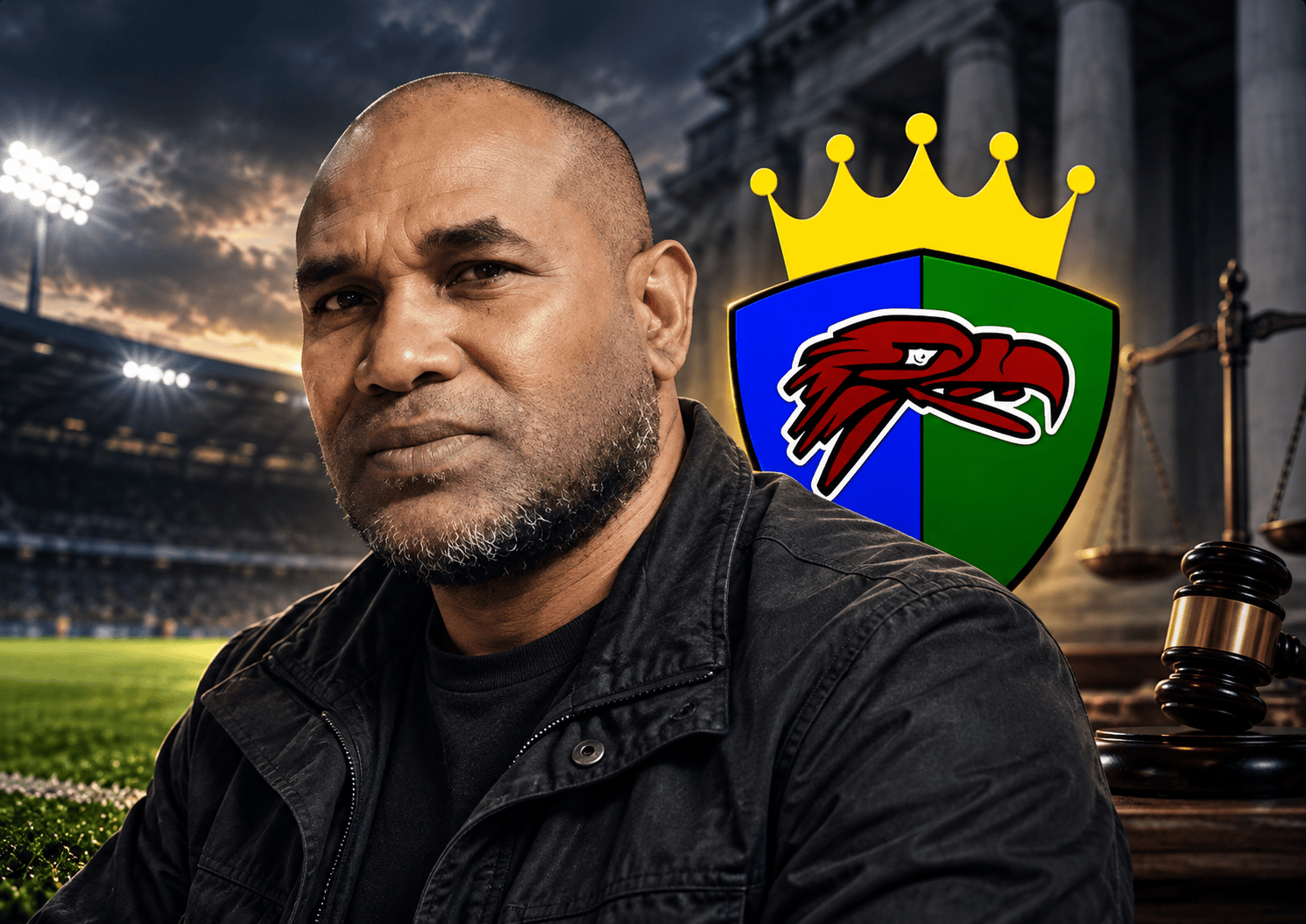
Moffat Konofilia’s contributions to Solomon Islands football have become a central part of his efforts to secure a favourable outcome in court, with the former national team player and current GHUPO Wantoks coach relying on his record in youth development as he awaits sentencing over his involvement in the November 2021 Honiara unrest. However, his claims have come under closer examination, with the Honiara Magistrate’s Court demanding independent verification of his work with young players, including those who travelled to England through his former Royals football project.
The latest hearing, held on Tuesday, 6 October, brought further controversy as prosecutors questioned aspects of his mitigation submissions and raised concerns about his conduct. According to Solomon Star, exchanges became increasingly tense when Konofilia raised his voice and pointed towards the prosecutor and a journalist, prompting repeated warnings from the presiding magistrate. The proceedings were eventually adjourned to Monday, 12 October, when he is scheduled to be sentenced.
Konofilia, 49, was convicted of unlawful assembly in connection with the disturbances that affected Honiara on 24 November 2021, when protests against the government of then Prime Minister Manasseh Sogavare escalated into widespread unrest, looting and destruction across the capital. He was acquitted of a separate sedition charge and has appealed his unlawful assembly conviction to the High Court. The conviction concerns his participation in an unlawful gathering and should not be confused with a finding that he personally committed the acts of arson and looting that occurred during the unrest.
Representing himself during the sentencing proceedings, Konofilia has requested that the court apply Section 35 of the Solomon Islands Penal Code, allowing the matter to be conditionally dismissed rather than proceeding with a conventional punishment. His proposal would give him 12 months to demonstrate good conduct without committing another offence. As part of his submissions, he has emphasised his contributions to football development and community reconciliation, seeking to establish that his activities should be considered in determining the appropriate judicial outcome.
For Solomon Islands football, the most significant development is that Konofilia’s sporting record is no longer simply a matter of public reputation. It has become evidence that the court is being asked to assess.
During proceedings in September, the presiding magistrate questioned whether the documents and photographs submitted by Konofilia were sufficient to demonstrate the extent of his involvement in youth football development. The court requested independent confirmation, suggesting that statements from parents or family members of young players who had benefited from his programmes would provide a stronger basis for evaluating his claims. Similar verification was requested concerning his involvement in community reconciliation initiatives.
The issue returned during Tuesday’s hearing when the prosecution addressed a statement submitted by the mother of one of the young footballers who had travelled to England. According to Solomon Star’s court reporting, the statement confirmed that assistance had been provided, but did not clearly establish the extent of the support that had come personally from Konofilia.
Konofilia responded by explaining that his involvement had included moral support and advice, arguing that he felt responsible for the young player’s welfare. His explanation presented his contribution as extending beyond financial or administrative assistance, reflecting a mentoring role in the player’s development and experience overseas.
The distinction is important. The existence of opportunities created through Royals does not automatically establish how much responsibility or credit belongs to any particular individual involved in the programme. Equally, the request for further verification does not mean that the court has rejected Konofilia’s contributions or concluded that his claims are false. What remains under examination is the evidence supporting those contributions and the weight they should carry in sentencing.
Royals was undoubtedly one of the most ambitious and controversial private football development projects undertaken in Solomon Islands during the previous decade. Established under Konofilia’s leadership, the programme sought to connect young Solomon Islands footballers with overseas training, education and playing opportunities, particularly in England. Through arrangements involving Stars Football Academy, dozens of players travelled abroad, with some progressing into English non-league football and others eventually returning to represent their country.
The programme produced recognisable football achievements. Players such as Ali Mekawir and Ian Kula received opportunities with English clubs, while Mekawir became the first Solomon Islander to score in the FA Cup. Rovu Boyers, another footballer associated with the overseas pathway, subsequently pursued opportunities in Greece, Sweden and Australia before becoming a Solomon Islands international and securing a professional contract with South Island United in the OFC Pro League.
These developments demonstrated that the overseas pathway was capable of producing tangible sporting opportunities. However, the programme also experienced serious difficulties, particularly during the COVID-19 pandemic, when a considerable number of young Solomon Islands footballers were left in England amid travel restrictions and uncertainty over their return home.
Oceania Football Center extensively covered those difficulties in 2020, including the public breakdown between Konofilia and former Royals technical director Alick Collin. Both men presented conflicting accounts of events surrounding the academy’s operations in England, while the situation of the stranded players raised questions about the responsibilities of those managing overseas development programmes.
The history of Royals has therefore never been straightforward. Its achievements coexist with disputes over management, institutional accountability and the welfare of players pursuing opportunities far from home. The latest court proceedings have brought renewed attention to that complicated record, although they are not a trial of the academy itself.
Another significant detail emerged when the court examined the registration status of Royals Football Club. The prosecution stated that the club had previously been registered but that its registration had not been renewed. Konofilia acknowledged that the organisation was no longer registered, while maintaining that he continued assisting players in his capacity as a football agent. He also argued that its registration could be renewed through payment of the required fees.
The magistrate observed that Konofilia’s football activities appeared to have continued despite the absence of current club registration, rather than operating through a formally registered academy. The distinction again reinforced the court’s interest in independently establishing the nature and extent of his ongoing contributions.
The renewed attention arrives at a particularly sensitive moment in Konofilia’s football career. Following years of disputes with the Solomon Islands Football Federation and a period spent overseas, he returned to a prominent position in the domestic game earlier this year when he was appointed head coach of GHUPO Wantoks FC.
The club’s 2026 project carries the backing of Papua New Guinea football powerhouse Hekari United, with John Kapi Nato and Vonnie Puia Nato involved in its development. GHUPO has outlined ambitions that extend beyond participation in the Telekom S-League, including youth academies, women’s football and opportunities connecting Solomon Islands players with clubs and development structures elsewhere in the Pacific.
Konofilia’s involvement represented an opportunity to return to the country’s highest domestic competition and participate in another ambitious football development project. It also meant that his activities would once again attract attention from supporters, administrators and the wider football community.
That scrutiny was already evident in August when Oceania Football Center reported on a confrontation involving security personnel and individuals around the GHUPO section during an S-League match against Green Shield at Lawson Tama Stadium. The available footage established that a confrontation occurred, although it did not independently determine how the dispute began or establish misconduct by Konofilia.
The incident followed a long history of disciplinary disputes involving the former international. In 2017, the Solomon Islands Football Federation imposed a three-year suspension on Konofilia after finding that he had assaulted a referee following a Solomon Cup match. The punishment was subsequently upheld on appeal in 2019.
His legal history also includes a separate conviction in England. In September 2025, Konofilia received an 18-month community order after being convicted of sexually assaulting a 17-year-old girl in Weymouth in December 2023. He denied the offence but was found guilty. The British proceedings are separate from the current Honiara case, and the latest publicly available reporting does not establish whether that conviction has been considered in the present sentencing submissions.
Tuesday’s hearing nevertheless produced further questions about the character evidence Konofilia had submitted. Special Prosecutor Mary Anne Zurenuoc raised two incidents at the court premises, including an exchange between herself and Konofilia in August and the reported arrival of some of his relatives at court while intoxicated in September. She also referred to his previous failure to comply with bail obligations when he travelled overseas, arguing that these matters undermined the claims of good character presented in his mitigation.
Konofilia disputed aspects of those accounts. He explained that the August disagreement arose after he had not received a document that the court had directed the prosecution to provide, while the prosecutor had been attending another case. Regarding his relatives, he insisted that he had not invited them to attend the hearing and that they had learned of the proceedings through media reports. He maintained that he had told them not to attend court while intoxicated.
The situation became more confrontational when Konofilia pointed towards the prosecutor while speaking and raised his voice. The magistrate warned him against pointing at people in court. A further warning followed when he gestured towards a journalist while discussing how his relatives had learned about the hearing dates. The magistrate stressed that journalists were carrying out their work and should not be subjected to such conduct.
Konofilia subsequently apologised, explaining that his raised voice reflected his normal manner of speaking and that he had not understood the impropriety of pointing his finger during the proceedings. The magistrate also reminded him that although allowances had been made because he was representing himself without a lawyer, he could not continue submitting additional documents indefinitely, as doing so would create further opportunities for prosecution responses and delay sentencing.
The court has not yet delivered its sentencing decision. Konofilia remains on bail, and his appeal against the unlawful assembly conviction is pending before the High Court.
Beyond the immediate legal proceedings, the developments raise questions about the relationship between football leadership, personal responsibility and the recognition of contributions made to young athletes. Konofilia’s involvement in Solomon Islands football has produced opportunities that form part of the country’s modern development history, but his record has also been accompanied by repeated controversy.
The court’s examination of his football activities is not intended to settle that wider sporting debate. Its task is to determine what evidence can properly be considered in mitigation and what outcome is appropriate under the law.
For the football community, however, the proceedings carry significance beyond the sentence itself. They have brought one of Solomon Islands football’s most divisive personalities back into the public spotlight at a time when he has returned to a leading coaching position and is again associated with ambitions to develop the next generation of players.
When the Honiara Magistrate’s Court reconvenes on 12 October, Konofilia’s legal future will be the immediate question. His football legacy, once presented chiefly through ambitious overseas projects and the careers of players who emerged from them, has now become part of the evidence he is asking the court to consider.
The outcome remains uncertain, but the latest developments have added another significant chapter to a career in which football opportunities, institutional conflict and personal controversy have repeatedly intersected.
Discover more from Oceania Football Center
Subscribe to get the latest posts sent to your email.

