
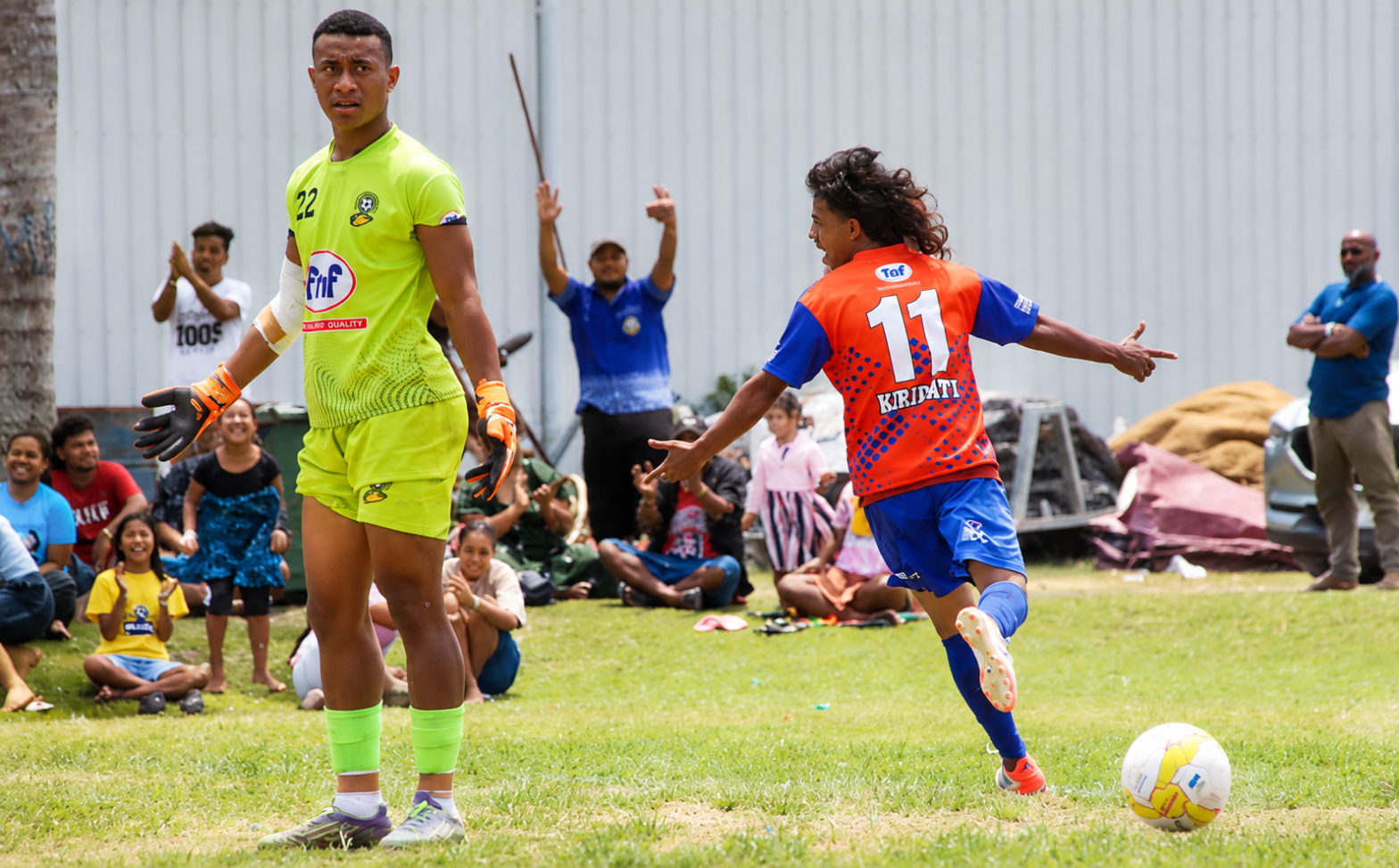
Kiribati have produced another remarkable result at the 2026 FMF Inter-District Championship, defeating Fiji’s World Cup-bound Under-17 national team 3-1 in the Premier Division semi-finals to reach Sunday’s final against Seaqaqa. Just two days after recording the first victory in the history of their senior national team, the Pacific islanders have now eliminated one of Fiji’s most promising youth squads, continuing an extraordinary campaign in their first appearance at the tournament.
Goals from Peter Diehm, Bauro Martin Jr and Nabetari Itiata secured the victory at Buckhurst Park in Suva, where Kiribati established a two-goal advantage before half-time and demonstrated considerable composure to withstand Fiji’s second-half response.
The achievement carries additional significance because of the opposition. Fiji’s Under-17 programme has secured qualification for the FIFA U-17 World Cup in Qatar in 2026 and has become increasingly competitive at regional level, qualifying for three consecutive editions of the tournament.
The squad competing at the IDC also includes players developing their football in New Zealand. Five New Zealand-based players are participating in the tournament with the young Fijian national side: Ryan Achari of Hamilton Wanderers, Ryan Swami of Fencibles United, Ayush Naidu of Auckland United, and Auckland City FC duo Mustafeez Khan and Somit Maharaj.
Their inclusion illustrates Fiji’s growing ability to draw upon players from established football environments outside the country. Swami and Maharaj were also involved in Fiji’s successful 2026 OFC U-16 Championship campaign, which secured qualification for the 2027 FIFA U-17 World Cup.
Khan had already demonstrated his contribution during the IDC group stage, scoring Fiji’s second goal in a 2-0 victory over Tailevu Naitasiri. The result helped the young national team progress towards the knockout stages and offered another example of the depth available within Fiji’s youth football structure.
Kiribati, therefore, were not simply facing an inexperienced local youth team. Their opponents were part of a national development programme with international ambitions, overseas-based players and recent success in Oceania.
Yet it was Kiribati who took control of the semi-final.
Peter Diehm opened the scoring before Bauro Martin Jr doubled the advantage, giving Kiribati a commanding 2-0 lead at half-time. The goals rewarded a confident performance from a team that had already demonstrated its attacking capabilities in previous matches.
Martin, in particular, has emerged as one of Kiribati’s outstanding players throughout the competition. The forward had scored in the opening 4-2 defeat against Seaqaqa before producing a hat-trick in the historic 6-0 victory over Nadroga.
Against Fiji U17, he again delivered when his team needed him.
However, the young Fijians refused to accept defeat without a response.
Fiji pulled a goal back after the interval and began pushing forward with greater urgency, searching for the equaliser that would bring them back into contention. Their increased attacking commitment placed Kiribati under pressure, but it also created opportunities for the islanders to exploit the spaces left behind.
Rather than abandoning their approach, Kiribati maintained their defensive organisation and looked to control possession whenever possible. They were prepared to sit deeper when necessary, avoiding unnecessary risks while remaining dangerous on the counterattack.
One of the most decisive incidents came during a rapid Kiribati break.
Martin chased a long ball beyond the Fijian defensive line and lifted it over the advancing goalkeeper. Attempting to prevent the attack, the Fiji U17 goalkeeper handled the ball outside his penalty area and was shown a red card.
The dismissal left Fiji with ten players at a moment when they were already committing considerable energy to finding an equaliser.
Kiribati made their advantage count.
Nabetari Itiata added the third goal, restoring the two-goal cushion and effectively ending Fiji’s hopes of completing a comeback.
It was another example of Kiribati’s effectiveness in transition. While Fiji attempted to recover the match through attacking pressure, the visitors remained alert to counterattacking opportunities and showed the composure required to protect their advantage.
Their performance was particularly notable for the balance between attacking ambition and defensive responsibility. Kiribati did not simply retreat and hope to survive. They managed periods of possession, slowed the tempo when appropriate and ensured that Fiji’s pursuit of another goal continued to expose spaces behind their defence.
The final whistle confirmed another milestone in what has already become the most successful week in Kiribati’s football history.
The country’s IDC campaign began on October 6 with a 4-2 defeat against Seaqaqa. Despite conceding four goals, Kiribati found the net through Teweia Butibara and Martin, demonstrating that they could compete against opponents accustomed to the intensity of Fijian district football.
Their next match produced a result that attracted attention throughout Oceania.
Kiribati overwhelmed Nadroga 6-0, with Martin scoring three times and Nabetari Itiata, Booia Maitina and Kiniole Filiki also finding the net. It was the first recorded victory achieved by Kiribati’s senior men’s national team since the country began participating in international football in 1979.
The distinction is important: because Nadroga are a Fijian district club rather than a national team, that result does not qualify as an official senior international victory. Nevertheless, it represented a genuine sporting breakthrough for a country that had spent decades without experiencing a win at senior national-team level.
Now Kiribati have followed that historic achievement with another victory, this time against a side associated with one of Oceania’s most successful recent youth development programmes.
The results are even more impressive considering the difficulties Kiribati face in developing football domestically.
The country is not a FIFA member and has limited access to regular international fixtures, organised high-level competition and suitable playing facilities. During the tournament, Kiribati players have highlighted the challenges created by the lack of grass pitches at home and the limited opportunities available to prepare under conditions comparable to those encountered in Fiji.
Participation in the IDC has offered a rare chance to overcome some of those obstacles.
Instead of being restricted to occasional international tournaments, Kiribati have been able to face experienced Fijian district teams and a national youth selection in competitive matches over several days. Their progress has been visible, from the defensive mistakes that contributed to their opening defeat to the more disciplined and composed performance that secured their place in the final.
The challenge ahead will bring the campaign back to where it started.
Kiribati will meet Seaqaqa in Sunday’s Premier Division final at HFC Bank Stadium, with kick-off scheduled for 12pm. The northern Fijian district qualified after recovering from a half-time deficit to defeat Tavua 3-1 in the other semi-final.
Seaqaqa were responsible for Kiribati’s opening defeat and will enter the championship decider knowing that they have already beaten their opponents. However, Kiribati have made substantial progress since that first encounter and will have the opportunity to demonstrate how much they have learned in a matter of days.
For a team that arrived in Fiji seeking competitive experience, reaching the final is already an exceptional achievement.
For a country that waited 47 years to celebrate its first senior national-team victory, the possibility of lifting a trophy only days later would have seemed almost unimaginable.
Kiribati now stand just one match away from completing an extraordinary chapter in Pacific football.
Discover more from Oceania Football Center
Subscribe to get the latest posts sent to your email.

