
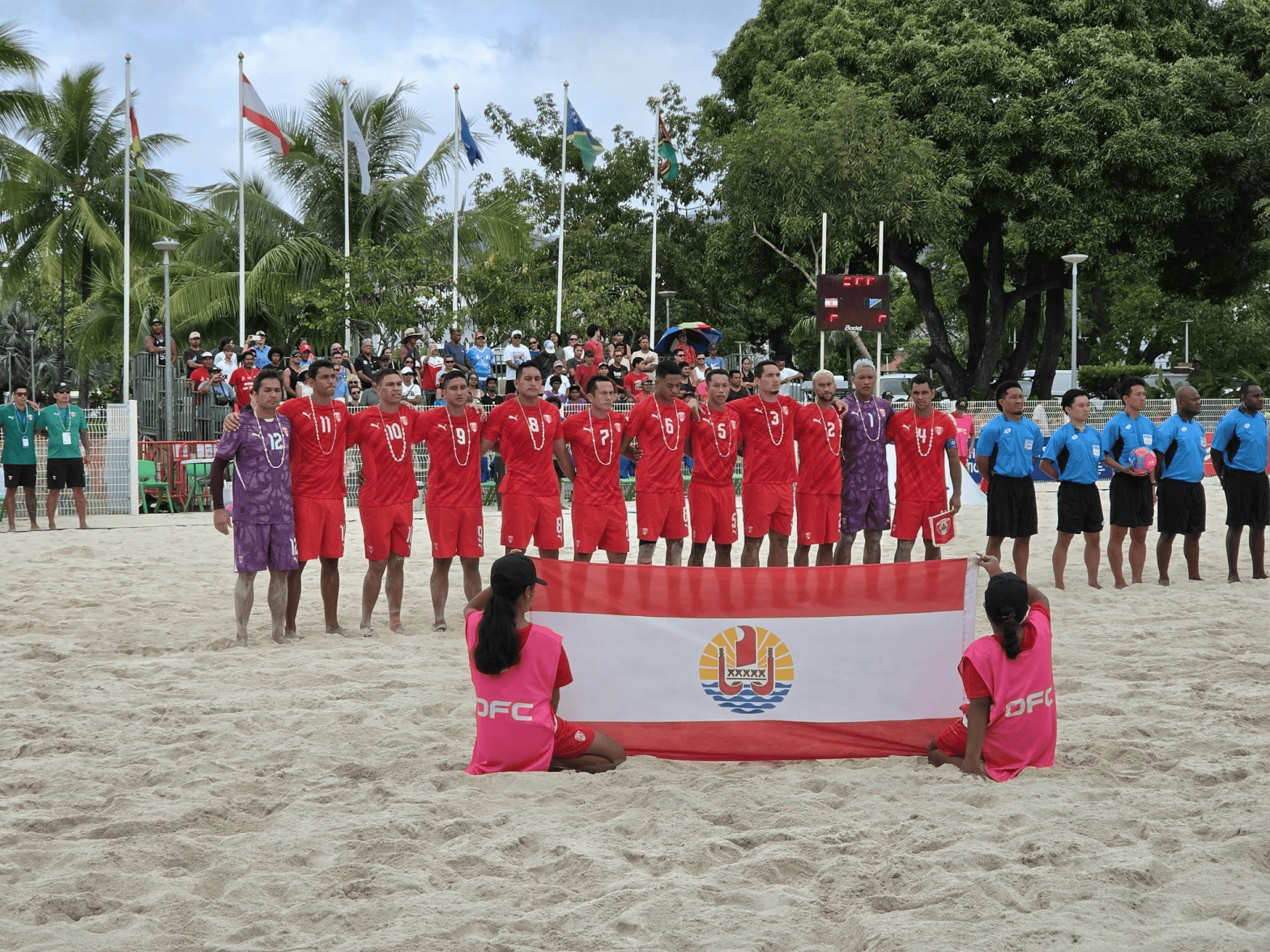
Tahiti have become the most successful nation in OFC Beach Soccer Men’s Nations Cup history after defeating Solomon Islands in a dramatic final at Aorai Tini Hau in Pirae on Saturday, October 31. The Tiki Toa secured their fifth continental crown and Oceania’s qualification berth for the 2027 FIFA Beach Soccer World Cup, completing an unbeaten campaign on home sand.
The victory was far from straightforward for Raimana Li Fung Kuee’s side, who faced a determined Solomon Islands team seeking to reclaim the regional championship for the first time since 2013. Unlike their high-scoring group-stage performances, the Tahitians were involved in a tense and physical contest that remained undecided until the closing two minutes.
According to local broadcaster Radio1 Tahiti, the hosts only managed to gain the decisive advantage late in the match, overcoming a Bilikiki side that pushed them throughout the final. The result confirmed Tahiti’s fourth consecutive continental title, following their previous triumphs in 2019, 2023 and 2024, and their fifth overall after also winning in 2011.
Both teams entered the final with four OFC titles each, making the encounter particularly significant for the history of beach soccer in Oceania. Solomon Islands had dominated the competition’s early years, winning in 2006, 2007, 2009 and 2013, but the balance of power shifted towards Tahiti over the following decade.
The Tiki Toa had already demonstrated their attacking strength during the group stage, recording three victories and scoring 37 goals. They opened the tournament with an extraordinary 18-1 victory over Vanuatu, followed by a 7-4 win against Solomon Islands and a 12-3 success over New Caledonia.
Heirauarii Salem and Ro’onui Tinirauarii were central to that attacking success, finishing the preliminary stage with 12 and 11 goals respectively. Salem also made history during the tournament by overtaking current Solomon Islands coach James Naka as the competition’s all-time leading goalscorer.
However, the final presented a considerably different challenge. Under Naka’s guidance, the Bilikiki entered the decisive match determined to reverse their earlier defeat to Tahiti and end their long absence from the FIFA Beach Soccer World Cup.
Solomon Islands had reached the final after victories over New Caledonia, 10-5, and Vanuatu, 7-2, with their only group-stage defeat coming against the hosts. Their latest loss means they have now been beaten by Tahiti in five OFC beach soccer finals, including the previous edition in Honiara, where the Tiki Toa secured a narrow 3-2 victory.
For Tahiti, the latest success extends an exceptional period of regional dominance and guarantees another appearance on the global stage. The national team has established itself as one of Oceania’s strongest representatives in FIFA competitions, having previously reached two Beach Soccer World Cup finals, in 2015 and 2017.
Earlier on Saturday, New Caledonia secured third place after defeating Vanuatu 4-3 in another closely contested encounter at Aorai Tini Hau.
The result gave the Cagous their second victory over Vanuatu during the tournament, following a 7-5 success in the group stage. New Caledonia had opened their campaign with a 10-5 defeat against Solomon Islands before suffering a heavy 12-3 loss to Tahiti, but recovered to finish the competition with a place on the podium.
For Vanuatu, the narrow defeat brought an end to a difficult campaign in which the team lost all four matches. Nevertheless, their performances against New Caledonia demonstrated greater competitiveness than their opening 18-1 defeat to Tahiti.
The tournament concluded with Tahiti as champions, Solomon Islands as runners-up, New Caledonia in third place and Vanuatu fourth.
With the regional title secured, the Tiki Toa now turn their attention to the 2027 FIFA Beach Soccer World Cup, where they will once again carry Oceania’s hopes against the world’s leading beach soccer nations.
Discover more from Oceania Football Center
Subscribe to get the latest posts sent to your email.

