
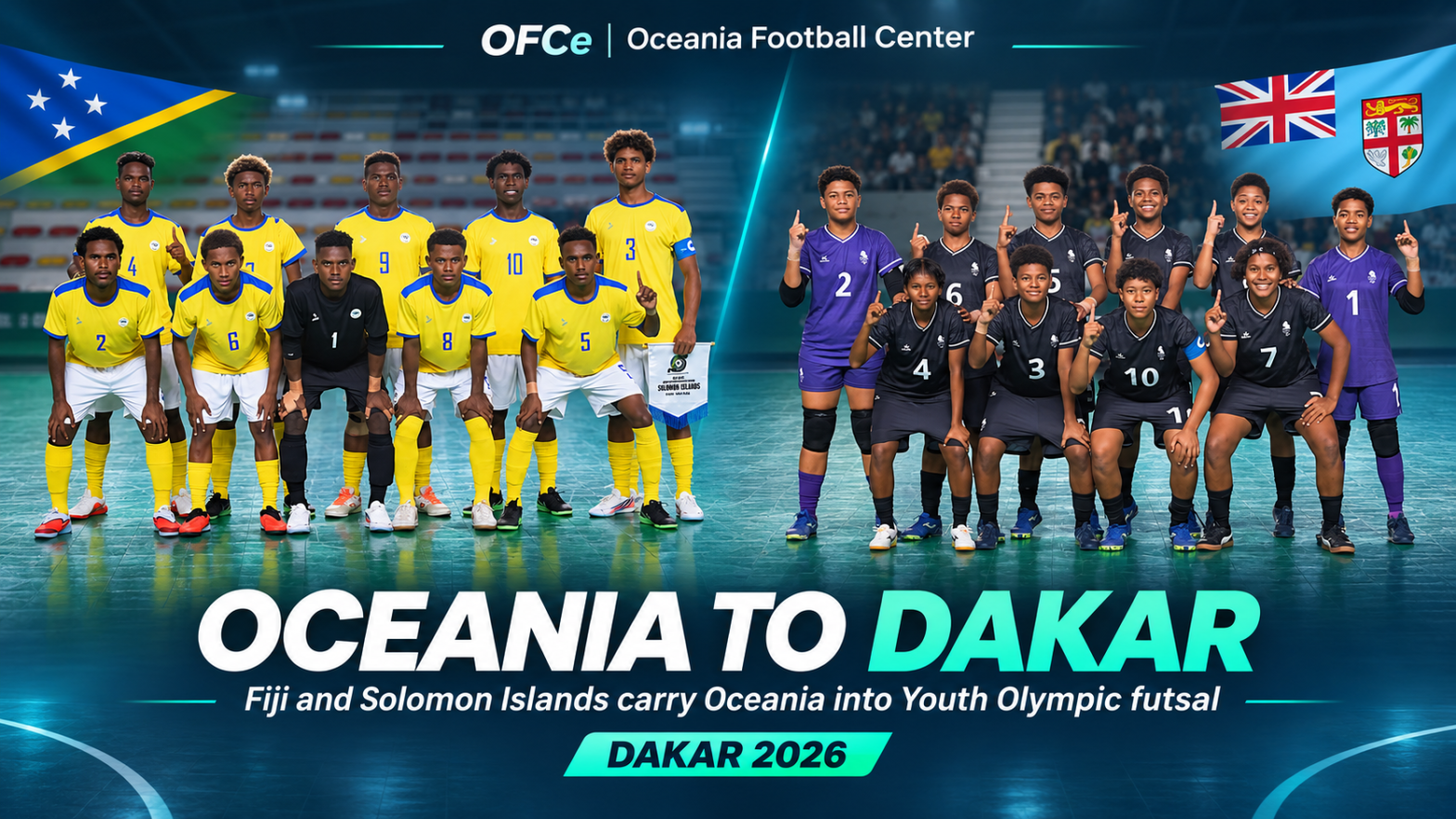
Fiji and Solomon Islands are representing Oceania at the 2026 Youth Olympic Games in Dakar, Senegal, marking another important milestone for futsal development in the Pacific. While the Fijian women’s team are making their first appearance in the competition, Solomon Islands have returned to the men’s tournament eight years after their participation in Buenos Aires. Both nations faced difficult opening matches against Senegal and Paraguay, but their presence provides a valuable opportunity for young Pacific footballers to compete on the global stage.
The Youth Olympic Futsal Tournaments, held from November 1 to 12, bring together 16 national teams across the men’s and women’s competitions. Each tournament features eight nations divided into two groups of four, with the top two teams advancing to the semi-finals. The players are aged 17 or under, making the competition an important platform for emerging international talent.
Dakar 2026 is only the second edition of futsal at the Youth Olympic Games, following its introduction in Buenos Aires in 2018. The event also represents a historic occasion for Senegal, which has become the first African country to host an Olympic sporting event.
Fiji began their women’s campaign on Sunday, November 1, facing hosts Senegal at the Iba Mar Diop Complex. Playing in front of an enthusiastic home crowd, the young Fijian side suffered an 8-1 defeat against an opponent that had already demonstrated its strength by winning the Dakar En Jeux tournament in 2025.
Senegal made an explosive start, with captain Mareme Niang scoring twice in the opening two minutes. Bousso Diallo extended the advantage before Akanisi Katonitabua scored Fiji’s historic first goal in the competition during the 18th minute.
The hosts continued to dominate, with Niang eventually completing a four-goal performance. Diallo finished with two goals, while Maman Diouf and Salimata Kande also found the net.
Despite the defeat, Fiji’s participation represents a significant achievement for the country’s women’s futsal programme. Under coach José Gerardo, the national team has been preparing for the tournament through training camps and a selection process focused on technical ability, physical development and tactical understanding.
The ten-player squad is captained by Salanieta Tausokula Vosadora, with Teonila Levuiciva and Vilomena Lutumaitoga Batirerega serving as vice-captains.
Fiji’s presence also comes at a time of growing interest in women’s futsal across the country. The senior national team reached the final of the 2024 OFC Futsal Women’s Nations Cup, narrowly missing qualification for the inaugural FIFA Futsal Women’s World Cup in 2025.
For the younger generation, the Olympic tournament offers an opportunity to build on that progress and experience international competition against nations with different futsal traditions.
The Fijians will continue their Group A campaign against Ukraine on November 3 before facing Venezuela two days later. The South American nation replaced Colombia, which had originally been included in the group during the tournament draw.
Meanwhile, Solomon Islands opened their men’s campaign on Monday, November 2, with a 9-2 defeat against Paraguay.
The South Americans took the lead after just 15 seconds through Oliver Sandoval and established a three-goal advantage before halftime. Nevertheless, the young Solomon Islanders demonstrated their attacking capabilities during the second period, with captain Emmanuel Suimae scoring twice.
Paraguay’s superior finishing ultimately proved decisive. Julio Cáceres and Juan Rambo each scored twice, while Facundo Boderone, Agustín Barreto, Octavio Cáceres and Mauro Mora also contributed to the victory alongside Sandoval.
Under head coach Dickson Kadau, the Solomon Islands team have spent recent months preparing for their return to Olympic competition. Several squad members have already gained experience in the SIFF Super Futsal League, providing a foundation for their development before encountering international opposition.
The country’s participation carries particular significance because of its history in the discipline. Solomon Islands represented Oceania at the inaugural Youth Olympic futsal tournament in Buenos Aires in 2018, when the squad included players such as Raphael Le’ai and Leon Kofana.
Le’ai, who has since represented the senior football national team and played professionally in Europe, scored twice against Iran during that tournament. His progression illustrates how participation in international youth competitions can form part of the development of players who subsequently establish themselves at senior level.
The 2026 squad will hope to follow a similar path, although their remaining opponents present considerable challenges.
Solomon Islands will face Portugal on November 4 before concluding their Group B fixtures against Morocco on November 7. Both opponents have established futsal programmes, with Portugal having won the senior FIFA Futsal World Cup in 2021.
For Fiji and Solomon Islands, reaching the semi-finals will be difficult following their opening defeats, but the competition extends beyond the immediate results. The experience of playing against opponents from Africa, Europe and South America offers young players exposure to different tactical approaches, greater intensity and the demands of international futsal.
Their participation also highlights the different stages of futsal development within Oceania. Solomon Islands have maintained a strong tradition in the men’s game through their national team and domestic competitions, while Fiji are working to expand opportunities for women’s participation.
With the group stage continuing throughout the week, both Pacific representatives will be looking to improve on their opening performances and gain further experience before returning home.
Whatever their final positions, Dakar 2026 provides another opportunity for Oceania’s emerging futsal talent to compete beyond the region and contribute to the future of the sport in the Pacific.
Discover more from Oceania Football Center
Subscribe to get the latest posts sent to your email.

