
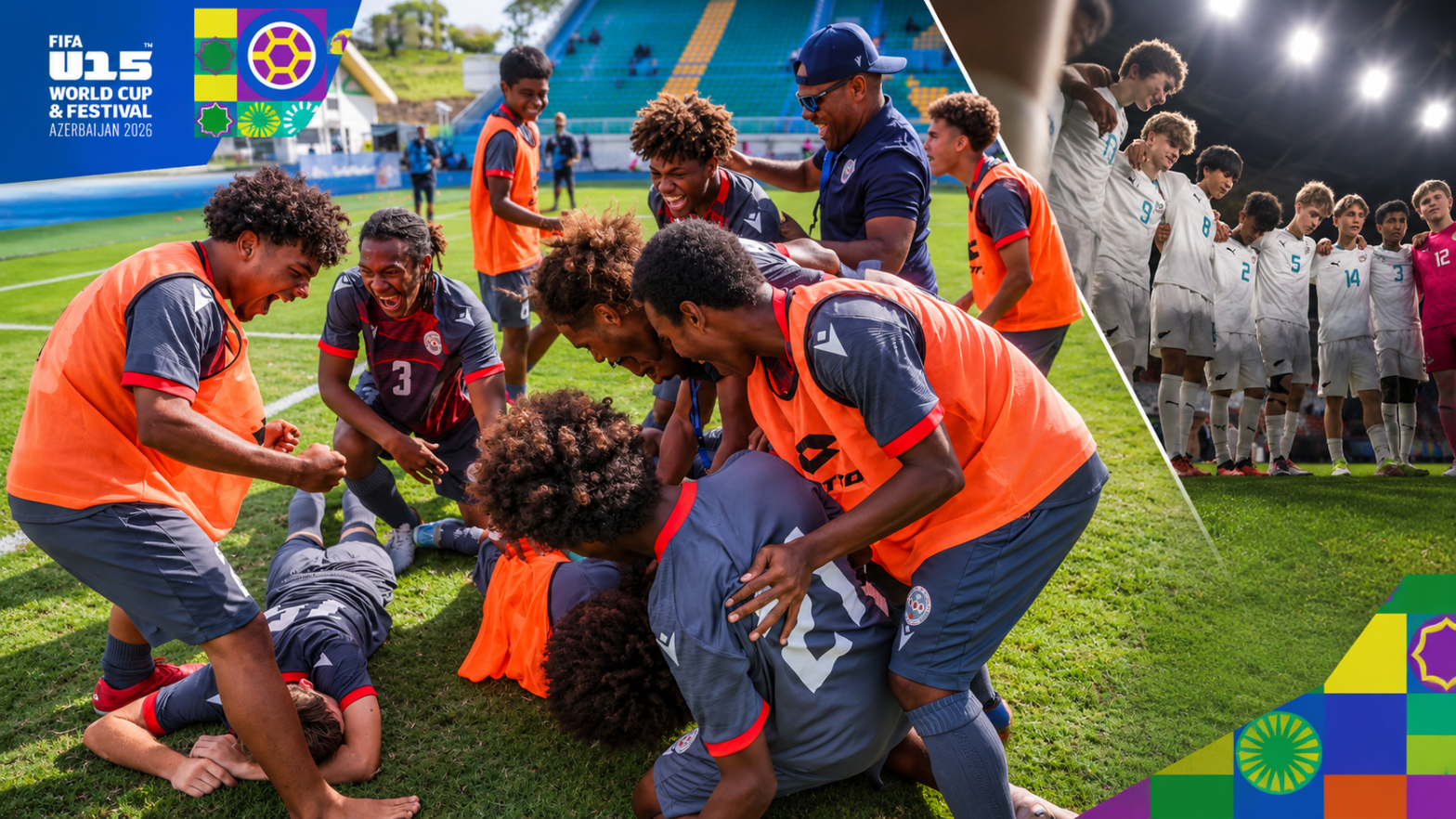
The inaugural FIFA U-15 World Cup and Festival in Azerbaijan provided an unprecedented opportunity for Oceania’s young footballers to compete against opponents from across the world. However, the tournament also exposed the substantial competitive gap separating the region from other confederations. Across 53 opening-stage matches, the 11 OFC representatives recorded just three victories, one draw and 49 defeats, scoring 40 goals while conceding 354. New Caledonia’s 2-1 victory over Burkina Faso emerged as one of the most encouraging results, while New Zealand’s struggles offered a particularly concerning assessment of the region’s leading football nation.
Held in Baku from 24 to 30 October, the competition brought together 189 national teams in an unusual development-focused format. Matches were played eight-a-side on smaller pitches, with two 20-minute halves and rolling substitutions. Following the opening group stage, teams entered six different competitive tiers based on their finishing positions. The format ensured that participating nations continued playing regardless of their initial results, giving young footballers considerably more international exposure than a conventional knockout tournament would have offered.
For Oceania, the opening stage produced a troubling picture. Nine of the 11 representatives finished bottom of their respective groups, with only New Caledonia and Tahiti avoiding last place. The regional goal difference of minus 314 was particularly striking, with OFC nations conceding an average of 6.68 goals per match. These figures came against opponents from several confederations, illustrating that the difficulties were not limited to encounters with traditional football powerhouses.
The disparity was also reflected in FIFA’s overall tournament statistics. Oceania recorded just 20 victories across its 11 participating nations, equivalent to 1.8 per team. By comparison, UEFA’s 37 representatives accumulated 213 wins, averaging 5.8 per nation, while South America’s ten teams registered 57 victories, averaging 5.7. Africa recorded 234 wins from 52 teams, Asia 183 from 45, and Concacaf 111 from 34. Crucially, only three of Oceania’s 20 recorded victories came during the opening group stage, before teams were separated into different competitive levels.
New Caledonia provided one of the tournament’s most significant positive stories for Oceania. Competing in Group AA, the Cagous recovered from an opening 7-2 defeat against Northern Ireland to overcome Burkina Faso 2-1. The victory against African opposition was particularly valuable in a tournament where positive results outside the Pacific were exceptionally difficult to obtain. New Caledonia subsequently suffered a 6-0 defeat to Lebanon but secured a 3-3 draw against Antigua and Barbuda, collecting four points and finishing third in their five-team group.
That third-place finish made New Caledonia the only Oceania representative to qualify for Tier C, above the competitive levels reached by the region’s other teams. Nevertheless, the classification matches demonstrated that considerable challenges remained. New Caledonia lost 7-0 to Nigeria and 8-1 to Cuba before further defeats against Nicaragua (5-2), Gibraltar (2-1) and Liberia (9-1). Across their nine matches, the New Caledonians recorded one victory and one draw, scoring 12 goals and conceding 48. Their campaign therefore offered both an important achievement against Burkina Faso and clear evidence of the difficulties they faced when attempting to compete consistently against international opposition.
Tahiti also produced some noteworthy results and was the region’s second-best representative in the tournament’s tier-based classification. The Tahitians finished fourth in Group V after defeating Seychelles 5-4, although defeats against Bolivia (5-2), Paraguay (8-0) and Gibraltar (2-0) prevented them from reaching a higher tier. They subsequently entered Tier D, where they lost 4-0 to Kosovo and were eliminated from their section of the classification bracket by Lesotho on penalties following a 3-3 draw. Tahiti then defeated Burkina Faso 2-1, becoming the second Oceania nation to overcome the West African side. Their campaign ended with defeats to Mauritania (5-1) and Botswana (7-1). New Caledonia and Tahiti finished 96th and 124th respectively in the bracket-based classification, although FIFA did not publish an official overall ranking.
Perhaps the most frustrating campaign belonged to New Zealand. Traditionally Oceania’s strongest nation in youth football, the New Zealanders entered the tournament with expectations of demonstrating their superiority within the region. Instead, they finished sixth in Group T, winning only one of five matches. A 5-0 opening defeat to Venezuela was followed by a narrow 4-3 loss to Madagascar. New Zealand then secured their only group-stage victory against Somalia, winning 3-2, before suffering further defeats to Puerto Rico (4-2) and Mozambique (1-0).
Finishing bottom of the group placed New Zealand in Tier F, the lowest of the tournament’s six competitive levels. The team responded positively in the classification stage, beating fellow Oceania representatives Cook Islands 3-0 and Malta 2-1 before overcoming Nepal 3-2 on penalties following a 1-1 draw. A 2-1 victory against Ethiopia in the Tier F final eventually secured a trophy for the New Zealanders, who became the only OFC representatives to win one of the six tiers.
While the recovery demonstrated resilience, it could hardly conceal the disappointment of the opening stage. New Zealand’s Tier F triumph was achieved against other teams that had also finished bottom of their original groups. In the tournament’s bracket-based classification, winning that tier corresponded to 161st place among the 189 participants. Although FIFA deliberately avoided publishing a definitive overall ranking because of the competition’s developmental format, New Zealand’s inability to progress beyond the lowest tier remains a significant concern for a country that regularly dominates youth competitions within Oceania.
Elsewhere, the scale of the challenge was evident in several particularly heavy defeats. Papua New Guinea conceded 20 goals against Belarus and 12 against Peru, while American Samoa suffered losses of 16-0 to Honduras, 17-0 to Guinea and 20-1 to Canada. Samoa lost 10-0 to Slovakia and 11-0 to Colombia, while Fiji was beaten 8-0 by Portugal and 10-1 by Wales. Tonga conceded 34 goals without scoring during the opening stage, and Vanuatu finished its five group matches with two goals scored and 26 conceded.
There were improvements when teams moved into the lower classification tiers. Fiji defeated the Bahamas 5-1 and finished their campaign with a 5-2 victory over Vanuatu. Samoa recorded wins over Papua New Guinea and Curaçao, while the Solomon Islands overcame Tonga and American Samoa. Papua New Guinea also recovered sufficiently to defeat the Solomon Islands 4-3 in their final placement match. The Cook Islands recorded victories over Saint Lucia and Montserrat, and Tonga secured a 4-3 win against Brunei Darussalam. These results showed that Oceania’s teams could compete more effectively when matched against opponents facing similar difficulties.
However, the contrast between the initial group stage and the classification matches is precisely what makes the overall results so revealing. While FIFA’s inclusive format allowed almost every participating country to experience victory, the original groups offered a much clearer assessment of how Oceania’s teams performed against opposition from different parts of the world. Three victories in 53 matches represented a winning rate of just 5.7%, illustrating the limitations of the region’s current competitive position at this age level.
The results should also be considered within the tournament’s distinctive format. Eight-a-side matches, shortened playing time and frequent substitutions differ substantially from conventional international football, while the condensed schedule placed additional demands on young players. The figures cannot, by themselves, establish the precise causes of Oceania’s difficulties. Nevertheless, the consistency of the results across 11 national teams raises important questions about youth development pathways, technical preparation, access to regular high-level competition and the opportunities available to talented players before they reach international tournaments.
For countries whose youth football programmes often operate with limited resources, the competition provided an important learning experience. Yet participation alone cannot be the ultimate objective. New Caledonia’s victory over Burkina Faso demonstrated that positive results against opponents from stronger competitive environments are possible, while Tahiti’s subsequent success against the same nation reinforced that point. New Zealand’s difficulties, meanwhile, showed that even Oceania’s traditional regional benchmark remains vulnerable when confronted with unfamiliar international opposition.
The inaugural U-15 World Cup gave Oceania something it rarely receives on such a scale: a direct comparison involving almost every football-playing nation in the world. The evidence was difficult to ignore. Beyond the valuable experience gained by the players, the most important outcome may be the challenge now facing the region’s football authorities: turning that exposure into sustained improvement, so that future generations can compete internationally rather than simply participate.
Discover more from Oceania Football Center
Subscribe to get the latest posts sent to your email.

