
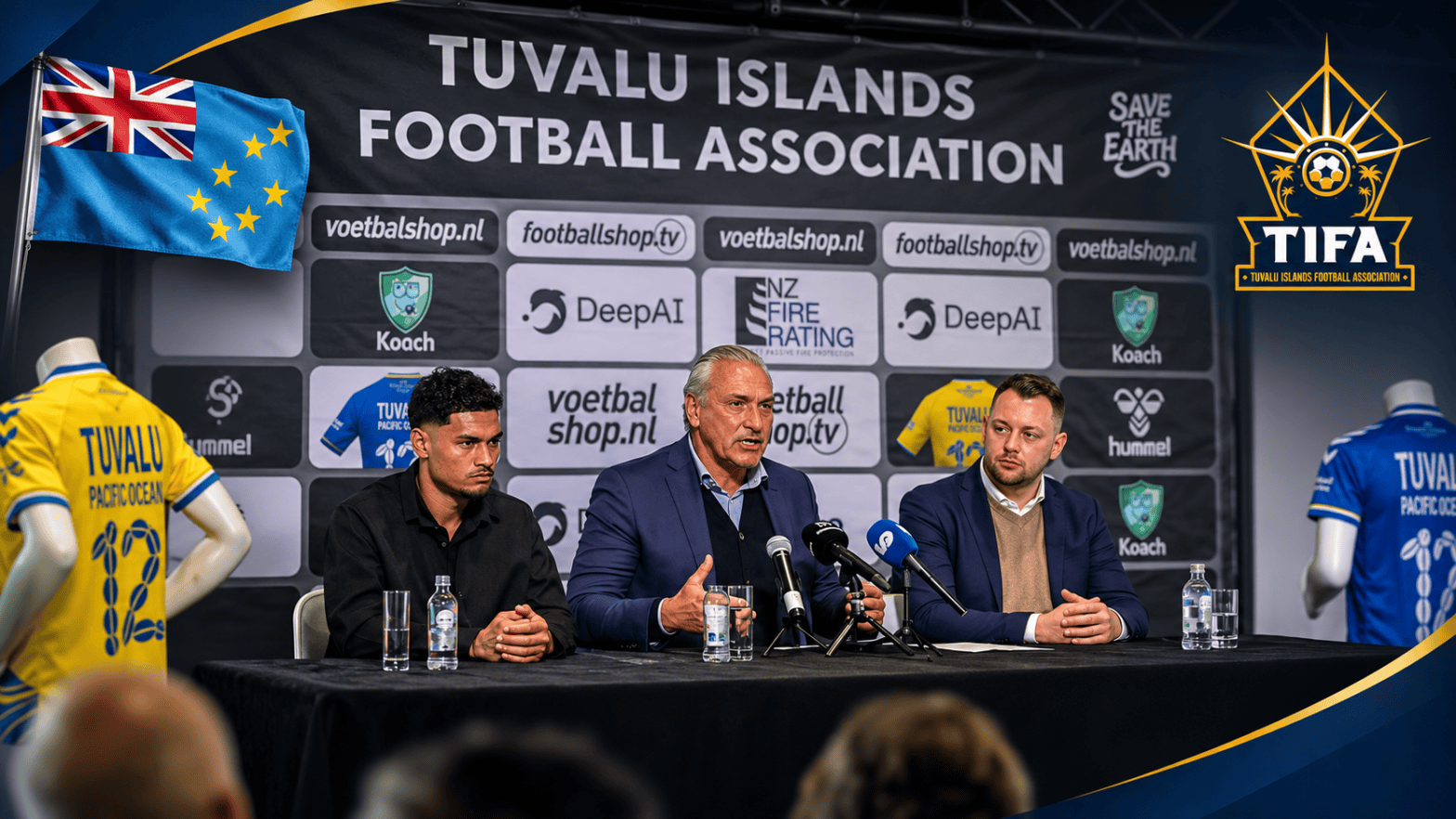
Tuvalu’s ambitious efforts to strengthen their national football team took another step forward on Wednesday, November 4, when newly appointed head coach Robert Maaskant was officially presented during a press conference at the Atik Stadium in Roosendaal, Netherlands. The event brought several important developments, including the appointment of former Netherlands World Cup defender Kew Jaliens as assistant coach and confirmation that Maaskant will undertake his new role without receiving a salary.
The 57-year-old Dutch coach, whose appointment was announced in October, has signed a one-year agreement with the Tuvalu Islands Football Association (TIFA). However, his decision to take charge of one of Oceania’s smallest national teams is motivated by considerably more than professional ambitions.
Speaking to Dutch journalists, Maaskant revealed that he will receive only travel and expense reimbursements from the association.
“A lot of people I know say: ‘He must be doing it for the money.’ But I’m not getting a penny, so that’s not really the case this time,” he explained.
Maaskant’s enthusiasm for the project stems partly from his interest in experiencing different football environments. Having previously coached clubs in the Netherlands, Poland and Belarus, he sees Tuvalu as an opportunity to combine football with a broader international experience.
The most significant sporting announcement during the presentation was the addition of Kew Jaliens to the technical staff.
The 48-year-old former defender earned ten senior international caps for the Netherlands between 2006 and 2007, including an appearance against Argentina during the 2006 FIFA World Cup in Germany.
Jaliens enjoyed a successful European career with clubs including Willem II, AZ Alkmaar and Wisła Kraków before moving to Australia, where he represented Newcastle Jets and Melbourne City in the A-League.
His appointment also reunites him with Maaskant, under whom he played at Wisła Kraków. The pair were part of the Polish club’s 2010/11 league championship campaign, establishing a professional relationship that will now continue in Oceania.
Jaliens joins a coaching structure that also includes Dutch assistant Thijs Matla, who works in youth development at VVV-Venlo, alongside Tuvaluan coaches Nabil Alefaio and Pasene Siale.
The combination of European coaching experience and local football knowledge is intended to help Tuvalu improve its competitive standards while developing opportunities for players and coaches.
Tuvalu Islands Football Association technical director Michiel van der Werf was among those involved in organising the presentation, having played a leading role in securing Maaskant’s appointment.
The association is preparing for a significant international programme in 2027, beginning with the Four Nations Cup scheduled for Auckland, New Zealand, in January.
The tournament is expected to provide Tuvalu with its first senior international matches since the 2023 Pacific Games in Solomon Islands.
For a national team that has struggled to obtain regular international fixtures, the opportunity represents an important step towards establishing greater continuity.
The press conference also brought attention to the participation of Tuvalu international Jason Alama, who is currently in the Netherlands for a two-week training opportunity with VVV-Venlo’s U-23 setup.
The 23-year-old defender, who has represented Western Springs in New Zealand, attended the presentation after meeting his new national team coach.
Speaking to Dutch outlet VoetbalPrimeur, Alama expressed confidence in Maaskant’s ability to connect with the players.
“He’s a talented coach with a lot of experience,” Alama said, describing the Dutchman as humorous and outspoken and predicting that his personality would be well received within the national team.
Alama’s presence also reflects Tuvalu’s increasing reliance on footballers with family connections to the country who have developed their careers overseas.
Born and raised in New Zealand to Tuvaluan parents, the defender has represented the national team despite never having visited the islands himself, illustrating the importance of the country’s international football community.
Beyond the immediate sporting objectives, Maaskant used the presentation to emphasise the wider significance of representing Tuvalu.
The Pacific nation faces severe challenges associated with climate change and rising sea levels, making international visibility particularly important.
The coach explained that his new position offers an opportunity to raise awareness of those issues through football.
“Football can help draw attention to this problem. I’m certainly no climate revolutionary, but I think it’s wonderful if we can help the world a little through football,” he said.
Maaskant also revealed that he had been invited to participate in a climate conference in Turkey, an unexpected responsibility arising from his involvement with the national team.
His ambitions even extend to the possibility of arranging a future friendly against Greenland, another territory facing environmental challenges, with climate awareness potentially forming part of the occasion. No such fixture has been confirmed.
Tuvalu’s long-term ambition remains to achieve full FIFA membership. The country is currently an associate member of the Oceania Football Confederation but is not affiliated with FIFA, limiting its opportunities to participate in official international competitions.
Previous Dutch coaches Foppe de Haan and Leen Looijen were involved in earlier efforts to develop Tuvaluan football, but the country has yet to secure the international recognition it seeks.
With Maaskant leading the national team, Jaliens joining the technical staff and new opportunities emerging for players such as Alama, TIFA is attempting to establish a more sustainable international programme.
The coming months will provide the first indication of whether those ambitions can translate into results on the pitch.
For Tuvalu, however, the project already represents something beyond the appointment of a new coach. It is another attempt to bring one of the world’s smallest football nations closer to the international stage while ensuring that its voice is heard beyond the Pacific.
Discover more from Oceania Football Center
Subscribe to get the latest posts sent to your email.

