Telekom S-League board announced that they are looking for applicants for a new team to make a 10-club league in the next season of the national football league from Solomon Islands.
The current season of U19 Telekom S-League counts on ten teams: nine teams that played the Senior S-League (Guadalcanal, Henderson Eels, Isabel United, Kossa, Laugu United, Malaita Kingz, Marist, Real Kakamora, Solomon Warriors) and Renbel FC.
The 2019-20 senior edition counted on nine teams including two newcomers. Isabel United and Laugu United had great debut seasons and now it is time to look for one more team to increase the number of Telekom S-League participants.
Telekom S-League logo.
Western United did not play the last season after finishing 2018 Telekom S-League in the fifth position.
It is not known if the next edition will really count on 10 teams but it would be good to see more and more teams taking part of the major football competition from Solomon Islands.
Malampa Revivors won Lae City by 3-0 in the last matchday of 2020 OFC Champions League Group B to advance through the knockout stage. All three goals were scored by Andre Batick that returned from suspension to make history.
Forward Andre Batick saw the red card in the opening matchday against Lautoka after fouling his countryman Jason Thomas in the first half. Despite playing the whole second half with ten players, Revivors managed to hold Lautoka to a 1-1 draw.
The Group B hosts had to deal with Batick’s absence in the second match against Henderson Eels from Solomon Islands. After suffering a lot, the Ni-Vanuatu side found a goal in the last minutes to draw another match.
The third and final match was decisive for Malampa. After drawing two matches in a row, the Ni-Vanuatu side needed to beat Lae City to qualify for the quarterfinals as Henderson Eels won Lautoka by 3-2 in the previous match.
It was supposed to be a very difficult match for Revivors as Lae City scored ten goals in two matches and they were the favourites to win the game while the team from Luganville was trying to win their first international official match of all time. After missing the clash against Eels, Andre Batick returned to the starting eleven to make history.
Andre Batick celebrates a goal against Lae City
The Papua New Guinean side did not have a great match and they saw Andre Batick return from suspension score one, two… three goals! Just like a hero, the 26-year-old forward found the net for three times to score a hat-trick and seal Revivors’ win by 3-0.
It was the first international win of Malampa Revivors’ history and the three goals scored by Batick put the team in the knockout stage of OFC Champions League for the first time ever. This fact becomes more and more unforgettable once it was done in front of their fans as the Group B was hosted by Revivors at Luganville.
Every tournament has its own history and Andre is now part of 2020 OFC Champions League’s history. Now he has the opportunity to keep making history as his team will play the knockout stage in April.
Tasman United won Auckland City by 2-1 in the 15th matchweek of 2019-20 ISPS Handa Premiership. New Caledonia international Jean-Philippe Saïko scored a late goal in the stoppage time to give the win to Tasman.
Saïko keeps doing fine in his first ever season in New Zealand as he scored seven goals in thirteen matches so far. He is being one of the most important players in the team as he has been playing an important role in Tasman’s attack. He scored six goals in the last six matches and he also had many other opportunities to score in these games.
Jean-Philippe Saïko. Source: NZF Media
Tasman is currently in the fifth position and fighting for a spot in the play-offs.
The 2020 PVFA Opening Cup is coming to its end. The two semifinals were played this weekend and now the finalists are known: Tafea and Ifira Black Bird are ready to clash to decide who will take the trophy home.
Ifira Black Bird won a young sided Erakor Golden Star by 4-2 to seal their spot in the final while Tafea has beaten Tupuji Imere by 1-0 with a goal scored by John Thomas.
Tafea starting elven against Tupuji Imere. Source: Tafea Media
According to reliable sources the final match will be played on Saturday. The Opening Cup is the first football competition in Port Vila this year as the 2019-20 Port Vila Premier League is expected to return in March. Tafea and Ifira Black Bird are currently leading the league with eighteen points each
Auckland City FC visited Tasman United at Trafalgar Park in the 15th matchweek of 2019-20 ISPS Handa Premiership, the main football league in New Zealand. It was a remarkable result as the Navy Blues lost in the Premiership for the first time since 2017.
Current league leaders Auckland City FC had a difficult day in Nelson. They saw Tasman’s captain Fox Slotemaker score in the first half to open the scoreboard but Tom Doyle netted for the Navy Blues in the 42nd minute to tie the game.
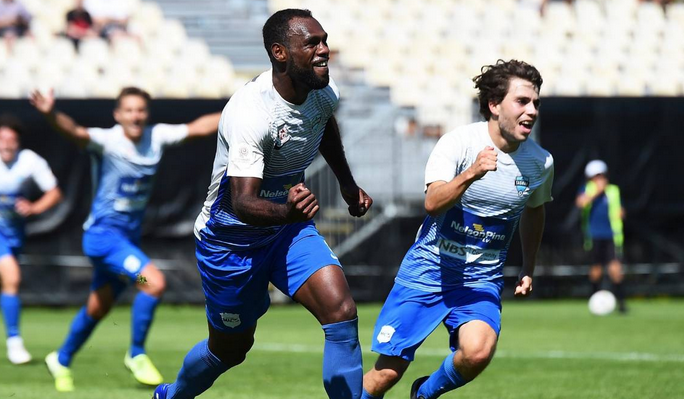
After a balanced second half it seemed that the match would end drawn but New Caledonia international Jean-Philippe Saïko found the net in the last minute to give the win to Tasman. It was the first Auckland City’s loss in the Premiership since December 2017 when they lost by 3-0 to Tasman United.
Saïko celebrates his goals against Auckland City. Source: Stuff.co.nz
The Navy Blues remain on top with 34 points while Tasman United is now in the fifth position with nineteen points in fifteen matches.
In the other two matches of the round, the bad moment of Canterbury United continued as they lost at home by 2-1 against Team Wellington, while Hamilton Wanderers could complete a brilliant commeback againt Waitakere to collect all points from the clash by winning the clash by 3-2 at Porrit Stadium.
Ba played three friendlies as part of their preparation for OFC Champions League. The Men in Black faced Rewa, Nadi and Suva and won all three matches.
Nasinu visited Nadi at Princes Charles Park in the fourth matchweek of 2020 Vodafone Premier League, the top-tier of Fijian football. This match was very important for both teams – Nasinu won in the previous matchweek and they were trying to keep the streak while Nadi lost two matches in a row after winning in the opening round.
After missing the previous match against Rewa, former Ba midfielder Avinesh Suwamy was on fire and scored four goals in the match to lead Nadi in the 5-0 win against Nasinu. This match also marked the return of Josua Tawake to the team after being sent off in the 6-0 loss against Lautoka in the second matchweek.
Avinesh Suwamy (left) scoring against Nasinu. Souce: Fiji FA Media
Nasinu did not count on Solomon Islands international Atkin Kaua in this round but Luke Savu made his debut in the season. However it was not enough to hold The Jetsetters. Nadi’s fifth goal was scored by Rusiate Matarerega.
Both representatives of Papua New Guinea, Lae City and Hekari United, were eliminated at the Group Stage of the 2020 OFC Champions League after a win, a draw and a defeat wasn’t enough for either side to finish in the top two of their group. The early eliminations indicate something systematically wrong with football in Papua New Guinea, especially given the rise of clubs from nations on a similar level to PNG in recent years, such as Vanuatu, New Caledonia and the Solomon Islands.
Firstly, we wanted to take a look at the competition record of Papua New Guinea, along those of nations of a similar level, in the OFC Champions League since Hekari’s victory in 2010. We graphed the results of this record, which you can see below. To note: in terms of colour coding, we have counted a second-place Group Stage finish pre-2017 on the same scale as a post-2017 quarter-final, as they essentially translate to the same thing. We included all the so-called Developed Association that currently do not need to qualify for the competition, but excluded New Zealand:
OFCe Graphic
With this data in mind, we’re able to deduce a fair amount. The following things stand out:
Papua New Guinea sides finish bottom of the group most often. Since Hekari’s incredible victory in the 2009/10 competition, PNG sides have finished in 4th position in the group stage more often than any other nation. Six times: Hekari (4), Madang FC (1) and Morobe Wawens (1). The most recent failures, in 17/18 and 18/19, saw Madang and Morobe Wawens qualify as PNG representatives mainly because of the league split, which saw Hekari, among others, become ineligible to qualify for the OFC competition. During those seasons, the standard in the National Soccer League was also exceptionally low, with Lae City essentially able to bulldoze the competition, and with their closest rivals not up to the high standard set by Hekari in previous years.
Papua New Guinea sides haven’t made the semi-finals for ten years. Another quite alarming deduction we can see from the graph is that since Hekari’s win, not a single PNG side has made at least the semi-finals of the competition. By contrast, Solomon Islands’s clubs have reached the semis once, Vanuatu sides three times, Tahiti sides four times, Fiji sides four times, and New Caledonia sides five times. It gets worse: if we compare PNG sides to their closest rivals in this analysis, Solomon Islands, in terms of quarter-final (or equivalent) finishes, we see clubs from the Solomon Islands reach seven (including this year), while PNG trail again with just five: Hekari (3) and Lae City (2).
For a third metric, we split the graphic above in half, and measured nation’s clubs’ performance before and after 2014, to get a measure of whether they have been improving or not:
OFCe Graphic.
Papua New Guinea sides aren’t really improving. Pre-2014, PNG clubs had three bottom-of-the-group finishes; post-2014 that’s the same. Hekari’s win in 2009/10 means they made the semi-finals or better once pre-2014; that hasn’t happened post-2014. One slight improvement has been the number of times PNG clubs have made the quarter-finals or better post-2014; but that may well be a result of two clubs taking part each year since 2015, rather than just one. They’re not particularly good numbers; especially when you consider the improvements seen in New Caledonia, the Solomon Islands and, to some extent, Tahiti, who have all either improved or stayed the same in all three categories. Vanuatu and Fiji were generally stronger before 2014 and seem to have been passed since then, although two qualifiers out of two this year for Vanuatu may suggest they’re back on the right track.
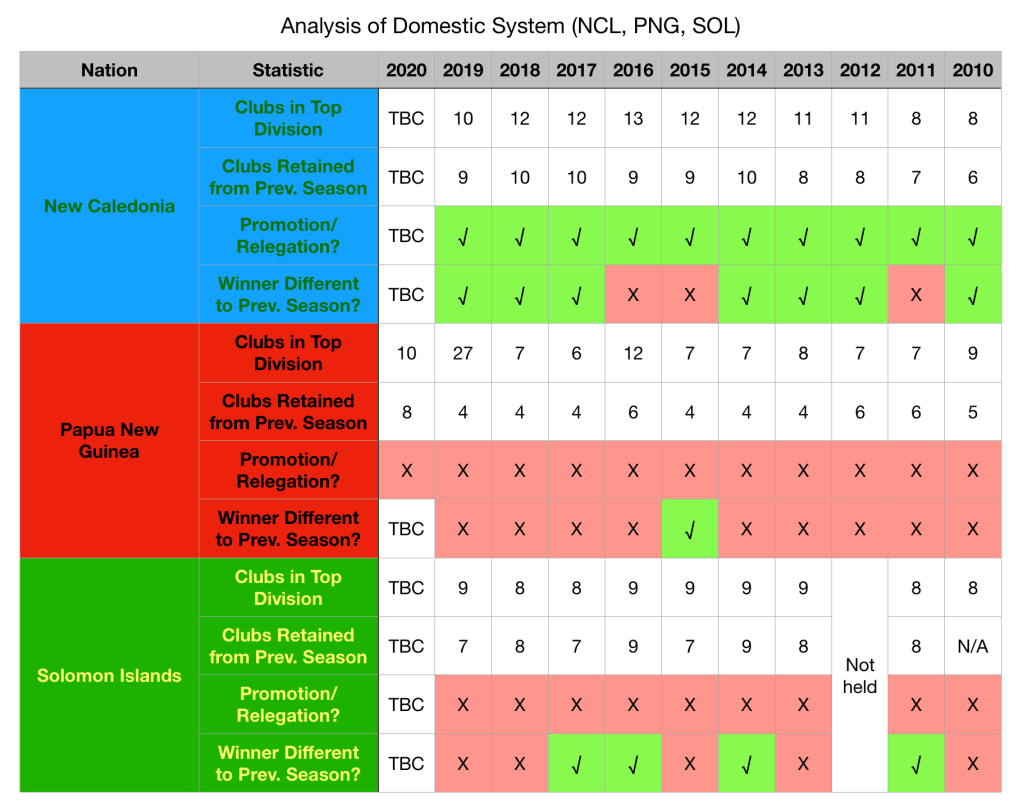
The next question is: why? What is going wrong in Papua New Guinea, that we’re not seeing the expected improvement, and that they’re performing on average worse than all the other Developed Associations in the OFC? To examine that, we’ll compare the domestic leagues of the two most-improved countries – Solomon Islands and New Caledonia – with that of Papua New Guinea, and see if there’s any correlation to be found.
We looked at the following four metrics: the number of clubs in the top division, to judge consistency; the number clubs in the top division that were retained from the previous season, to judge continuity; whether the system has promotion or relegation, to judge chances for lower-level teams; and whether the winner of the league was the same as the previous season, to judge the league’s overall competitiveness:
OFCe Graphic
Let’s look at New Caledonia first: the top division is generally very consistent, with the clubs retained fluctuating only because of the differing numbers of promotion and relegation places. On that subject, it also has promotion and relegation, which allows clubs from different regions of the country to earn passage into the top division on merit. Furthermore, the winner of the league has been different to the previous season on seven of ten occasions, indicating the league is competitive and clubs feel challenged throughout the season. Some additional data: four of the eight clubs that were in the top division in 2010 have taken part in every single competition since. This is how a league system should be: promotion and relegation, the same clubs taking part every year, and competitiveness so that it’s not the same club winning every single year.
The Solomon Islands is run differently, but still has advantages: there’s no promotion and relegation, but the teams taking part are hugely consistent. If there are changes at all to the line-up, they are slight, with never fewer than seven teams having been retained from the previous season for the last ten years. Winners are slightly more predictable (Solomon Warriors have won five of the last ten competitions) but in general, teams are able to plan for the future, knowing that their place in the top division is secure for the following season. And that additional data: five of the eight clubs that were in the top division in 2020 have taken part in every single competition since. This is as good and as consistent as a league could be, given there’s no promotion and relegation.
Let’s take a look at Papua New Guinea: what a mess! While the number of teams in the top division is generally fairly consistent (the past five years excluded, thanks mainly to the league split and last year’s trial of four regional competitions), the number of teams retained from the previous season is desperately poor, giving teams and players low levels of continuity, meaning one year players could be at a team, and the next year they no longer have a team in the top division to play for. This leads to players hopping from club to club and having different teammates every year. How can you build decent chemistry if the people around you are different to the previous year? Furthermore, PNG has only seen two champions during this period, with two phases: Hekari dominance until 2014, and Lae City dominance thereafter. And that additional data: ZERO of the nine clubs that were in the top division in 2010 have taken part in every single competition since. Hekari would have been the sole club to have done so were it not for their absence due to the league split in 2017 and 2018. That essentially means that the nine of the ten clubs that are in this year’s National Soccer League didn’t even exist ten years ago. Compare that with the situation in the two countries above, and it’s quite a stark difference.
With all this in mind, is it any wonder that the same two clubs keep winning the NSL, yet fail to perform on the big stage? If you look beyond Lae City (a club which is only six years old) and Hekari United, which clubs can realistically provide a challenge to them domestically? Who can push them to really improve and lift their game week after week? This is the kind of competition they need to perform at OFC Champions League level, and they’re simply not getting it, because a club’s lifespan in PNG is simply not long enough.
So what’s the solution?
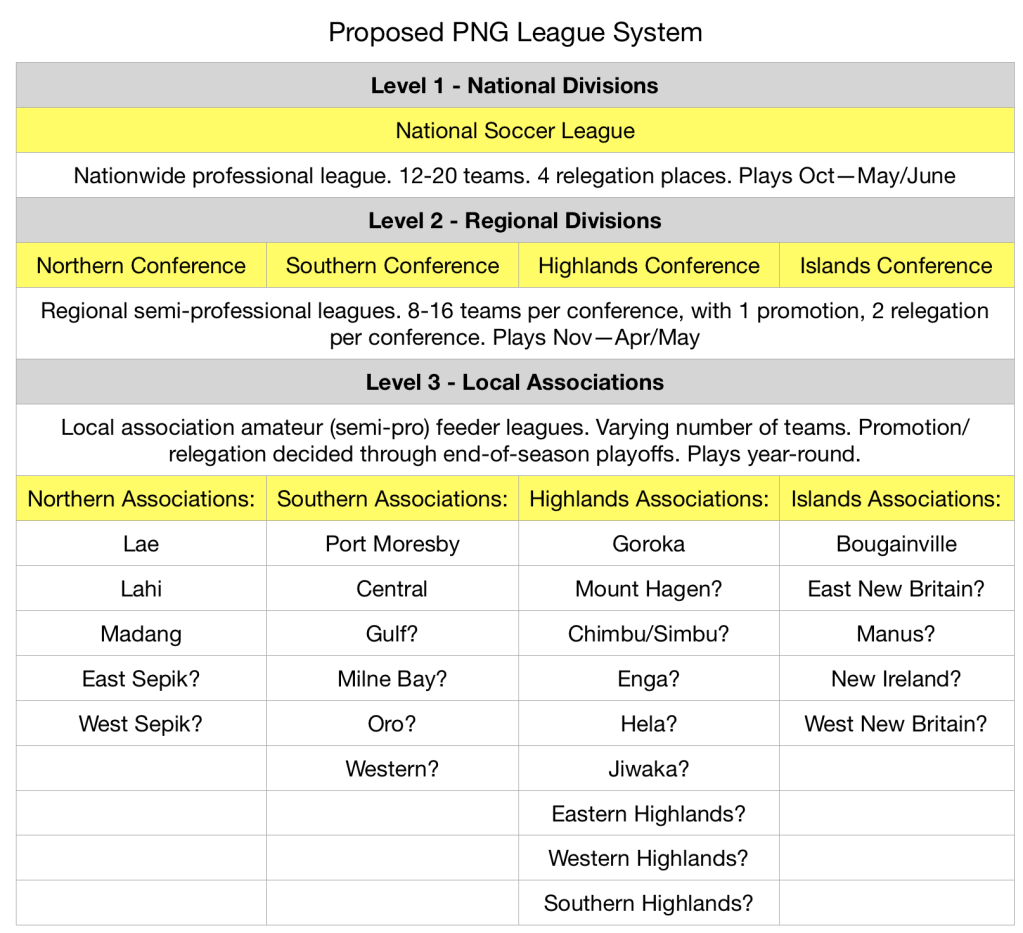
OFCe Graphic
About a month ago, I posted the above graphic on social media platforms. It received high praise, and I was immediately asked to email the graphic, as well as my clarifying comments, to several people involved with the PNGFA and NSL. I will attempt to simplify my comments below, to simply explain how I believe a league system in Papua new Guinea should work.
The National Soccer League should remain the top division in the nation, but with two key differences: promotion and relegation, and the same teams every year. The latter is of vital importance. Clubs must be able to plan for the future so that they can eventually develop youth academies, scouting systems and the ability to gel a team together for many years. Only two teams have been able to do that, and they have been the ones that have won every competition since the NSL’s inception.
The NSL should be fed by four regional leagues from the four regions of the country. This would work similarly to last season’s NSL, and the top team in each division would earn promotion to the NSL. These leagues would then be fed by leagues from local associations (Level 3), the champions of which would then have the opportunity to enter the regional divisions at Level 2, probably via some sort of promotion playoffs.
It would take some time to establish a system like this, but Papua New Guinea is a large country and there are many teams that play at local level: the Port Moresby Soccer Association already has four divisions with promotion and relegation, while there are active leagues in Madang, Morobe, and several Highlands and Islands provinces. Of course, I would not expect this to happen next year, but gradual movement towards something like this, starting with a consistent NSL, would allow for greater competitiveness in the top division, for greater opportunities for players at smaller clubs to impress the bigger clubs’ scouts, and should lead to better performances from PNG teams in OFC competitions.
Rewa visited Labasa at Subrail Park in the fourth matchweek of 2020 Vodafone Premier League, the top-tier of Fijian football. Both teams won in the previous round and people could expect a good game between these teams.
Labasa did not have a good first half as they saw Samuela Kautoga score a brace for Rewa. Things did not get better in the second half and Patrick Joseph scored from the penalty spot to increase Delta Tigers’ lead to 3-0.
Kautoga playing for Rewa in 2019 IDC. Source: Fiji FA Media
Ratu Anare still had time to found the net for Labasa but it was not enough to put Babasiga Lions back to the game. Rewa won by 3-1 and took the lead of 2020 Vodafone Premier League with nine points in four matches. On the other hand Labasa is not having a good start as they won only one out of four matches so far.
You can check the current league standings and the top scorers by clicking here.
The 2019-20 Indian Super League regular season is over for ATK. The team from Kolkata played its 18th and last match in this stage on this Saturday against Bengaluru FC at Sree Kanteerava Stadium.
It was not an important match for ATK once they were already qualified for the play-offs in he second position – they could not reach FC Goa that finished in the first position and they could not be overtaken by the third place.
Roy Krishna played 90 minutes but he did not have a great match. The 32-year-old player from Fiji did not have a big participation in the match as he saw his team draw against Bengaluru by 2-2. ATK’s goals were scored by Edu Garcia and Michael Soosairaj.
Roy Krishna. Source: ISL Media
ATK finished the regular season in the second position with 34 points in matches. The Indian Super League play-offs begin on next weekend. ATK’s opponent is not known yet as Chennaiyin FC will play their last match of the regualr season on Tuesday against North East United. However it is known that Krishna’s team will play at home against Bengaluru FC or Chennaiyin FC to fight for a spot in the final.
Krishna finished this stage with 14 goals scored in 18 matches.








 Oceania Football Center