
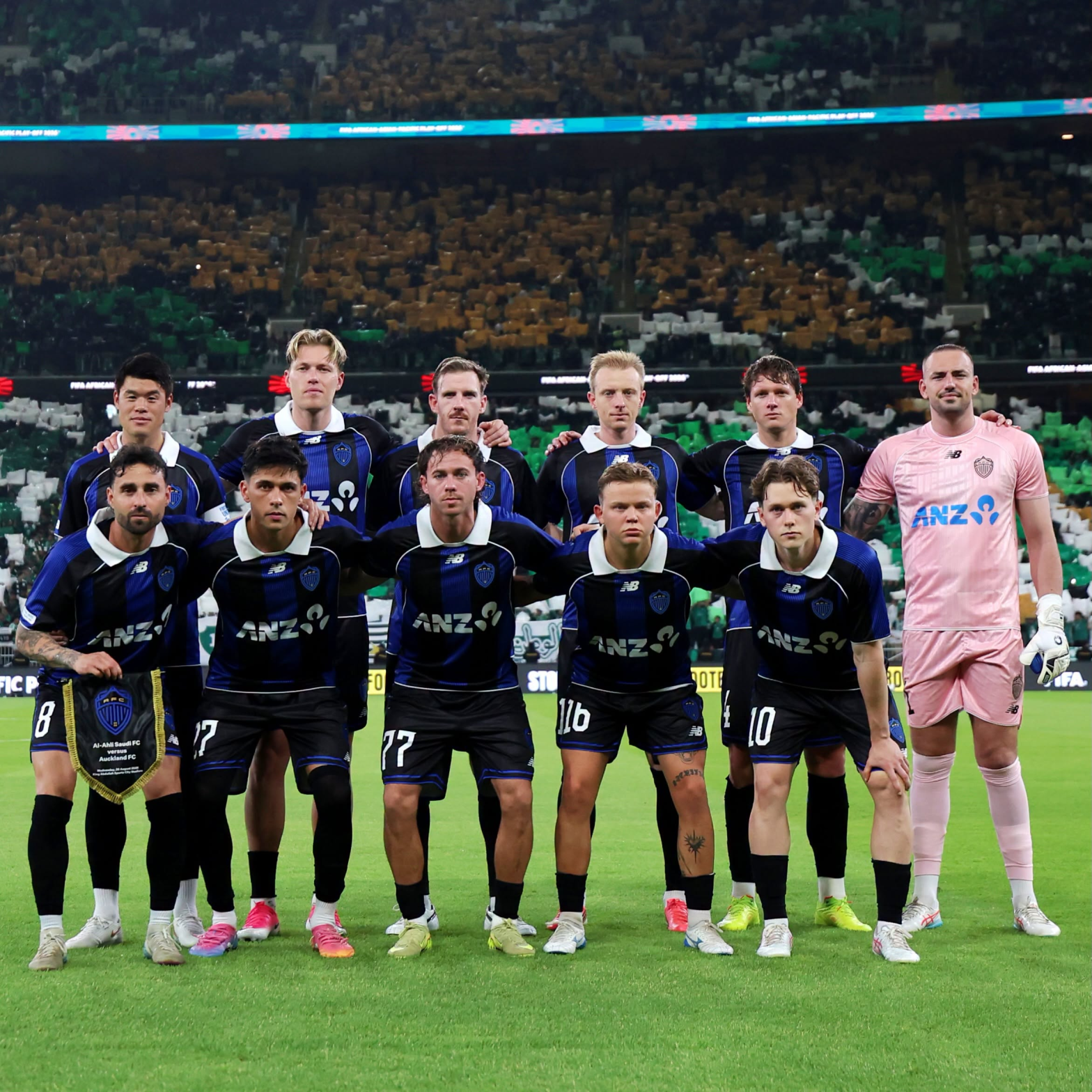
Auckland FC’s first appearance on the FIFA stage ended in defeat, but the New Zealand professional side produced a competitive performance against the champions of Asia, falling only 1-0 to Al-Ahli in the opening match of the 2026 FIFA Intercontinental Cup in Jeddah.
Saleh Abu Al-Shamat scored the only goal of the night in the 63rd minute at King Abdullah Sports City, while Auckland finished the match with ten men following a late red card to Sam Cosgrove.
The result brought an immediate end to Auckland FC’s first FIFA campaign, but the context behind the team that represented Oceania in Saudi Arabia is particularly significant.
Auckland qualified for the Intercontinental Cup by winning the inaugural OFC Pro League earlier this year. However, the side that faced Al-Ahli was substantially different from the one that had spent the first half of 2026 competing across the Pacific.
Instead, Auckland arrived in Jeddah with essentially the strength of their senior A-League operation.
The distinction matters.
During the OFC Pro League season, Auckland FC operated a separate squad under Luke Casserly while the club’s senior team simultaneously competed in Australia’s A-League. The arrangement proved remarkably successful: Auckland’s A-League side won the championship before its Pro League squad defeated South Melbourne 2-1 at Eden Park the following day to complete an extraordinary double for the club.
The Pro League title provided Auckland with the ticket to the FIFA Intercontinental Cup. When the time came to use it, however, the club was able to turn primarily to the squad that had competed at the higher weekly level of the A-League.
Of the 22 players selected to travel to Saudi Arabia, only seven had been members of Auckland’s OFC Pro League-winning group. Just three of those players eventually appeared against Al-Ahli.
Daniel Normann provided the most direct connection between the two campaigns.
One of the outstanding performers of the inaugural OFC Pro League, the Norwegian midfielder made 14 appearances, won Auckland FC’s Players’ Player of the Season award and was awarded the OFC Pro League Golden Ball. His performances earned him promotion into the club’s A-League squad alongside defender Ronan Wynne.
Normann was the only regular member of Auckland’s Pro League championship side to start against Al-Ahli.
Wynne, who made 12 appearances during the Pro League campaign and was named Auckland’s MVP for that competition, joined the action in the 53rd minute. Van Fitzharris was introduced in the 76th minute.
They were the only three players to take the field in Jeddah who had also played a direct role in Auckland’s OFC Pro League campaign.
The rest of the team reflected the strength available to the club through its A-League operation, with names such as Michael Woud, Hiroki Sakai, Nando Pijnaker, Francis de Vries, Felipe Gallegos, Logan Rogerson and Sam Cosgrove involved from the start.
That made Auckland’s FIFA debut a particularly interesting test.
The Black Knights were no longer facing Pacific opposition with the largely separate group assembled for the OFC Pro League. They were taking the core of a team capable of winning the A-League into a match against the reigning AFC Champions League Elite winners.
And the difference between the two continental environments could hardly have been more striking.
Al-Ahli lined up with a squad packed with players accustomed to elite European and international football, including former Chelsea goalkeeper Édouard Mendy, Brazilian international Galeno, Portuguese attacker Francisco Trincão, Brazilian defender Roger Ibañez and England striker Ivan Toney.
Auckland were also entering the match in difficult circumstances. It was their first competitive fixture since winning the A-League Championship in May, with the New Zealanders still effectively in pre-season under new head coach Pedro Moreira.
In front of an estimated crowd of 45,000 and in demanding heat and humidity, Auckland nevertheless refused to simply retreat and survive.
Al-Ahli controlled more of the ball and produced the greater volume of attacks, but Auckland had opportunities of their own during an encouraging opening half.
Michael Woud was required to make an important save from Galeno after 17 minutes, but Auckland responded through Logan Rogerson.
The New Zealand international caused problems for the Saudi defence and forced Mendy into action, most notably with a looping header that required an acrobatic save from the Senegalese goalkeeper.
Woud was again decisive before half-time, denying Eduard Spertsyan to ensure Auckland reached the interval at 0-0.
For a side playing its first competitive match in three months, away from home against the champions of Asia, Auckland had done considerably more than merely remain alive in the contest.
Al-Ahli continued to push after the restart and finally found their breakthrough shortly after turning to the bench.
Abu Al-Shamat entered the match in the 62nd minute and made an almost immediate impact. Spertsyan broke forward down the left and created the opportunity for the substitute, who finished past Woud in the 63rd minute.
The goal ultimately separated the sides.
Auckland remained in the match and Al-Ahli were unable to turn their territorial superiority into a comfortable victory. Cosgrove’s straight red card with three minutes of normal time remaining made the prospect of a late equaliser considerably more difficult, and the Asian champions eventually closed out the 1-0 win.
Moreira was proud of his side after the match and highlighted the circumstances surrounding Auckland’s first competitive appearance of the new season.
“We did an amazing job. We cannot forget that we are in pre-season,” he said.
“This is the first time these players played a full 90 minutes. With this weather, with this humidity, with this crowd… amazing, I am very proud of this team.”
Auckland’s elimination continues Oceania’s difficult record in the opening stages of the new Intercontinental Cup format, but the margin was considerably narrower than in the region’s previous two appearances.
Auckland City, then qualifying as OFC Champions League winners, were beaten 6-2 by Asian champions Al Ain in the inaugural 2024 edition. The Navy Blues returned in 2025 and suffered a 3-0 defeat against African champions Pyramids FC in Cairo.
This time it was Auckland FC representing the region, following the OFC’s decision to award Oceania’s Intercontinental Cup place through its new professional competition.
A 1-0 defeat against the Asian champions therefore provides an encouraging result for Oceanian football, but it also requires some context.
It would be premature to interpret the performance in Jeddah simply as proof that the OFC Pro League has already closed the gap between Oceania and the stronger continental competitions.
The team that won the Pro League and the team that faced Al-Ahli were largely different.
Auckland effectively won Oceania’s new professional championship with a second squad while its strongest players were focused on the A-League. Once qualification for FIFA competition had been secured, the club was able to bring those two structures together and send predominantly its senior A-League group to Saudi Arabia.
That advantage cannot be ignored when comparing Auckland with the other clubs competing in the OFC Pro League.
At the same time, the pathway created by the competition was visible.
Normann is perhaps its clearest example. He entered the year as part of Auckland’s Pro League squad, emerged as the competition’s best player, earned promotion to the A-League group and, months later, started against the champions of Asia on the FIFA stage. Wynne followed a similar route from the Pro League into Auckland’s senior squad.
In that sense, the Intercontinental Cup highlighted two different strengths of the Auckland FC project: the considerable depth created by having access to both an A-League-level first team and a competitive Pro League squad, and the possibility of using the Oceanian competition to develop players capable of making the step into the senior professional environment.
For the rest of the region, however, Auckland’s performance also provides food for thought.
Most OFC Pro League clubs do not possess another first team competing every week in a competition of the A-League’s standard. Auckland FC do. Their route to Jeddah may have come through the Pro League, but the team that represented Oceania once they arrived there was predominantly the A-League champion rather than the side seen throughout the Pacific competition.
That makes the 1-0 result both encouraging and difficult to use as a direct measurement of the OFC Pro League itself.
What can be measured is Auckland FC.
Less than two years after entering professional football, the club has already won the A-League Championship, captured the first OFC Pro League title and made its debut on the FIFA stage.
In Jeddah, facing a team containing players who have competed at some of the highest levels of world football, Auckland were beaten — but they were not overwhelmed.
Al-Ahli advance to meet African champions Mamelodi Sundowns in Pretoria on 19 September for the FIFA African-Asian-Pacific Cup.
Auckland FC return home with their first Intercontinental Cup campaign over after only one game, but also with a valuable reference point.
The ticket to Jeddah was earned by their OFC Pro League team. The performance in Jeddah was delivered largely by their A-League champions.
Understanding that distinction is essential when assessing what Auckland FC’s narrow defeat really tells us about the club — and about the new era of professional football that Oceania has only just begun.
Discover more from Oceania Football Center
Subscribe to get the latest posts sent to your email.

