
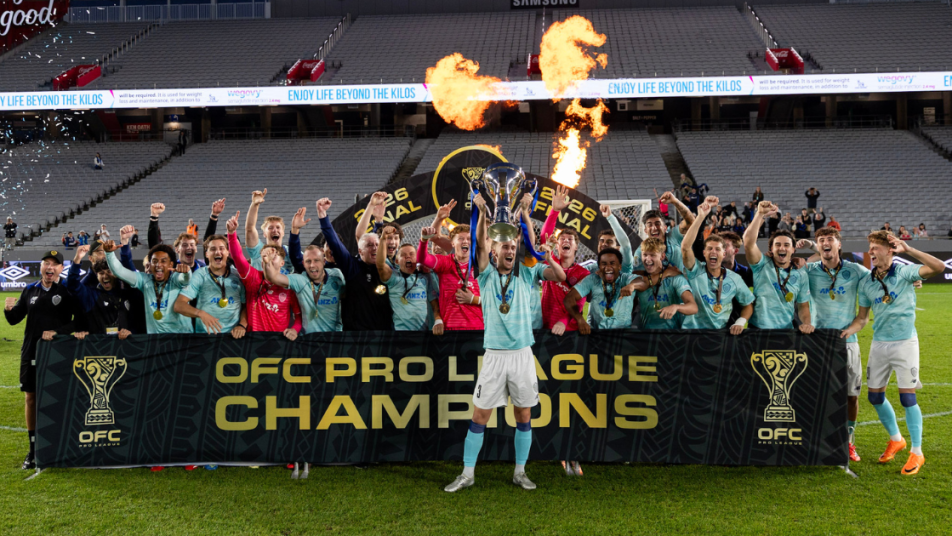
Auckland FC’s narrow 1-0 defeat to Saudi giants Al-Ahli in the FIFA Intercontinental Cup was, on the pitch, a respectable first appearance on the global stage. The New Zealand club competed well against the AFC Champions League Elite winners and remained in the contest until the end in Jeddah.
Yet the match also exposed an uncomfortable question surrounding the inaugural OFC Pro League: was the Auckland FC that represented Oceania at the FIFA Intercontinental Cup really the same football team that had earned the right to be there?
Legally and institutionally, the answer is simple. Auckland FC won the first OFC Pro League and therefore qualified as Oceania’s representative. Sporting-wise, however, the picture is far more complicated.
Only seven members of the 22-player squad selected for the FIFA Intercontinental Cup had been part of Auckland’s OFC Pro League-winning campaign. Of those, only Daniel Normann started against Al-Ahli. Ronan Wynne and Van Fitzharris were introduced from the bench, meaning just three players who had been involved in Auckland’s Pro League title run actually took the field in Jeddah.
The difference was not simply the consequence of normal squad turnover between seasons.
From the beginning, Auckland FC operated two substantially different football teams.
Before the OFC Pro League started, Auckland FC itself explained that competition regulations and the club’s A-League commitments meant its Pro League team would be separate from the first-team squad. The new side was built largely around players from Auckland’s reserve structure alongside recruits specifically assembled for the new Oceania competition. Luke Casserly, then coach of Auckland’s reserves, was placed in charge.
Even independent New Zealand coverage openly treated it as a second-string Auckland side. Friends of Football described Auckland as the only OFC Pro League club fielding a “second-string team” in its season preview. Ahead of the FIFA fixture months later, the same outlet went further, stating that Auckland had qualified by winning the OFC Pro League with its reserve team but would face Al-Ahli with the first-team squad that had won the A-League.
That distinction was visible even during the most important weekend in the club’s history.
Auckland’s A-League operation won its championship before the Pro League side defeated South Melbourne 2-1 at Eden Park to become Oceania’s first professional champions. Auckland FC’s own report referred to the A-League champions as the Pro League team’s “sister squad”, illustrating just how separate the two operations had become in practice.
OFC officials had previously resisted the suggestion that Auckland were simply entering a B team. General Secretary Franck Castillo argued before the competition that Auckland would “create another team” capable of challenging for the title. His point was understandable: the squad was professionally assembled, competitive and ultimately good enough to become champions.
But that argument also makes what happened afterwards more difficult to ignore.
If Auckland’s Pro League side was not merely a B team but a legitimate professional team created specifically to compete for Oceania’s championship, what became of that team when the reward for winning the championship arrived?
Normann provided the clearest bridge between the two versions of Auckland FC. He was one of the outstanding players of the OFC campaign, starting all 19 matches and winning the competition’s Golden Ball before earning a place in Auckland’s A-League setup. Wynne also moved into the senior squad, while Fitzharris appeared from the bench against Al-Ahli. Their progression demonstrates exactly the type of pathway the Pro League can provide.
For most of their title-winning teammates, however, there was no such FIFA moment.
Instead, Auckland arrived in Saudi Arabia with a team overwhelmingly made up of its A-League operation, including Michael Woud, Hiroki Sakai, Nando Pijnaker, Francis de Vries, Felipe Gallegos, Logan Rogerson and Sam Cosgrove. Pedro Moreira, appointed to lead Auckland’s A-League side, was in charge against Al-Ahli, while Pro League-winning coach Casserly served as his assistant.
The reaction among supporters showed that the distinction had not gone unnoticed.
Under OFCe’s coverage of the Intercontinental Cup match, several supporters questioned why the players who had won the OFC Pro League were largely absent. Others described the team in Jeddah as Auckland’s A-League side rather than the one that had competed across Oceania. Similar concerns had already appeared in New Zealand football discussion before the match.
None of this means Auckland FC did anything wrong.
There is no suggestion the club breached FIFA or OFC regulations, and it would be difficult to criticise Auckland for selecting the strongest squad available for a match against one of Asia’s most powerful clubs. Once permitted to use its A-League players, leaving its best footballers at home would have made little sporting sense.
The issue instead belongs to the structure surrounding the competition.
Squads change in football. Players are transferred, injured, promoted or released between qualification and the tournament for which a club has qualified. But Auckland’s case was fundamentally different. Two separate squads existed simultaneously because the club was competing in the A-League and OFC Pro League at the same time. The separation was explicitly acknowledged before the season and remained evident throughout the competition.
The first OFC Pro League was also supposed to represent something bigger than another regional tournament. It was presented as the beginning of Oceania’s professional era, with the league champion earning access to the FIFA Intercontinental Cup and the competition forming part of the pathway towards the FIFA Club World Cup.
That makes the symbolism important.
Players from Tahiti United, Solomon Kings, Bula FC, PNG Hekari, Vanuatu United, South Island United and South Melbourne spent months competing against Auckland’s Pro League squad. That Auckland team travelled through the league’s Pacific circuits, finished top of the regular season and eventually defeated South Melbourne in the final.
Those were the players who won Oceania’s new championship.
Yet when Oceania finally appeared on the FIFA stage, almost all of them were watching.
Auckland FC’s performance against Al-Ahli should still be recognised. Holding the Asian champions to a 1-0 result was a strong showing, and the quality of Auckland’s A-League squad arguably allowed Oceania to present a more competitive representative internationally.
But competitiveness and credibility are not necessarily the same question.
The inaugural OFC Pro League has now produced a peculiar precedent: one Auckland FC team can earn qualification, while an almost entirely different Auckland FC team can receive the reward.
The badge remained the same. The players largely did not.
For a competition attempting to establish its identity, prestige and importance across the Pacific, that distinction cannot simply be ignored.
Discover more from Oceania Football Center
Subscribe to get the latest posts sent to your email.


To me it also raises the question whether there is fair share of resources in OFC to raise up the other nations/teams. If OFC is based in NZ and NZ continues to rise as a team, what happens to the others?
LikeLike