
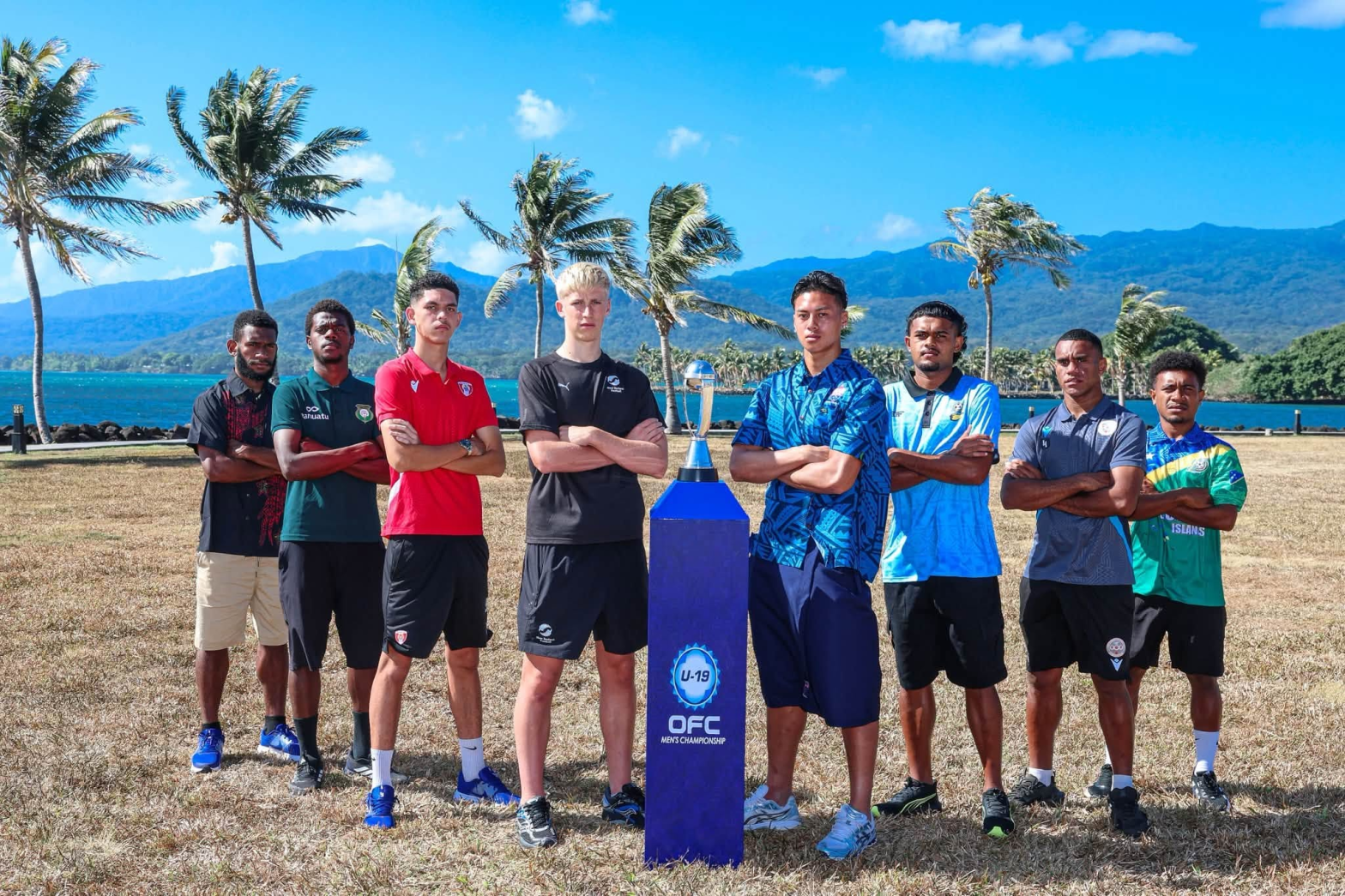
Eight nations, two places at the FIFA U-20 World Cup and some of Oceania’s most promising young footballers will take centre stage in Samoa as the OFC U-19 Men’s Championship begins on 1 September.
The tournament runs until 14 September in Apia and brings together New Zealand, Fiji, Tahiti, Vanuatu, Solomon Islands, New Caledonia, hosts Samoa and Papua New Guinea, who earned their place through the qualifying tournament in the Cook Islands.
The stakes are significant. The two finalists will qualify for the 2027 FIFA U-20 World Cup in Azerbaijan and Uzbekistan, giving the semi-finals particular importance: winning there means reaching both the continental final and the world stage.
New Zealand enter as defending champions and, once again, the obvious favourites. They have won the last four editions of the competition and arrive with one of the deepest squads in the tournament.
José Figueira’s side includes a large Auckland FC contingent, three Wellington Phoenix players and several footballers already developing in Australia and Europe. Alex Lienard comes from Sunderland’s academy, while Ricky Fransen represents Western Sydney Wanderers and Anton Isaako is with Sydney Olympic. Eight members of the squad also progressed through New Zealand’s recent U-17 cycle.
Perhaps more importantly, several already have experience beyond youth football. Luka Vicelich, Van Fitzharris, Eli Jones, Dejaun Naidoo and Bailey Ferguson were involved with Auckland FC during the inaugural OFC Pro League. Their exposure to senior football gives New Zealand a level of experience rarely seen at this age in Oceania.
Fitzharris is one of the names particularly worth following. He has already featured in some of Auckland FC’s biggest matches during 2026 and now drops back into his age group as one of the more experienced players in Figueira’s squad.
New Zealand are therefore not simply expected to qualify. Their benchmark remains winning the tournament. Figueira made that ambition clear before the competition, saying the objective is not only to reach another FIFA tournament but to continue preparing players who can eventually compete successfully at world level.
If there is a team with the tools to seriously challenge New Zealand in Group B, Fiji may be it.
Marika Rodu has assembled a particularly interesting squad combining domestic players, overseas-based talent and footballers who have already experienced professional competition. Four members of the squad — Delon Shankar, Maikah Dau, Ibraheem Afazal and Ryan Naresh — featured for Bula FC in the inaugural OFC Pro League, where the Fijian side reached the semi-final playoff.
There is also considerable continuity from previous youth teams. Seven members of the group have already played at a FIFA U-17 World Cup, while two are returning for a second OFC U-19 campaign. Fiji have also selected nine overseas-based players, reflecting a growing attempt by Fiji FA to bring diaspora talent into its national pathway.
One of the most recognisable names is Jovesa Uqe. The Labasa winger has already produced senior football performances at domestic level and will miss the opening phase of Fiji’s Battle of the Giants because of his involvement in Samoa. His pace and ability in wide areas make him one of the Junior Bula Boys’ most interesting attacking options.
Fiji have prepared extensively, including a six-week camp at the Fiji Football Academy and training matches against OFC Champions League participants Lae City and AS Tiga Sport. Their stated objective is clear: reach the World Cup.
Tahiti should not be overlooked either.
The French Polynesians remain one of the few nations outside New Zealand to have won this competition, lifting the title in 2008 when it was still staged at U-20 level. They also finished runners-up in 2018 and have regularly been competitive at this age group.
This year’s squad contains three players already seen in the OFC Pro League with Tahiti United: Kalï Lenoir, Bradley Ruiz and Niuhau Firiapu. That experience could be particularly important in a demanding Group B where every point will matter.
Coach Raimana Bu-Luc has had his squad together for several months and has openly stated that qualification for the World Cup is the goal.
That leaves Vanuatu as perhaps the most difficult team to measure in Group B.
The squad contains considerable age-group international experience, with many players having already represented Vanuatu at U-16 and U-19 level. Coach Philemon John has initially set the target of reaching the semi-finals, where qualification could then be decided in a single match.
Given the progress made by Vanuatu football during 2026 — particularly through Vanuatu United’s strong OFC Pro League campaign — there is every reason for their youth side to believe they can trouble the more highly rated teams.
Group A, meanwhile, looks considerably more open.
Solomon Islands enter with genuine expectations after finishing third in 2024. Franco Ne’e’s squad combines players from across the provinces with youngsters who have already accumulated senior football experience at home.
The headline name is Jayroll Patty.
At just 19, Patty was already an important midfielder for Solomon Kings during the inaugural OFC Pro League and now returns to youth international football as one of the most experienced players in the Solomon Islands squad. OFC itself has identified him as a player expected to have significant influence on the tournament.
The Solomon Islands have never qualified for the FIFA U-20 World Cup, meaning a place in the final would represent a historic breakthrough.
Their opening match against Papua New Guinea could already prove crucial.
PNG arrive with something none of the other teams possess: competitive qualification matches already behind them. Matthew Witu’s side won both matches in the preliminary tournament, beating Tonga 4-0 and Cook Islands 5-1 to advance with nine goals scored and just one conceded.
Forward David Tita was the standout performer, scoring four goals across the two matches and finishing as the qualifying tournament’s leading scorer. Captain Nalau Moses also found the net against the Cook Islands and provides another attacking threat.
Witu has retained the same group that succeeded in the Cook Islands, giving PNG valuable continuity ahead of a much more difficult challenge in Samoa.
New Caledonia arrive with perhaps the strongest recent pedigree in Group A.
They reached the final in 2024 before losing to New Zealand and have repeatedly produced technically strong youth sides. Coach Jules Wakanumune is not hiding his ambitions either, stating before the tournament that his team want to progress from the group and potentially challenge for the title.
Their opening match against hosts Samoa will immediately test those expectations.
Samoa themselves enter as underdogs but will have home support behind them. Spanish coach Michael Alvarez has emphasised competitiveness rather than making bold qualification predictions, and the opportunity to play the tournament at home could give his young side an additional lift.
The tournament therefore seems to have two very different groups.
Group B contains defending champions New Zealand alongside three teams — Fiji, Tahiti and Vanuatu — all capable of making qualification uncomfortable. Group A appears less predictable, with New Caledonia and Solomon Islands carrying strong recent results but PNG arriving with competitive momentum and Samoa benefiting from home conditions.
There is also another reason why this edition may be particularly interesting.
Thirteen players selected across the eight teams have already appeared in the inaugural OFC Pro League. Five come from New Zealand, four from Fiji, three from Tahiti and one from Solomon Islands. For a youth tournament in Oceania, that represents an unusually large pool of players already exposed to professional senior football.
The competition could therefore provide an early indication of whether the region’s new professional structure is beginning to influence its next generation.
Among the players worth following closely are New Zealand’s Van Fitzharris, Luka Vicelich and Alex Lienard; Fiji’s Jovesa Uqe, Maikah Dau and Ibraheem Afazal; Solomon Islands midfielder Jayroll Patty; Tahiti United trio Bradley Ruiz, Kalï Lenoir and Niuhau Firiapu; and Papua New Guinea striker David Tita.
Some will arrive already familiar to followers of Oceania football. Others may leave Samoa as names much more widely known.
The first matches take place on 1 September, when Papua New Guinea face Solomon Islands and hosts Samoa meet New Caledonia. Group B begins one day later with Fiji facing Vanuatu and defending champions New Zealand taking on Tahiti. The semi-finals are scheduled for 11 September, with the final on 14 September.
Every match will be available live and free through OFC’s digital platforms, giving supporters across the region the chance to follow what could be one of the most revealing youth tournaments Oceania has staged in recent years.
For New Zealand, another title is expected. For Fiji, Tahiti, New Caledonia and Solomon Islands, there is a genuine opportunity to challenge that hierarchy. For Vanuatu, PNG and Samoa, the tournament offers the possibility of producing one of its major surprises.
And for every player involved, the ultimate prize is considerably bigger than an Oceania title: a place in the final will also mean a ticket to the FIFA U-20 World Cup.
Discover more from Oceania Football Center
Subscribe to get the latest posts sent to your email.

