
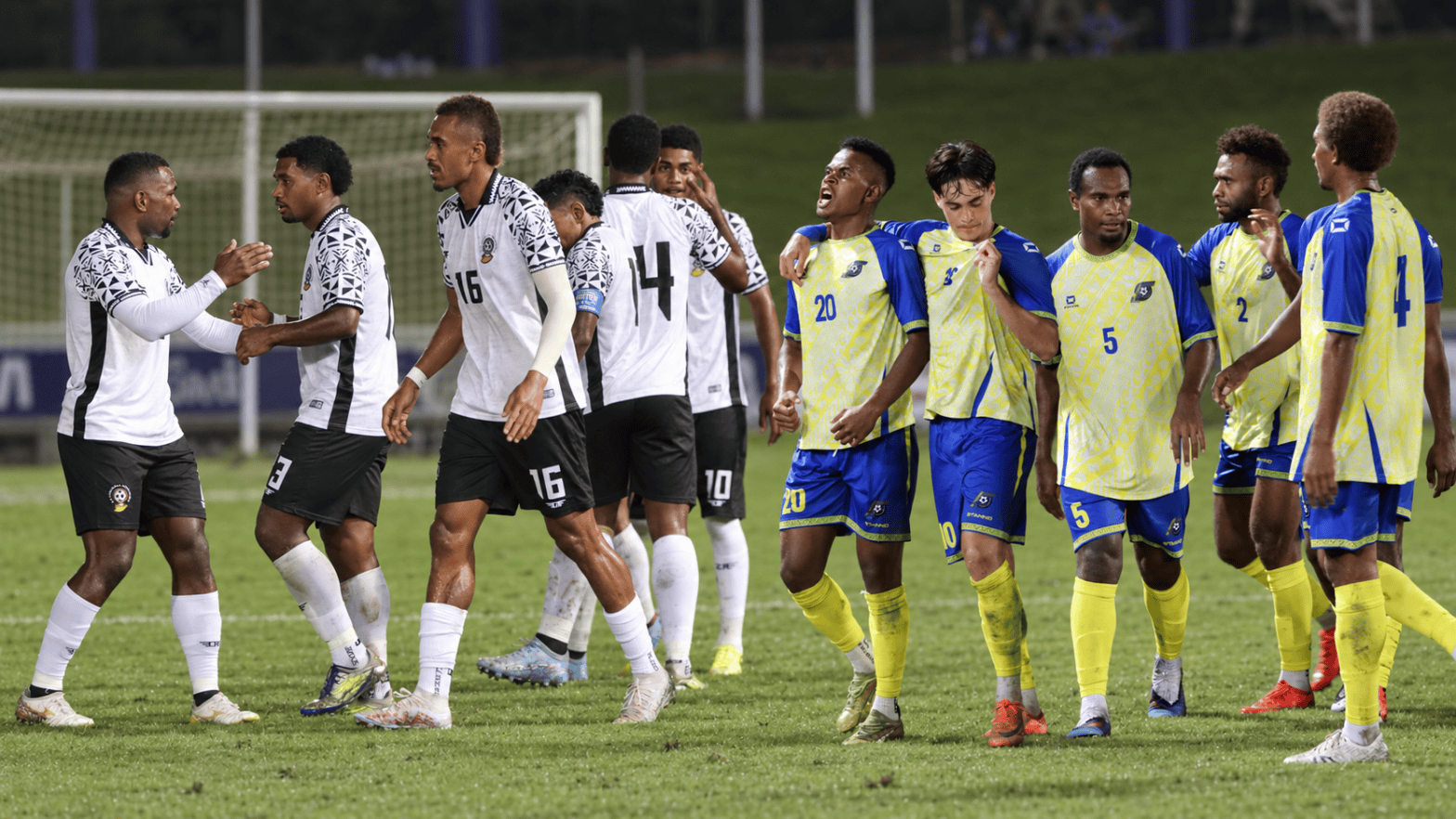
Fiji appeared to be cruising towards a winning start to the 2026 MSG Prime Minister’s Cup when Thomas Dunn put the hosts 3–1 ahead early in the second half. Yet an avoidable red card, a gradual loss of territorial control and an increasingly confident Solomon Islands response transformed the contest. Jayroll Patty reduced the deficit in the 82nd minute before Javin Wae struck in added time to complete a remarkable comeback and secure a 3–3 draw.
The result will feel very different inside the two dressing rooms. Fiji demonstrated enough attacking quality to win the match and led by two goals with less than 20 minutes remaining. However, their failure to protect that advantage exposed problems in discipline and game management. Solomon Islands, meanwhile, recovered from conceding three times and being placed in an apparently hopeless position. Their point was not simply the product of Fiji’s collapse; it was also earned through persistence, composure and an immediate recognition of how the match had changed after the hosts were reduced to ten men.
Krishna provides the expected leadership
Fiji made the more convincing start in front of their home crowd, with captain Roy Krishna opening the scoring in the 26th minute. Krishna remains the central reference point of Stéphane Auvray’s developing side, and his goal provided precisely the type of contribution expected from the country’s record scorer.
His importance extends beyond finishing. Krishna’s movement gives Fiji a forward capable of creating space for the younger players around him, while his experience offers structure to an attack still learning how to operate together. On an opening night when Fiji fielded several emerging players, it was significant that the breakthrough came from their most established figure.
Solomon Islands responded through Rooney Riugaemai, who converted from the penalty spot to make it 1–1. The equaliser interrupted Fiji’s momentum and demonstrated the danger posed by Ben Cahn’s team whenever the hosts allowed the game to become open. Fiji nevertheless recovered before the interval, with Maikah Dau restoring their advantage and sending the Bula Boys into halftime leading 2–1.
Dau’s goal was one of the most encouraging elements of the performance for Fiji. The youngster was promoted directly from the country’s recent under-19 programme and is part of Auvray’s attempt to build a squad for the next World Cup cycle. Scoring in his first major senior tournament appearance was therefore more than an isolated moment. It suggested that Fiji’s youth integration can produce immediate competitive value rather than serving only as a long-term experiment.
Dunn puts Fiji in control
Fiji began the second half with the same attacking intent and extended their advantage in the 54th minute through Thomas Dunn. At 3–1, the hosts had established the strongest position of the match.
The three goals also revealed the breadth of Fiji’s attacking resources. Their captain had delivered the opener, one of their youngest players had scored the second, and Dunn added the third. Rather than depending entirely on Krishna, Fiji received contributions from different parts of the forward unit.
At that stage, the main challenge was no longer creating opportunities. It was controlling the remaining time. A two-goal lead did not require Fiji to withdraw completely, but it did demand greater attention to risk: keeping the team compact, protecting possession and preventing Solomon Islands from building sustained pressure.
Instead, the match changed dramatically in the 72nd minute.
Waranaivalu’s red card changes everything
Tevita Waranaivalu, introduced at the beginning of the second half, was sent off after only 26 minutes on the field. His dismissal was the decisive incident of the contest because it altered both the numerical balance and the psychological direction of the match.
Before the red card, Fiji were leading comfortably and Solomon Islands needed two goals merely to draw level. After it, the visitors had an extra player, approximately 20 minutes to attack and nothing to gain from remaining cautious. Fiji were forced to abandon much of their earlier attacking ambition and devote additional players to protecting the spaces created by their numerical disadvantage.
The dismissal was particularly damaging because Waranaivalu had been brought on to influence the second half. Instead, Fiji lost both the substitute and the flexibility that substitution was intended to provide. Auvray’s team went from managing a lead with eleven players to defending deep with ten, while Solomon Islands could commit greater numbers forward without facing the same level of pressure in transition.
Fiji still had a two-goal cushion, but the flow of the match had reversed. Their clear routes out of defence became less frequent, possession was harder to retain and each clearance invited another Solomon Islands attack. The hosts were no longer dictating where the game was played.
Solomon Islands recognise their opportunity
Solomon Islands deserve considerable credit for how they exploited the change. Playing against ten men does not automatically produce goals, particularly when the opposition still holds a substantial lead. The Bonitos needed to circulate the ball quickly, stretch Fiji’s reduced defensive structure and maintain belief as the clock continued to run.
Their pressure finally produced a reward in the 82nd minute when Jayroll Patty made it 3–2. The goal changed the emotional balance once again. What had initially looked like a consolation became the beginning of a genuine attempt to rescue the match.
For Fiji, Patty’s strike created a difficult final period. The hosts were protecting only a one-goal lead, had one fewer player and were facing a Solomon Islands team that could sense uncertainty. At that point, Fiji needed calm possession or a sequence of controlled defensive actions to slow the game. They found neither consistently enough.
Javin Wae completed the comeback in injury time, scoring the sixth and final goal of a contest that Fiji had seemed certain to win. The timing made the equaliser especially painful for the hosts because there was almost no opportunity to repair the damage.
For Solomon Islands, however, Wae’s goal was the product of a team refusing to accept the apparent direction of the match. They had fallen behind three times in the scoring sequence, trailed by two goals in the second half and still emerged with a point.
A promising attack undermined by poor management
Fiji should not allow the late collapse to erase the positive elements of their performance. Scoring three times against Solomon Islands is significant, and the contributions of Krishna, Dau and Dunn suggest that Auvray has several different attacking profiles available. Dau’s emergence was especially valuable in a tournament being used partly to expose Fiji’s next generation to senior international football.
However, tournament football is determined as much by control as creativity. Fiji had already done the most difficult work by establishing a 3–1 lead. The failure to convert that advantage into three points means the discussion will inevitably focus on discipline, defensive concentration and decision-making under pressure.
The red card provides the clearest explanation for the turnaround, but it should not become a complete excuse. Fiji still had a two-goal advantage when they went down to ten men. More experienced management of the closing stages could have protected at least one additional goal, slowed Solomon Islands’ momentum or reduced the amount of added-time danger.
For Solomon Islands, the defensive side of the match also requires attention. Conceding three goals showed that Cahn’s new-look team remains vulnerable when opponents attack with speed and make effective use of movement around the penalty area. Yet their response demonstrated an important quality for a side at the beginning of a longer project: they did not lose their structure or belief when the result appeared beyond them.
A costly point for Fiji, a valuable one for Solomon Islands
The draw leaves both nations on one point after the opening round, behind Papua New Guinea following their 2–1 victory over defending champions Vanuatu earlier in the day. In a five-team round-robin competition where only the leading two sides reach the final, Fiji may eventually view this as a major missed opportunity.
The hosts now face Vanuatu on Sunday knowing that another failure to win would place significant pressure on their remaining fixtures against Papua New Guinea and New Caledonia. Solomon Islands will next face New Caledonia and can approach that contest with confidence generated by their late recovery.
The opening performance offered reasons for optimism about Fiji’s attacking future, particularly through Dau’s impact and the continued influence of Krishna. But it also delivered a warning. Talent can create a winning position; discipline and control are required to finish the job.
Solomon Islands understood that reality better during the decisive final minutes. Fiji produced the stronger opening and built the larger advantage, but the Bonitos produced the
Discover more from Oceania Football Center
Subscribe to get the latest posts sent to your email.

