
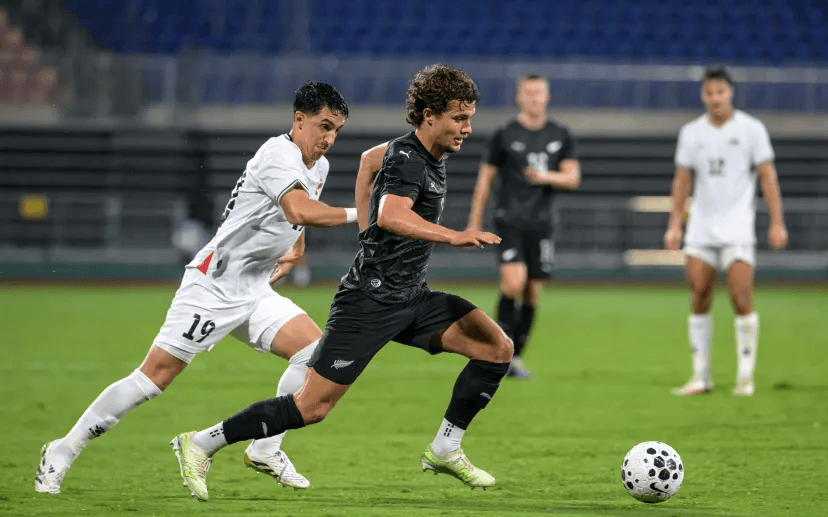
New Zealand returned to international action for the first time since the 2026 FIFA World Cup with a 2-2 draw against Palestine in Chongqing, China, in a match that gave Darren Bazeley the opportunity to test the depth of his squad and hand three players their senior international debuts.
The All Whites twice took the lead during an open first half, with Ben Waine and Jesse Randall finding the net, but Palestine responded on both occasions through Assad Al Hamlawi and Oday Dabbagh. All four goals arrived before the interval, while a heavily changed New Zealand side spent much of the second half managing minutes and providing opportunities across the wider squad.
The draw should not be viewed simply as New Zealand failing to beat a lower-ranked opponent. Palestine arrived with a number of players carrying strong professional experience abroad, particularly in attack and midfield. Oday Dabbagh, one of the most established figures in the squad, plays his club football with Zamalek in Egypt and has built a strong international scoring record for Palestine. Al Hamlawi, meanwhile, has developed his career in Europe and is currently with Universitatea Craiova in Romania after previous spells in Sweden and Poland. Behind them, Palestine could also call on players attached to clubs in Egypt, Qatar, Peru and elsewhere, giving the side more individual quality than the FIFA ranking alone might suggest.
Bazeley nevertheless used the match primarily as an opportunity to widen his options. None of the players who had started New Zealand’s final World Cup match against Belgium were included in the starting XI against Palestine, with several established names either rested or initially kept on the bench.
One of those given an opportunity was George Stanger. The defender had previously been involved with the All Whites setup without making a senior appearance, but he was handed his debut from the start and took only a few minutes to have an influence on the game.
New Zealand went ahead after five minutes. Stanger played a ball over the Palestinian defensive line towards Waine, whose movement created the opening before he finished past goalkeeper Abed Yassin at the near post.
The early goal gave the All Whites an encouraging beginning and also showed the direct threat available through Waine. Palestine, however, gradually settled into the contest and demonstrated why their attacking unit required attention.
The equaliser arrived in the 27th minute. A corner delivered by Wajdi Nabhan found Al Hamlawi inside the area, and the striker headed home to make it 1-1. It was his first goal for the Palestinian senior national team.
Al Hamlawi is not an unknown quantity at club level. Born in Sweden, the 25-year-old has accumulated professional experience across several European competitions, including spells with Helsingborg, Śląsk Wrocław and his current club Universitatea Craiova. His physical presence and penalty-area movement provided Palestine with a genuine focal point against the New Zealand defence.
The All Whites responded eight minutes later.
New Zealand recovered possession high up the field and quickly turned the turnover into an attacking opportunity. Lachie Bayliss delivered the ball into the penalty area, where a scramble developed before Jesse Randall reacted quickest and finished to restore the lead at 2-1.
Again, however, Palestine found an answer.
Their second equaliser came in the 39th minute following another transition. Palestine won the ball and moved quickly forward before a cross reached Dabbagh, who converted to bring the score to 2-2 before halftime.
Dabbagh’s involvement was particularly significant because he represents one of the strongest individual threats in Palestine’s squad. The 27-year-old has played professionally in several countries and is among his country’s leading international scorers. His club career has included football in Kuwait, Portugal, Belgium and Egypt, and that experience was visible in the way he positioned himself to finish Palestine’s second goal.
There was quality elsewhere in the Palestinian side as well. Captain Mus’ab Al Battat has extensive international experience and has played club football in Qatar, while midfielders Hamed Hamdan and Ameed Sawafta are based in Egypt with Pyramids and Al-Masry respectively. Khaled Al-Nabris, another attacking option, is also playing in the Egyptian top flight with Ceramica Cleopatra. Palestine therefore brought a group containing players accustomed to competitive professional environments across Asia, Africa and Europe.
Their recent international development also provides useful context to the result. Palestine have increasingly built a squad combining players developed domestically with members of the diaspora and footballers based abroad. Against New Zealand, that mixture was evident in a lineup capable of responding immediately whenever the All Whites gained an advantage.
After the four-goal first half, the nature of the match changed considerably.
Bazeley began using the second period to distribute minutes across his squad. Wellington Phoenix goalkeeper Henry Gray replaced Michael Woud at halftime, giving Gray his first senior appearance for New Zealand. Woud himself had been making his first All Whites start since November 2023.
Further changes followed throughout the half. Callan Elliot and Tyler Bindon entered in the 56th minute, replacing Dane Ingham and Bill Tuiloma. Ten minutes later, Moses Dyer, Stipe Ukich, Marko Stamenić and Eli Just were introduced for Waine, Logan Rogerson, Alex Rufer and Bayliss. Callum McCowatt and Dalton Wilkins later replaced Owen Parker-Price and Randall.
Ukich’s appearance provided another notable moment. The 19-year-old had received his first All Whites call-up for this international window after impressing at club level in Croatia, and his introduction in the 66th minute gave him his first senior cap.
Together with Stanger and Gray, he became one of three New Zealand debutants on the night.
With so many substitutions, the second half naturally lost some of the continuity seen before the interval. Neither side managed to reproduce the same attacking rhythm that had generated four goals, and the score remained unchanged through to the final whistle.
For Bazeley, the match was therefore about more than the immediate result. New Zealand were beginning a new international period after the World Cup and deliberately used the opportunity to assess players who have been outside the regular starting group.
There were positives. Waine scored early, Randall took his opportunity, Stanger contributed an assist on debut and three players received their first senior international minutes. At the same time, twice losing an advantage will give Bazeley something to address before the remaining matches of the window.
Palestine deserve credit within that assessment as well. Their two equalisers were not simply products of New Zealand mistakes. Al Hamlawi and Dabbagh are experienced professional attackers, while the wider Palestinian squad contains players competing at a good level across several countries. They punished New Zealand when opportunities appeared and showed enough technical and attacking quality to make the 2-2 scoreline a reasonable reflection of an even contest.
The All Whites will next face China PR in Chongqing on September 28 before travelling to Japan for the Kirin Cup, where Panama will provide the next opposition on October 1. A further match against either Japan or Ecuador will follow on October 5.
The opening game of the tour therefore produced a mixed but useful night for Bazeley. New Zealand twice found themselves in front and could not hold the advantage, but the fixture provided significant minutes to the wider squad and introduced Stanger, Gray and Ukich to senior international football.
Against a Palestine side containing considerably more professional quality than their name or ranking may immediately suggest, it was also a useful reminder that this international window will offer very few straightforward matches.
Discover more from Oceania Football Center
Subscribe to get the latest posts sent to your email.

