
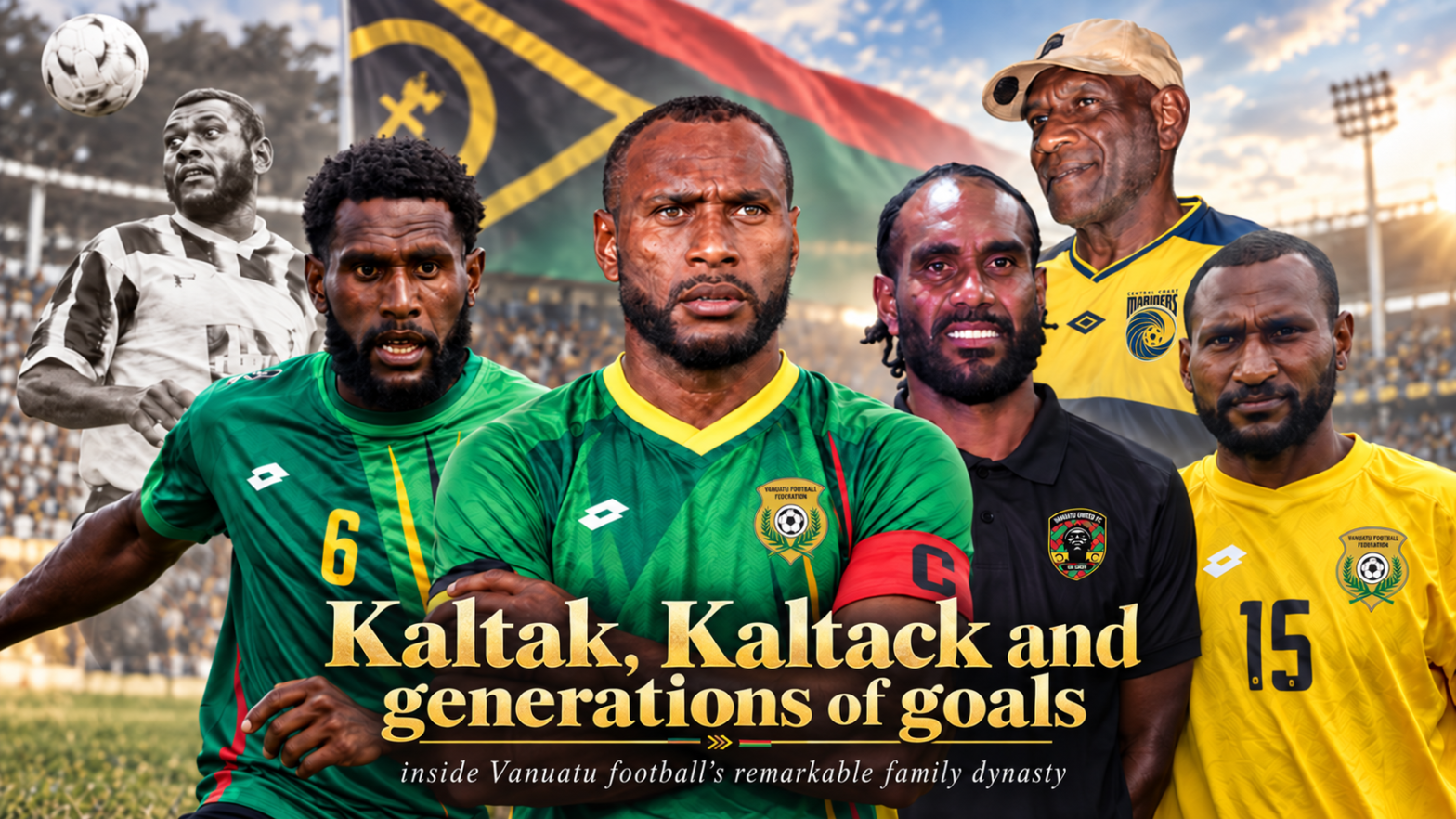
Two Vanuatu goals in the opening two rounds of the 2026 MSG Prime Minister’s Cup have carried a surname that has been appearing in the country’s football for generations. Tony Kaltack found the net against Papua New Guinea before Bill Kaltfer Kaltack scored the winner against Fiji. Different players, different matches, but members of the same remarkable football family.
For followers of Vanuatu football, the name is hardly new. Kaltak — or Kaltack, depending on the member of the family — has been attached to the national team, Erakor Golden Star and football across the Pacific for decades. The spelling may differ on team sheets and official records, but the family connection does not.
The story stretches back to an earlier generation. Ivoki Kaltack, himself a former Vanuatu international striker, is the father of Jean, Tony and Bill Kaltfer Kaltack. His generation helped establish a football tradition within the family and within Erakor, the community from which so many of its players emerged.
Ivoki represented Vanuatu and also spent part of his playing career in Tahiti. Years later, when his son Jean earned an opportunity to join Hekari United in Papua New Guinea, Ivoki travelled with him and publicly spoke about the pride that the achievement had brought to both their family and village.
Jean Kaltack would become one of the most recognisable attacking talents produced by that branch of the family. He represented Vanuatu from youth level through to the senior national team and played abroad with Hekari United, while also remaining closely associated with Erakor Golden Star. Goals were central to his reputation, including a prolific period with Vanuatu’s age-group teams.
Then came Tony Kaltack, another attacking player whose career has repeatedly brought him into the Vanuatu national-team picture. Tony established himself with Erakor Golden Star and earned particular attention during the club’s OFC Champions League campaigns. His ability to score from different areas of the pitch made him one of Erakor’s major attacking weapons.
The 2026 MSG Prime Minister’s Cup has provided another reminder that Tony remains capable of influencing matches for his country. Against Papua New Guinea, he broke the deadlock in the second half to put Vanuatu ahead. PNG eventually recovered to win 2-1, but another Kaltack had once again appeared on a Vanuatu scoresheet.
The family connection became even more visible three days later.
Against hosts Fiji, Bill Kaltfer Kaltack scored the only goal in Vanuatu’s crucial 1-0 victory at HFC Bank Stadium. It was not an isolated strike created from nothing. Vanuatu patiently exchanged passes inside the penalty area, moved Fiji’s defence and eventually created the opening for Kaltack to finish the move.
Bill’s full name provides another detail in a story already complicated by different surname spellings. Often referred to simply as Bill Kaltack, he is Bill Kaltfer Kaltack, another son of Ivoki and brother of Jean and Tony. He has represented Vanuatu internationally and has spent much of his domestic career connected to Erakor Golden Star.
His decisive contribution against Fiji was also not his first important MSG Cup moment. In the 2025 final against Papua New Guinea, Vanuatu and PNG finished level after extra time and went to penalties. Bill Kaltfer Kaltack converted the decisive kick as Vanuatu won the shootout 5-4 and captured the MSG Prime Minister’s Cup.
Yet Jean, Tony and Bill are only one branch of the story.
Brian Kaltak, whose surname is generally written without the final “c”, belongs to the same football family. Brian is the son of Timothy Kaltack and cousin of Jean, Tony and Bill. Like Ivoki, Timothy was an important football influence inside the family, with Brian recalling how he followed his father to the football field as a child in Erakor.
Brian eventually took the family name further internationally than any of his relatives had before him. After years playing around Oceania, including spells in Fiji and New Zealand, the central defender broke into Australian professional football and established himself in the A-League. His rise provided Vanuatu with one of its most visible footballers abroad and extended the Kaltak-Kaltack story beyond the Pacific Islands competitions in which the family had already become so familiar.
There is also another member who should not disappear from the picture: Semici Kaltack.
Semici was already being presented by the Oceania Football Confederation as part of the Kaltack football lineage when he represented Vanuatu at the 2018 OFC U-16 Championship. OFC identified him specifically as the younger brother of Jean Kaltack and cousin of Brian Kaltak. Growing up in Erakor, Semici said that watching his brothers play had inspired him to follow the same path.
At that tournament he operated as an attacking midfielder and was considered one of the creative players in Vanuatu’s U-16 side. His presence showed that the family production line had not ended with Jean, Tony, Bill or Brian. Another Kaltack was progressing through Vanuatu’s national youth system, carrying both the surname and the connection to Erakor into a new generation.
The number of footballers within the family makes the story unusual even by the standards of communities with strong football traditions. Ivoki played for Vanuatu. His sons Jean, Tony and Bill Kaltfer followed him into high-level football. Timothy’s son Brian became a senior international and professional player abroad. Semici then emerged through Vanuatu’s youth national teams as Jean’s younger brother and Brian’s cousin.
At the centre of virtually every branch is Erakor.
The village and Erakor Golden Star have provided much more than a club badge beside the players’ names. They form the environment in which several members of the family learned the game. OFC itself has previously described the Kaltack name as almost synonymous with football in Vanuatu, particularly when documenting Tony’s performances for Golden Star and later Semici’s emergence with the national youth team.
That background also helps explain why spelling the surname is less straightforward than tracing the relationship. Brian is widely registered as Kaltak, while Jean, Tony, Bill Kaltfer and Semici regularly appear as Kaltack. Historical records involving Ivoki and other members of the family have also used variations. Trying to force everyone under one spelling risks creating an artificial distinction where the football history shows the opposite.
They are relatives, and the differences in spelling do not represent separate football families.
The 2026 MSG Prime Minister’s Cup has simply provided the latest chapter. Tony scoring against Papua New Guinea followed by Bill scoring the winner against Fiji means that, decades after the previous generation established the name in Vanuatu football, members of the family are still directly influencing senior international matches.
Brian’s professional career may have taken the surname to a different stage, while Jean produced his own international goals and Semici represents another continuation of the line. But the roots remain remarkably concentrated: one family, one community and several generations connected to the Vanuatu national team.
So whether a team sheet reads Kaltak or Kaltack, the wider story is the same. Ivoki, Timothy, Jean, Tony, Bill Kaltfer, Brian and Semici are not simply a collection of familiar surnames appearing throughout Vanuatu football history.
They are part of the same football dynasty.
Discover more from Oceania Football Center
Subscribe to get the latest posts sent to your email.


One thought on “Kaltak or Kaltack? Inside the Vanuatu football dynasty still deciding matches generations later”