
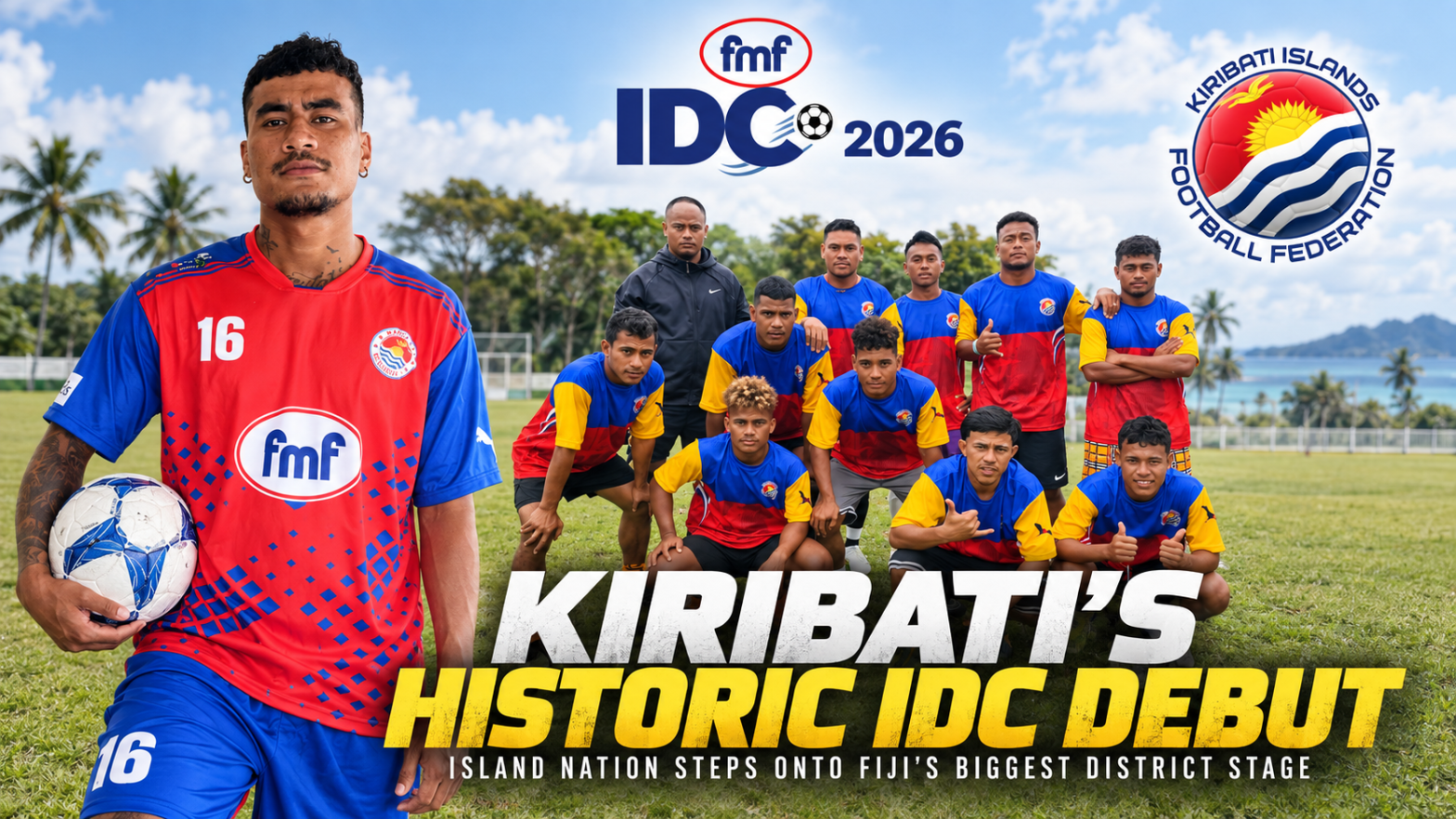
Kiribati’s participation in the 2026 FMF Inter-District Championship is about much more than entering another football tournament. When the national team walks onto the HFC Bank Stadium pitch in Suva, it will be taking part in one of the most important competitive tests available to a country still fighting for a permanent place within Oceania’s international football structure.
The 19-player Kiribati squad will make its historic IDC debut against Seaqaqa at 11am on October 6, competing in the Premier Division alongside Seaqaqa and Nadroga in Pool A. It is the first time Kiribati have entered the traditional Fijian tournament, and the opportunity arrives at a significant point in the development of football in the island nation.
Kiribati remain an associate member of the Oceania Football Confederation rather than a full member and are outside FIFA. That status severely limits the competitive opportunities available to the national team: there are no World Cup qualifiers and no regular senior OFC pathway comparable to those enjoyed by most of their Pacific neighbours. KIFF has openly identified full OFC and FIFA membership as one of its major long-term objectives.
Speaking directly to Oceania Football Center ahead of the IDC, Kiribati head coach Pine George Holomoana Iosefa made clear that the trip to Fiji is connected to that larger ambition.
“One of our main expectations for our football movement is to become a full member of OFC and FIFA,” Iosefa told OFCe.
For the coach, however, institutional recognition is only one part of what this tournament can provide. The IDC also gives Kiribati something much more immediate: an opportunity to discover where their football currently stands when placed against organised Fijian opposition.
“We hope to participate in the IDC competition to see our players’ standard against Fiji,” he added.
That may be the most important sporting question Kiribati will answer during their stay in Suva.
Unlike nations that can assess themselves through regular FIFA windows, qualifiers and regional championships, Kiribati have comparatively few opportunities to put their best players into a sustained competitive environment outside the country. The IDC therefore provides something that isolated friendly matches cannot: consecutive matches, tournament pressure and opponents accustomed to a demanding domestic football structure.
Kiribati have at least arrived with confidence. Their final preparations included a friendly against KISA on October 3, with the national selection — Te Itei — recording a 9-2 victory before turning its attention towards the IDC.
The squad itself also provides an important picture of where Kiribati football currently comes from.
Kiribati media and marketing officer Kamaraia Namina told OFCe that the travelling delegation consists of 19 players and five officials — two coaches, a team manager, medical assistant and media officer. The playing group has been assembled primarily from three of the country’s leading clubs: SB Rainbow FC and Dijron FC from Tarawa, and Tekinati FC from Butaritari.
The presence of Tekinati is particularly significant. It means the national side is not simply a Tarawa-based selection but includes representation from football outside the capital, an important consideration for a federation trying to develop a game spread across a geographically fragmented island nation.
Asked by OFCe about individual players who could attract attention during the tournament, Namina highlighted young midfielder Tekaai Tekaai.
“Tekaai is one of them. He is the youngest and a rising star,” Namina said.
Tekaai, wearing number 13 in Kiribati’s IDC squad, will therefore be one of the players worth following as the tournament progresses. Namina also pointed to midfielder Sakensa Vulitemo as another player capable of standing out.
Their performances will matter beyond Kiribati’s results.
For players accustomed largely to domestic football, facing experienced Fijian district teams offers a rare comparison with another Pacific football environment. Seaqaqa will provide the first measure before Kiribati also face Nadroga, a district with extensive experience in Fiji’s national competitions.
There is little reason to place unrealistic expectations on Kiribati in terms of winning the Premier Division. Their opponents operate within a deeper and more regularly competitive football structure, while the visitors are entering unfamiliar territory. But judging Kiribati only through wins and losses would miss much of the significance of their participation.
How well they organise defensively, how comfortable the players are under pressure, whether they can maintain the intensity required across consecutive tournament matches and which individuals prove capable of competing at this level may ultimately tell KIFF much more than the final standings.
There is also a remarkable historical connection between Kiribati and their hosts.
Kiribati’s first recorded men’s international was played against Fiji on 30 August 1979. Almost five decades later, Fiji is again providing an important reference point for the development of the Kiribati national team — this time by opening one of its most established domestic competitions to them.
The relationship has now moved beyond a single invitation. Kiribati officials have described their participation as the product of cooperation between KIFF and Fiji Football Association, while the IDC places the country before a Fijian audience and gives its players visibility they rarely receive elsewhere in the region.
For a federation whose stated ambitions include progressing from associate status towards full OFC membership and ultimately FIFA, those opportunities matter.
Kiribati cannot reach that objective through one tournament, and strong performances in Suva will not by themselves change their international status. What the IDC can do is give their football something essential to any development project: evidence.
For the first time, Kiribati can take a locally developed national squad into one of Fiji’s major football environments, measure its players against established opposition and leave the tournament with a clearer understanding of what has already been built — and how far there is still to go.
The results will be recorded in the IDC tables. For Kiribati, the real value of the week in Suva could be considerably bigger.
Discover more from Oceania Football Center
Subscribe to get the latest posts sent to your email.


One thought on “Kiribati’s historic IDC debut carries a bigger ambition: proving they belong on Oceania football’s next stage”