
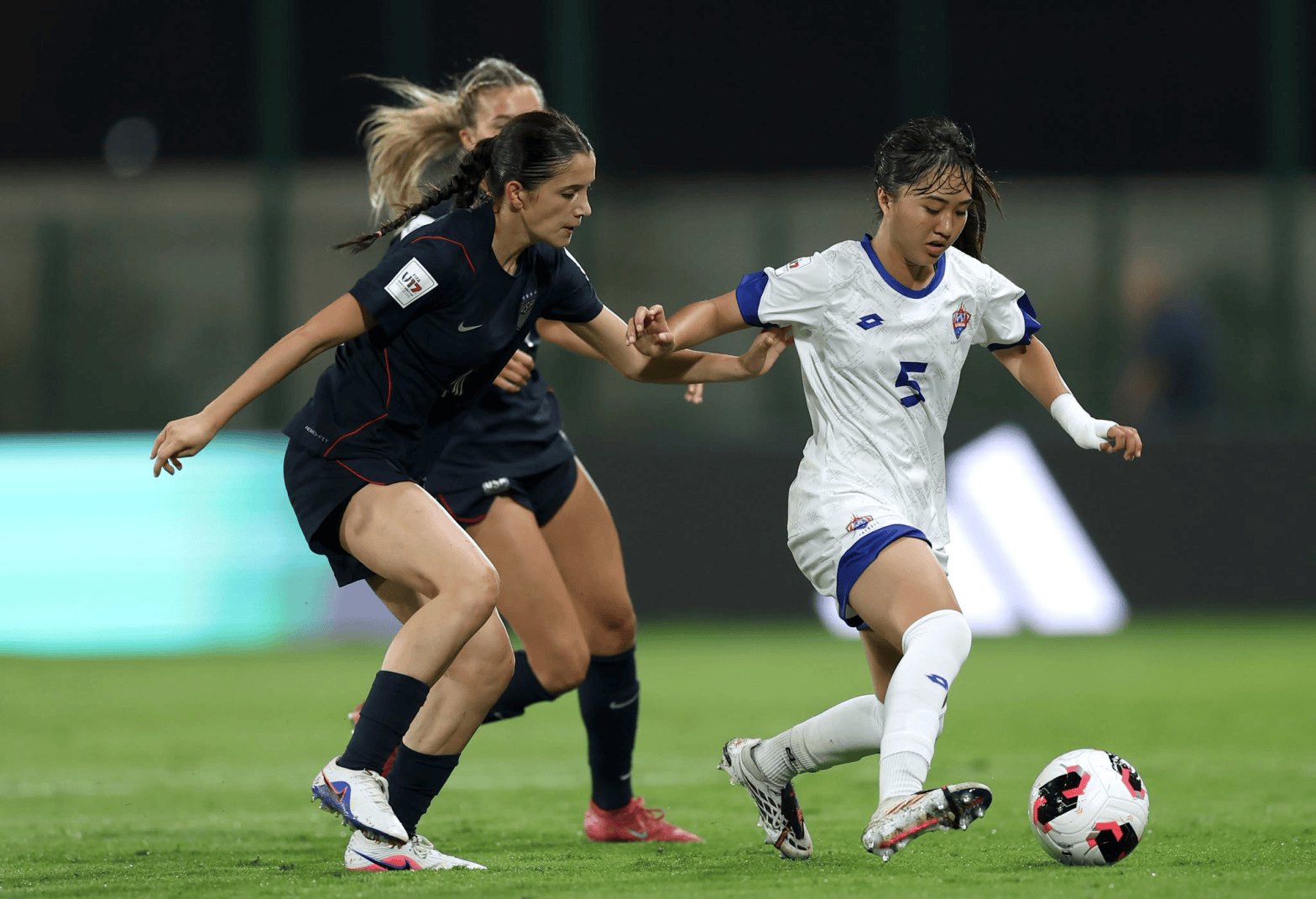
Samoa suffered the heaviest defeat in FIFA World Cup history on Monday, 19 October, losing 17-0 to the United States in their opening match of the 2026 FIFA U-17 Women’s World Cup in Morocco. The extraordinary scoreline highlighted the enormous gap that still separates some of Oceania’s developing football nations from the world’s established powers, while raising important questions about the opportunities available to smaller countries seeking to improve internationally.
Playing at the Mohammed VI Football Complex in Salé, Samoa were overwhelmed by an American team that scored nine goals in the first half and another eight after the interval. Maddie DiMaria led the scoring with six goals, setting a new record for the most goals by an individual player in a single FIFA U-17 Women’s World Cup match.
The United States needed just 62 seconds to take the lead through DiMaria, who capitalised on a defensive mistake. Mia Corona doubled the advantage in the 12th minute before DiMaria completed her hat-trick with goals in the 18th and 20th minutes.
Loradana Paletta scored twice during the opening period, while Grace Murray, Amari Manning and another goal from DiMaria extended the American advantage to 9-0 before halftime.
There was little relief for Samoa after the break. Deus Stanislaus, Carolina Reyna, Isa Ortiz, Meila Brewer and Gianna Hanf joined the scoresheet, while DiMaria completed her six-goal performance and Reyna added a second.
The statistics illustrated the scale of American dominance. The United States registered 58 shots without allowing Samoa a single attempt, while goalkeeper Susahna Peacock made 13 saves despite conceding 17 goals.
The result surpassed the previous record for the largest victory at any FIFA World Cup, established when Morocco defeated New Caledonia 16-0 at the 2025 FIFA U-17 World Cup.
For Samoa, however, the significance of the match extends beyond an unwanted place in football history.
The Pacific nation, with a population of approximately 220,000 people, are participating in their second consecutive FIFA U-17 Women’s World Cup. Their debut in 2025 represented a historic achievement, making them the first Samoan national team to qualify for a FIFA tournament.
That first appearance also produced an encouraging moment against France. Despite facing considerable pressure, Samoa scored twice against the former world champions before eventually losing 4-2.
Jayde Eldredge and Makea Leonard scored Samoa’s first goals on the global stage, demonstrating that even against far stronger opponents, the team could produce moments of quality.
The encounter nevertheless revealed the difference in competitive standards. France registered 61 attempts compared with Samoa’s two, even though the final score was considerably closer than the statistics suggested.
A year later, the defeat to the United States showed just how difficult it remains for Samoa to consistently compete against countries with considerably larger football systems, more extensive development structures and greater access to high-level competition.
The United States benefit from an established network of youth clubs, academies, collegiate pathways and professional opportunities. Their players can develop within an environment where training standards, specialist coaching and demanding matches are available throughout their formative years.
Samoa operate on a very different scale. Their smaller population naturally limits the available player pool, while the development of women’s football must compete with the challenges of geography, infrastructure, funding and access to regular high-level opposition.
These differences become particularly visible at youth tournaments, where players from emerging football nations may be encountering an opponent of this quality and intensity for the first time.
Technical ability, tactical awareness and physical preparation are all influenced by the environments in which young footballers develop. When those opportunities differ substantially, the consequences can be particularly severe against opponents capable of maintaining pressure throughout an entire match.
Yet this disparity is also precisely why participation in international tournaments remains important.
Without opportunities to face stronger nations, developing teams have limited chances to experience the speed, decision-making and tactical demands required at the highest level. Domestic and regional competitions provide essential foundations, but they cannot always replicate the challenges presented by the world’s leading youth programmes.
Samoa head coach Juan Chang Urrea acknowledged the value of that exposure before the tournament, reflecting on the lessons learned during his team’s first World Cup appearance.
“Last year’s tournament gave us a much clearer understanding of what it takes to compete at the highest level. We learned a lot about the speed of the game, the quality of decision-making required, and how important it is to stay composed and trust ourselves under pressure,” he told the Oceania Football Confederation.
“Perhaps the biggest lesson though, was that we belong on this stage, and we cannot afford to be intimidated by the occasion.”
Those words take on additional significance following such a difficult defeat.
Samoa’s second World Cup squad includes six players who participated in the 2025 tournament. Their experience provides an important foundation, but the remaining 15 squad members are making their first appearances at a FIFA competition.
The value of these experiences should not be measured exclusively through immediate results. Players exposed to stronger opponents can return with a clearer understanding of their development needs, while coaches gain opportunities to assess their teams against international standards.
However, exposure alone cannot eliminate the competitive gap.
For Samoa and other developing football nations in Oceania, meaningful progress also requires stronger domestic competitions, improved coaching structures, more international fixtures and sustained investment in women’s youth football. Without opportunities to apply the lessons learned at major tournaments, the benefits of participating on the world stage risk remaining limited.
The expansion of the FIFA U-17 Women’s World Cup to 24 teams in 2025, alongside its transition to an annual tournament, has created more opportunities for countries outside the traditional football powers to participate.
That increased representation is an important development for global football. It allows more young players to experience international competition and provides smaller nations with a platform that previously seemed beyond their reach.
At the same time, results such as Samoa’s defeat demonstrate that expanding access to major tournaments must be accompanied by efforts to narrow the developmental differences between participants.
For Oceania, where New Zealand have traditionally dominated women’s youth football, Samoa’s consecutive qualifications represent an important achievement in themselves. The country finished runners-up at the OFC U-16 Women’s Championship in both 2024 and 2025, showing that its progress within the region has been sustained rather than accidental.
Urrea has also emphasised the wider impact that World Cup appearances can have on the development of women’s football in Samoa.
“When young girls see players from Samoa competing at a FIFA World Cup, it helps them believe that they can achieve something similar. It gives women’s football greater visibility and creates something for our communities to rally behind,” he said before the tournament.
The challenge now is ensuring that increased visibility translates into lasting opportunities for the next generation.
Samoa will return to action against China PR on 22 October before completing their Group E campaign against Kenya on 25 October, with both matches offering further opportunities to gain experience against international opposition.
The 17-0 defeat will remain a painful result for the players and coaching staff, and its magnitude should not be overlooked. However, it should not overshadow the importance of Samoa’s presence at a second consecutive World Cup.
For a country still building its foundations in women’s football, competing against the world’s strongest teams is part of a much longer development process. The challenge for Samoa, the Oceania Football Confederation and the wider international football community is ensuring that these opportunities lead to tangible progress beyond the tournament itself.
Discover more from Oceania Football Center
Subscribe to get the latest posts sent to your email.

