
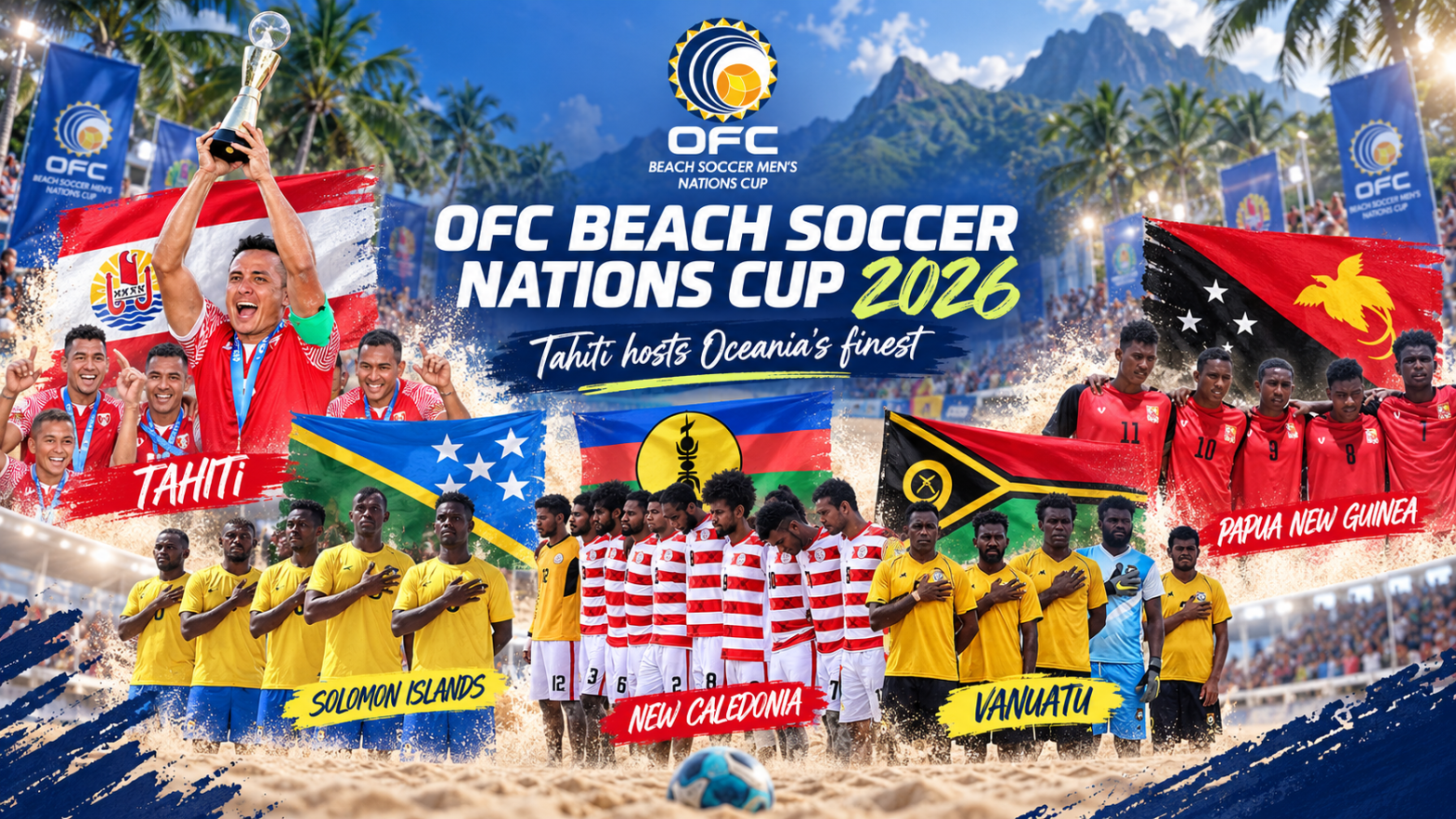
Tahiti will attempt to extend their dominance of Oceania beach soccer when the 2026 OFC Beach Soccer Men’s Nations Cup begins on Thursday, 22 October, at Aorai Tini Hau in Pirae, with five Pacific nations competing for the regional title and qualification for the 2027 FIFA Beach Soccer World Cup.
The Tiki Toa enter the tournament as three-time defending champions, having won four of the previous five editions of the competition. However, they will face familiar rivals Solomon Islands, alongside New Caledonia, Vanuatu and Papua New Guinea, in a tournament that brings together established regional powers and nations seeking to strengthen their beach soccer programmes.
All five teams will face one another during a round-robin stage, with the two highest-placed sides advancing to the final on 31 October. The third and fourth-placed teams will contest a playoff earlier that day.
Tahiti’s record makes them the team to beat. The hosts have not lost a match at the OFC Beach Soccer Nations Cup since 2011 and defeated Solomon Islands in each of their previous four appearances in the final, including a 3-2 victory in Honiara in 2024.
The Tiki Toa have also established themselves internationally, reaching the FIFA Beach Soccer World Cup final in both 2015 and 2017, achievements unmatched by any other Oceania representative.
This year’s campaign will nevertheless bring a significant change on the sidelines. Former captain Raimana Li Fung Kuee has taken charge of the national team for his first major tournament as head coach, while remaining available as a player.
The experienced Tahitian was part of the squads that reached consecutive World Cup finals and now faces the responsibility of maintaining the country’s regional supremacy.
“It’s always an advantage and a pleasure to play at home because we’ll have the support of our families and the crowd,” Li Fung Kuee said.
Tahiti have retained the core of their 2024 championship squad while introducing three new players. Their preparations included a series of international friendlies against Switzerland, allowing the coaching staff to test the team against strong opposition before the tournament.
Among the players expected to play a prominent role is Heirauarii Salem. The 28-year-old won the Golden Boot at the 2024 Nations Cup with 11 goals and enters this year’s competition after scoring 33 times in the 2026 Swiss Beach Soccer League.
Salem’s finishing ability makes him one of the tournament’s leading attacking threats as Tahiti pursue another regional title.
Their strongest historical challengers are Solomon Islands, who travel to French Polynesia determined to end a 13-year championship drought.
The Bilikiki dominated the early years of Oceania beach soccer, winning the first three editions between 2006 and 2009 before securing their fourth title in 2013. They remain level with Tahiti on four championships but have subsequently lost three consecutive finals against the Tiki Toa.
Legendary former player James Naka will again coach Solomon Islands. The competition’s all-time leading goalscorer, with 34 goals, has been involved in every edition since its introduction in 2006 and brings extensive experience to a team determined to regain its place at the top of the region.
“Our main objective is to win the tournament and qualify back to the World Cup,” Naka said ahead of the competition.
Seven players from Solomon Islands’ 2024 runners-up squad have returned, including Erick Wanega, James Do’oro, Charlie Otainao, Albert Bobby, Max Fa’ari, Peter Reginald and Apolos Ahua.
Otainao and Adrian Mara have also represented Solomon Islands at senior international level in conventional football, adding further experience to a squad with an average age of 30.
Wanega will be particularly important to the Bilikiki’s attacking ambitions. Although he operates as a goalkeeper in conventional football and is associated with Solomon Kings FC in the OFC Professional League, he is a prolific beach soccer attacker. He scored eight goals in the 2024 regional tournament, including five against Papua New Guinea.
Solomon Islands will open their campaign against Papua New Guinea on 22 October before facing Tahiti two days later in a highly anticipated rematch of the previous final.
New Caledonia could provide another significant challenge. Returning to the competition for the first time since 2019, the team will be guided by Felix Tagawa, who also coaches the senior men’s national football side.
Tagawa previously led New Caledonia in their two earlier Beach Soccer Nations Cup appearances, when they finished runners-up in 2013 and third in 2019. His return provides continuity for a squad that combines limited recent beach soccer experience with players who have competed at a high level in conventional football.
Three members of the squad — Germain Haewegene, Makaluë Xowi and Jean-Gilles Hnamuko — are senior New Caledonian internationals.
Haewegene is among the most interesting additions to the tournament. The attacker scored six goals in 17 OFC Professional League appearances for Tahiti United and also represented AS Vénus in the OFC Men’s Champions League earlier this year.
His transition to international beach soccer adds an intriguing dimension to New Caledonia’s attack, while veteran Jean-Pierre Ayawa provides experience from both the 2013 and 2019 campaigns.
New Caledonia will face Tahiti in their opening match, immediately testing their ability to compete with the defending champions.
Vanuatu also return after a prolonged absence, having last participated in 2019. The national team enjoyed success in the early editions of the tournament, finishing runners-up three times, but now enter a rebuilding phase under coach Terry Malapa.
The squad brings together players from futsal, youth international football and the traditional eleven-a-side game, reflecting an attempt to develop a new generation of beach soccer players.
One of the most promising members is 19-year-old Paul Takaro, who has represented Vanuatu at youth and futsal levels. Takaro previously captained the country’s U-16 national team and scored an important equaliser against Solomon Islands during the 2025 OFC Futsal Men’s Cup.
Malapa has acknowledged the challenges of returning to international beach soccer after seven years away, but believes the team can establish a foundation for future development while remaining capable of causing an upset.
Papua New Guinea complete the five-team field, making their second appearance after debuting in Solomon Islands two years ago.
Their introduction to international beach soccer in 2024 was memorable, beginning with an 8-6 victory over Fiji. However, three subsequent defeats left PNG in fourth place, demonstrating the challenges facing a developing national programme.
Coach Babob Labong returns with eight players from the inaugural squad, providing valuable continuity. Five of those returning players scored during the previous tournament.
Much of the sport’s development in Papua New Guinea has been centred on Fisherman’s Island, near Port Moresby, where several members of the national squad have developed their skills.
Captain and goalkeeper Kopi Samuel will again be a central figure as PNG attempt to improve on their debut campaign, particularly defensively after conceding 43 goals across four matches in 2024.
Beyond the competition itself, PNG hope that another international appearance will support the development of domestic beach soccer and encourage greater participation across the country.
The opening day on 22 October will see Papua New Guinea face Solomon Islands at 2pm local time, followed by New Caledonia against Tahiti at 4pm.
Another major encounter follows on 24 October, when Tahiti meet Solomon Islands in a match that could prove decisive in determining the two finalists.
The remaining round-robin matches will take place on 26, 27 and 29 October, before the third-place playoff and final conclude the tournament on 31 October.
With Tahiti seeking to extend their dominance, Solomon Islands pursuing a return to the World Cup and three Melanesian challengers hoping to disrupt the established order, the competition offers another important chapter in the development of beach soccer across Oceania.
All matches will be broadcast live and free through the Oceania Football Confederation’s official YouTube channel.
Discover more from Oceania Football Center
Subscribe to get the latest posts sent to your email.

