
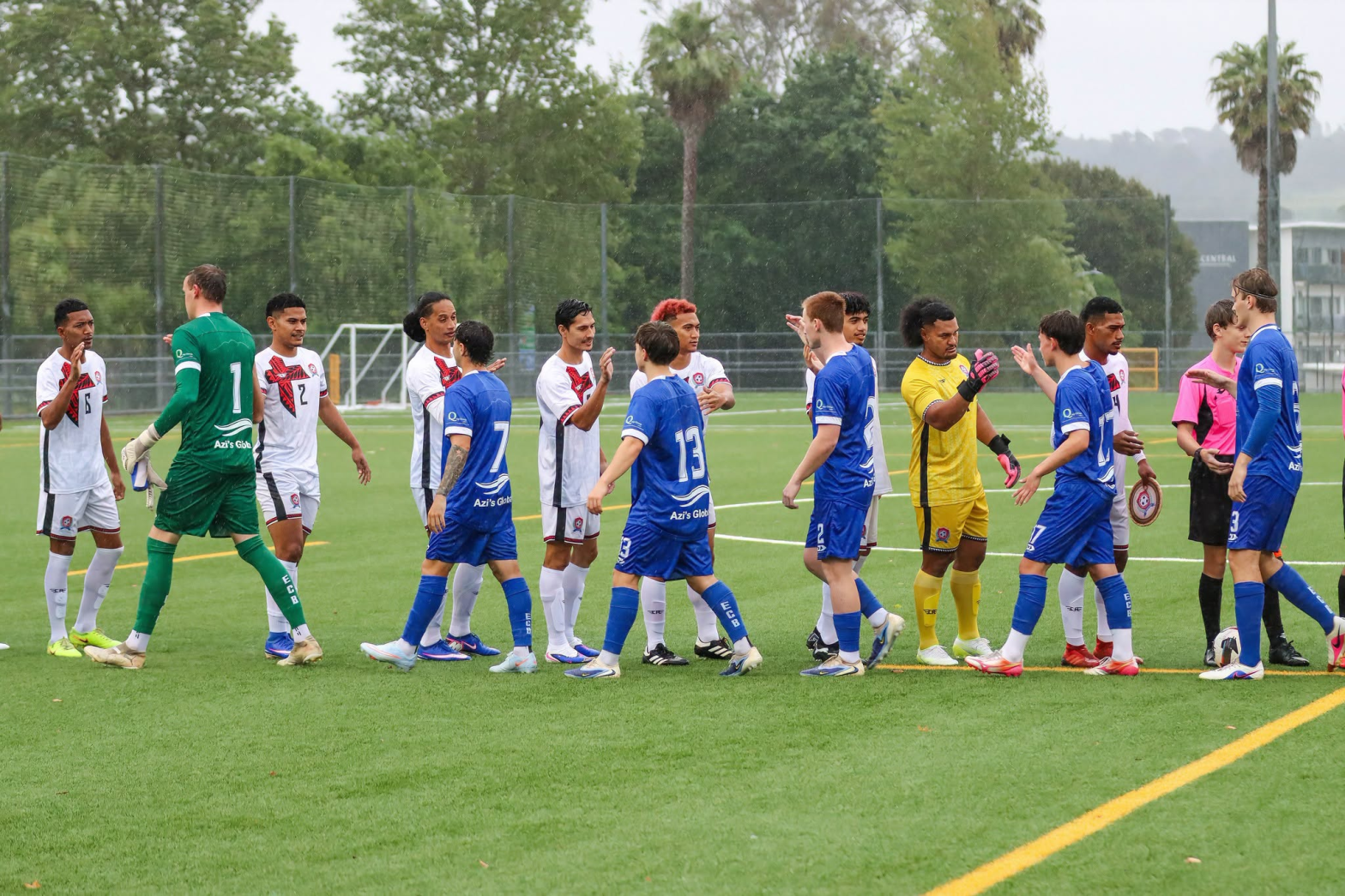
Tonga’s return to football after more than two years without senior international action began in devastating fashion on Tuesday, November 10, as the Tu’ulalupe suffered an 11–0 defeat against Northern League side East Coast Bays AFC in Auckland. The result exposed the enormous challenges facing the national team as they attempt to rebuild ahead of future Oceania competitions, with eight of the eleven goals conceded during a disastrous second half.
The opening encounter of Tonga’s four-match New Zealand tour was expected to provide head coach Timote Moleni with an opportunity to assess his squad against established club opposition. Instead, the team experienced a difficult introduction to the demands of playing against opponents accustomed to a more competitive domestic football environment.
East Coast Bays established a 3–0 lead before halftime, leaving Tonga with a considerable deficit but still an opportunity to demonstrate improvement during the second period.
However, the situation deteriorated dramatically after the interval.
The Auckland-based club added eight unanswered goals during the second half, completing an emphatic victory and leaving the visitors with a significant challenge to recover their confidence ahead of the remaining matches.
The final score was confirmed by the Oceania Football Confederation (OFC), which acknowledged Tonga’s difficult beginning to the tour while emphasising the importance of gaining competitive experience.
Detailed information concerning the individual goalscorers, Tonga’s starting lineup and substitutions has not yet been made publicly available through the sources consulted.
Nevertheless, the scale of the defeat is particularly concerning considering the level of opposition.
East Coast Bays compete in New Zealand’s Northern League, one of the country’s leading regional competitions, but operate outside the professional structures of the A-League and OFC Professional League.
The club finished sixth in the 2026 Northern League season, competing against established teams including Auckland City, Birkenhead United, Auckland United and Eastern Suburbs.
For Tonga, facing such opposition was intended to provide valuable exposure to a higher standard of football. However, conceding eleven goals against a regional club highlights the considerable distance the national team must travel before becoming consistently competitive at international level.
The result also brings renewed attention to the difficulties surrounding Tonga’s recent football development.
The national team had not played an official senior international match since September 2024, when they were eliminated from Oceania’s qualification tournament for the 2026 FIFA World Cup.
During that campaign, Tonga began with an encouraging 3–1 victory over Cook Islands before suffering a 2–1 extra-time defeat against Samoa, ending their hopes of reaching the group stage.
Since then, the absence of regular international fixtures has restricted opportunities to establish a consistent squad, develop tactical understanding and provide players with experience against stronger opponents.
The November tour was organised partly to address those problems.
Moleni, who previously coached Tonga between 2015 and 2023, has returned for a second spell in charge, bringing extensive knowledge of the country’s domestic football environment.
His 26-player squad combines footballers representing clubs in Tonga with six players based in New Zealand, reflecting an effort to strengthen the national team through its overseas football community.
Players from Veitongo, Lavengatonga, Longoteme, Longolongo, Lotoha’apai, Navutoka, Marist and Folaha were among those selected for the trip.
The presence of footballers competing in different environments provides an opportunity to expand the national team’s player pool, although establishing effective combinations remains a challenge when international gatherings are infrequent.
Tonga’s domestic football structures also face significant limitations compared with the systems available in New Zealand.
While Northern League clubs participate in regular competitions against established opposition, Tonga’s players have comparatively fewer opportunities to experience matches at a similar intensity.
That difference is one of the challenges the national federation hopes to address through overseas tours and greater international exposure.
However, Tuesday’s result demonstrates that simply organising matches against stronger opposition does not guarantee immediate improvements.
The ability to maintain defensive organisation, cope with sustained pressure and compete throughout ninety minutes will be important areas for the coaching staff to evaluate following the heavy defeat.
The eight goals conceded after halftime are particularly significant, although without a detailed match report it remains unclear whether tactical difficulties, physical conditioning, substitutions or other circumstances contributed to the second-half collapse.
The result should therefore be treated as a warning about the challenges facing the programme rather than definitive evidence of any single underlying problem.
Importantly, the match was a club friendly rather than an official senior international fixture. It will not count towards Tonga’s FIFA ranking or official international results.
However, its unofficial status does little to diminish the sporting concerns raised by such a substantial defeat.
The Tu’ulalupe now face a difficult task in responding before their next appearance, scheduled for Friday, November 13, against Māngere United.
The South Auckland club compete in New Zealand’s regional football structure and will provide another opportunity for Tonga to assess their progress.
Three days later, Tonga will face Auckland City FC’s U-23 side, representing a further challenge against players developing within one of Oceania’s most successful club environments.
The tour will conclude on November 18 against Western Springs, another Northern League opponent.
Those remaining matches will provide Moleni with opportunities to make adjustments, assess different players and determine which areas require the greatest attention.
Beyond the immediate programme, Tonga are preparing for the 2027 Pacific Games in Tahiti and the qualification process for the 2028 OFC Men’s Nations Cup.
Both competitions will present significant challenges for a team seeking to improve its standing within Oceania.
For a country where football continues to develop amid limited resources and opportunities for international exposure, the importance of maintaining a consistent national-team programme cannot be understated.
The defeat against East Coast Bays illustrates the consequences of entering a demanding competitive environment without the benefit of regular international matches.
At the same time, Tonga’s willingness to organise the tour represents an attempt to confront those difficulties rather than remain inactive.
The challenge now is ensuring that the experience contributes to meaningful improvements.
With three matches remaining, Moleni and his players have an opportunity to respond to an extremely disappointing beginning and demonstrate progress before returning home.
For Tonga, the New Zealand tour was designed to provide a foundation for the next stage of the national team’s development.
After an 11–0 defeat in their opening match, that rebuilding process already appears considerably more demanding than anticipated.
Discover more from Oceania Football Center
Subscribe to get the latest posts sent to your email.

