Bainivalu is an experienced defender who last played for Lautoka in the 2020 OFC Champions League while Dogalau is a young midfielder that comes from Ba youth system.
Ellerslie AFC keep stregnthening their squad for the upcoming winter football season in New Zealand as young Cook Islander Lee Harmon joined the squad that will play the NRFL Division 1, the second tier of the Northern Regional Football League in Auckland region.
Lee Harmon is a 18-year-old forward with some experience at international tournaments. He represented Cook Islands’ powerhouse Tupapa Maraerenga in the last three OFC Champions League editions. He also represented his nation in the 2018 OFC U20 Championship.
Lee Harmon (left) last played for Tupapa Maraerenga
It was also confirmed by Ellerslie AFC that a second Cook Islander is joining the team: Avi Enoka. Enoka was also in Tupapa Maraerenga’s squad and now both players will have the opportunity to face a higher challenge in New Zealand.
Papua New Guinean football is growing fast. The PNG National Soccer League is becoming an interesting tournament while some players are having some success overseas. David Browne is currently in Europe playing for HJK from Finland and Gimale Essacu – who recently graduated at college – spent two years playing in the United States while Terry Stephenson is a good prospect of Middlesbrough’s youth teams.
However there is an important story involving a football player from Papua New Guinea in the Asian football and it seems that it was forgotten by people and it must be remembered. Nigel Dabinyaba‘s stint in Malaysia during 2017.
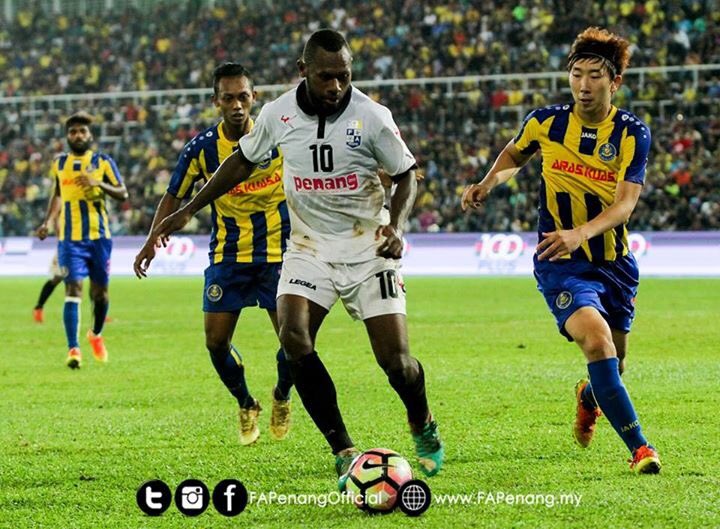
On 8 June 2016 the Papua New Guinea has beaten Malaysia by 2-0 in an international friendly and Dabinyaba called the attention in that match. A few months later he travelled to the Asian country for trials with FA Penang a football club that was playing in the top-tier of Malaysian football at that time.
The trials were successful and he signed with the Malaysian team, becoming the first Papua New Guinean to play at the professional level since Manis Lamond graced the Australian National Soccer League in the 1980s and 1990s.
Dabinyaba (wearing white shirt) signed with FA Penang from Malaysia. Source: FA Penang media
The Papua New Guinean forward quickly became one of the most important players in the team. He was in Penang’s starting eleven week in week out and he helped the team by scoring four goals in twenty matches. Despite his good level of performance things were not so good at all.
Dabinyaba started to face lots of problems in his new club including lack of payment – Penang FA did not keep the promise and the Oceanian player spent some months in Malaysia without receiving his salary
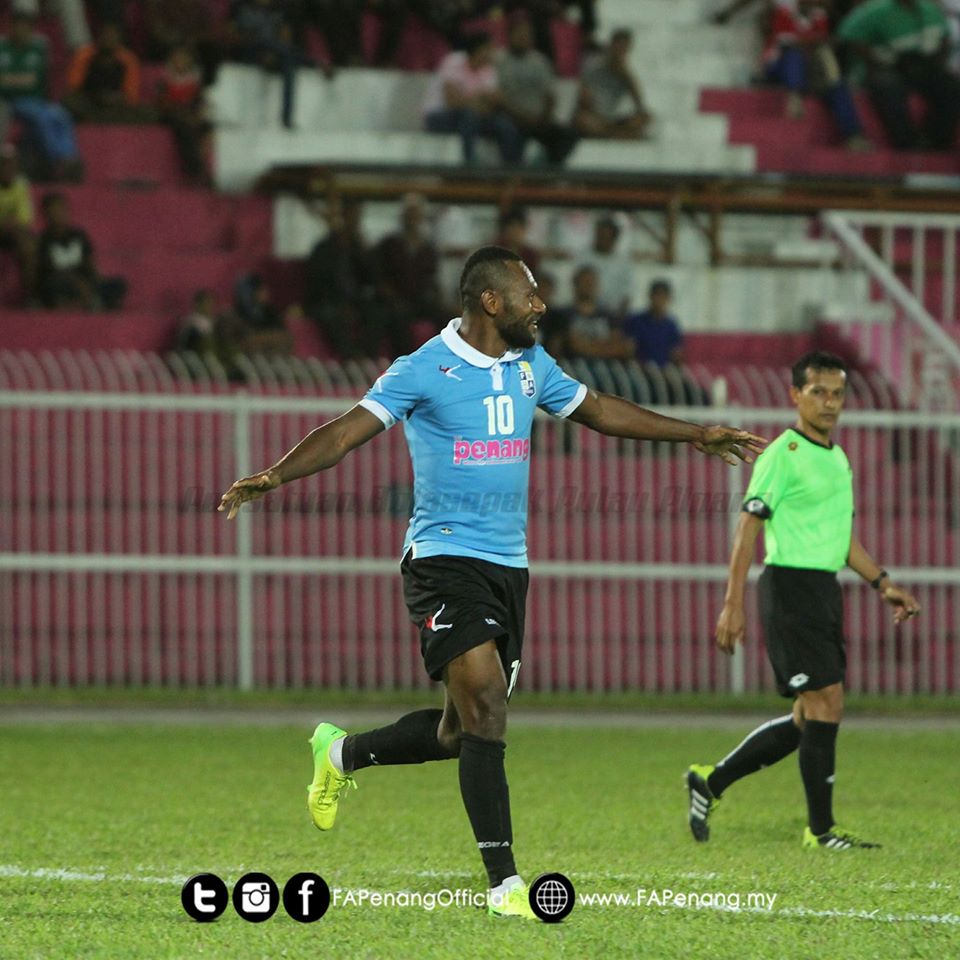
Dabinyaba kept the good level despite the problems. Source: FA Penang media
The season’s outcome was a huge disaster for FA Penang. They were relegated to the second tier of Malaysian football after an awful campaign in the 2017 Malaysian Super League with only twelve points in 22 matches.
Dabinyaba officialy left the club in December 2017 and he was surely good enough to keep his path in Asia and move to a better club, but he did not. Currently a Free Agent, it would be nice if we could see him playing outside Oceania again.
The Fédération Tahitienne de Football (FTF) has consultated the clubs on 23 May about what should be done regarding the 2019-20 season situation as it is stopped due to COVID-19 pandemics.
There was a meeting on this Wednesday (27 May) and the Executive Committee decided that all leagues and cups are definitely cancelled, repealing the decisions of the Executive Committee taken on 16 May 2020.
Once the final decision is already taken, we finally have a final for 2019-20 football season in Tahiti. The Ligue 1 VINI had its classification fixed I and title of champion was awarded to AS Pirae that is qualified for 2021 OFC Champions League alongside AS Vénus while third-placed AS Tiare Tahiti is qualified for the seventh round of 2020-2021 French Cup.
AS Pirae is 2019-20 Ligue 1 Vini Champions
The other tournaments had a different end. The final standings were established according to the ratio method calculated as follows for each team: the number of points as at 17 March is divided by the number of matches played. You can check the list of champions below:
U15 Elite: AS Vénus U15 Excellence: AS Arue U18 Elite: AS Vénus U18 Excellence: AS Tefana U23 Women: AS Tefana Senior Women: AS Te Ui Tefana Ligue 2: AS Excelsior U21 Championship: AS Manu-Ura Corporate Championship: AS Teva Import
AS Excelsior and AS Arue were promoted to 2020-21 Ligue 1 VINI. There will be 12 teams in the next season once there was no releagtion this season.
The 2019-20 season of the biggest football league from Australia is very close to resume after being stopped due to COVID-19 pandemic. Football Federation Australia (FFA) CEO James Johnson confirmed that FFA, the Hyundai A-League clubs and Professional Footballers Australia (PFA) reached agreement for the re-start of the Hyundai A-League 2019/20 season. However they still need to reach an agreement with Fox Sport – their broadcast partner.
There is no scheduled date yet, but players must return to training soon – “Ideally mid-June will see players return to training, allowing them to reach the required elite level of fitness for competitive matches to commence by mid-July, and for the Hyundai A-League Finals Series to be completed by mid-August,” said Johnson.
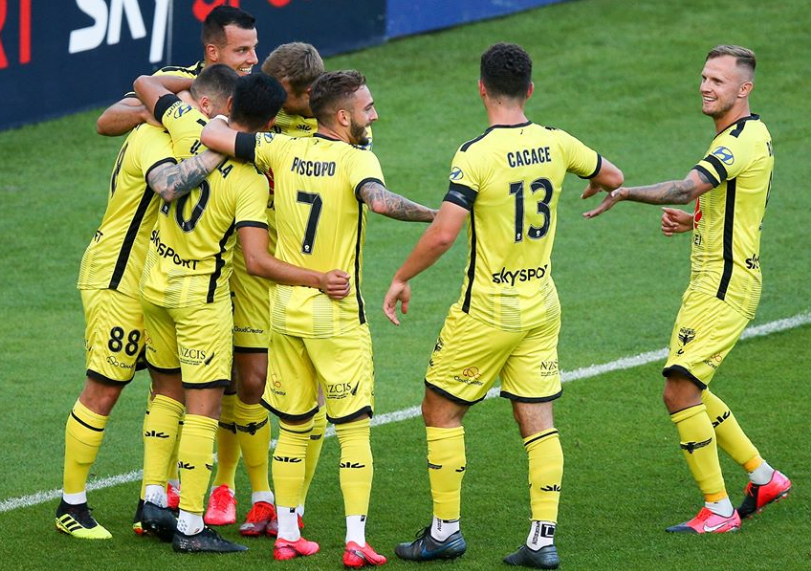
Wellington Phoenix is having a good season in 2019-20 Hyundai A-League
During this period FFA and Hyundai A-League will follow the best protocols in order to keep everyone safe – “The health and safety of our players, match officials, coaches, staff and other match day personnel remains our highest priority,” said Greg O’Rourke, the head of Hyundai A-League.
The return of Hyundai A-League means that we will be able to watch Wellington Phoenix in the pitch soon. The New Zealand-based club is currently in the third position with 36 points in 20 matches. You can check the current standings by clicking here.
It has been some months since Solomon Islands Football Federation (SIFF) announced that they are looking for a new head coach to lead Solomon Islands National Football Team in their upcoming challenges. However due to COVID-19 pandemic the new head coach has not been announced yet.
It was previously reported by Oceania Football Center that SIFF is close to announce the new head coach thanks to their partnership with LaLiga. According to reliable sources, Felipe Vega-Arango is the favourite candidate to become the next Solomon Islands National Team’s head coach but it was also reported that LaLiga is yet to confirm his availability.
Vega-Arango is well known in the Solomon Islands. In 2017 he was appointed as SIFF Technical Director and then he also became the National Team’s head coach. He managed the Bonitos in eleven matches from May to December 2017.
Another accomplishment for Fijian legend Roy Krishna. The 32-year-old forward was named for EA FIFA Mobile 2019-20 Indian Super League (ISL) team of the season. He is in the ISL’s starting eleven as one of the most powerful players of the league – his card has a 91 rate.
He was also part of Indian Super League Team of the Tournament, an award given by the league. Krishna helped ATK to win the 2019-20 Indian Super League by scoring 15 goals in 21 matches.
On 1 January 2006, Football Federation Australia moved from Oceania Football Confederation (OFC) to Asian Football Confederation (AFC) and since then the Socceroos qualified for all FIFA World Cups at senior level – 2010, 2014 and 2018. New Zealand – the biggest rival of Australia in OFC – became the “Kings of Oceanian football” since their rivals moved to AFC.
Today we will go back to the Oceanian 1990 FIFA World Cup qualifiers, the same qualifiers that almost took Israel to FIFA World Cup as an OFC member. This qualifying tournament was divided in two rounds. In the first one four of the five teams were drawn into two home-and-away ties and the two winners advanced to the second round.
Australia, Fiji, New Zealand and Chinese Taipei (Taiwan) were the first round’s participants in 1988. Chinese Taipei was not a trouble for New Zealand as the All Whites have smashed them in both matches. The same thing was supposed to happen in the clash between Australia and Fiji, but it did not happen…
BACKGROUND
Australia was living a huge moment in football in 1988 as they have beaten 1986 FIFA World Cup champions Argentina by 4-1 a couple of months before the 1990 FIFA World Cup qualifiers’ beginning. This unexpected result against one of the biggest football nations of the world took place in the Australia Bicentenary Gold Cup.
The Australia Bicentenary Gold Cup was an one-off association football tournament to celebrate the bincentennial of first settlement at Port Jackson by Captain Arthur Phillip in 1788. It was contested by 1988 AFC Asian Cup winners, Saudi Arabia, 1986 FIFA World Cup winners, Argentina, world number one ranked side, Brazil and host nation Australia.
On the other hand, Fiji was also excited about this clash against the Socceroos as they were 1988 Melanesia Cup champions exactly one month before facing the Australian side at Prince Charles Park in Nadi.
Fiji won 1988 Melanesia Cup held in Solomon Islands
This match would be the fourth clash between Australia and Fiji in football’s history. Their last meeting at that time was in 1981 when the Socceroos smashed the Bula Boys by 10-0 in the 1982 FIFA World Cup qualifiers.
THE MATCH
More than six thousand people went to Prince Charles Park in Nadi to watch the first leg of this home-and-away tie on November 26, 1988. Fiji counted on some important players like the talented 22-year-old player Ivor Evans who spent many years playing in North America and Simons Peters – one of the biggest local football idols of Roy Krishna. The team led by head coach Billy Singh is considered by local people as one of the best teams Fiji has ever produced.
Singh fielded Nasoni Buli (Lautoka) in goal, skipper Pita Dau (Lautoka), Dan Lutumailagi (Nadi), Maretino Nemani (Suva), Lote Delai (Ba) and Abraham Watkins (Nadroga) in defence. Ivor Evans (Vancouver 86ers), Vimal Sami (Ba) and Meli Vuilabasa (Ba) were the midfielders. The strikers were Jone Watisoni (Nadroga) and Simon Peters (Labasa).
Singh also revealed before the match that it was the match of their lives – “Our preparation has been the best it has ever been and the players are believing in themselves,” he told the Sydney Morning Herald – “Normally they play for fun, but this time it is serious. They have tasted the glory of winning and they like it,” – he added. The Fijian squad was also offered a $500 bonus for each in case of winning.
The Australian side counted on Charlie Yankos (30-time Socceroos captain), the Argentine Australian Oscar Crino, current Socceroos head coach Graham Arnold and Jeff Olver – regarded as one of the greatest goalkeepers Australia has ever produced.
Fiji and Australia’s line-ups for the match
The Australian side had a strict plan: Get in, win, and get out – “We were not necessarily at the peak of our fitness because the expectation would have been we are playing Fiji, the minnows… so it does not really matter,” said Charlie Yankos told Guardian Australia.
“The first thing I can remember about that was there was at least 200 frogs on the pitch,” remembered Socceroos winger Scott Ollerenshaw told Guardian Australia – “There were frogs everywhere […] There were also hundreds of people hanging off the trees. It was a very unusual setting with the frogs, and people hanging out of trees,” he completed.
It was a tough match between Fiji and Australia
After a 0-0 draw in the first half, Ravuama Madigi came from the bench to replace Rokova Watisoni and write his name in the history. After a cross from from the left, Madigi unleashed a left-foot volley to put the hosts ahead – “It was the best moment of my life,” revealed Abraham Watkins, who was representing Fiji that day. He was later named the Fijian Sportsman of the Year for his role in the victory – “It was a big achievement for us, and the country. The whole country was celebrating. The party was big,” he added.
It was a huge achievement for Fiji but they could not forget that they should play the second leg in the upcoming week. Despite playing with their hearts, they could not level up with the Australian side and lost by 5-1 and the Socceroos advanced to the second round of 1990 FIFA World Cup qualifiers. You can check the highlights of this match in the video below:
In 2018 Fiji Football Association (FFA) honoured those involved in this historical win against Australia. An amazing attitude showing respect and gratitude. Time goes on but they never forgot that 26 November 1988.
They were honoured by FFA in 2018. Source: Fiji FA
Unfortunately Fiji did not qualify for the upcoming round at that time but they showed their power against their opponents that certainly learned to never underrate their opponents.
In the past few years the number of Samoan descendants representing Samoa National Team is increasing. Most of them are from Australia, New Zealand or United States and they have been helping the Oceanian nation to move forward internationally. One of these players comes from Hawai’i (USA) and represented the country in the 2016 OFC Nations Cup and in the 2019 Pacific Games, he is Keone Kapisi.
Born in Hawai’i in 1994, Kapisi has Samoan heritage as his father is from the Oceanian nation. He started to play football competitively at school by representing Maui Sabers from 2008 to 2012. The opportunity to represent his father’s country came in 2016 when he was called-up to play the OFC Nations Cup – “My family from Samoa reached out to me about playing,” said Keone.
Kapisi (number 14) represented Samoa in the 2016 OFC Nations Cup
In 2017 he joined Brigham Young University (BYU) to study and play football. In the same year he was called-up to represent the United States in the 2017 Summer Universiade – an international multi-sport event, organized for university athletes by the International University Sports Federation (FISU) – held in Taiwan. He was eligible to represent USA in this tournament because it is not linked to FIFA.
Kapisi represented BYU from 2017 to 2019. Last year he had the opportunity to play for Samoa one more time in the 2019 Pacific Games. He played just two matches in the tournament because he got injured against New Zealand – “I injured my knee so I was out for a time,” he said.
Kapisi played for BYU from 2017 to 2019
Back from injury, Keone recently moved back to Hawai’i and he is currently a free agent – “I have not found a new club yet […] I am no longer injured but I am still working back to where I was” he explained. The 26-year-old is still available to play for Samoa and he would be a huge addition for the National Team in the 2022 FIFA World Cup Qualifying round.
The number of footballers from New Zealand playing in the United States grows yearly. There are eight Kiwis attached to Major League Soccer – the main football league in the USA – clubs this year. There are also dozens of young players studying and playing at college level in the National Collegiate Athletic Association (NCAA).
The NCAA Division I men’s soccer is ready to count on another player from New Zealand as Henry Hamilton has committed to the University of Maryland, one of the most important teams at college level – “Ever since I can remember it has been my dream become a professional footballer. I believe this route will allow me to continue working towards my dream as well as further my education,” he expressed on Social Media.
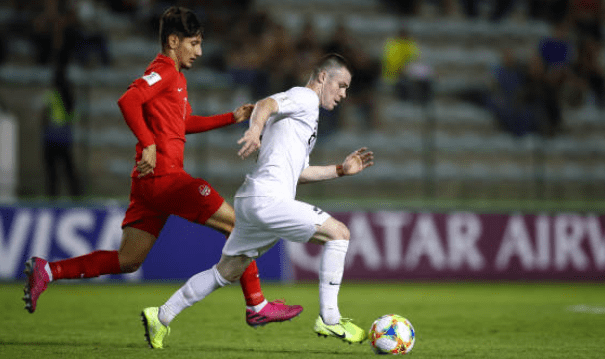
Hamilton (right) playing for New Zealand in the 2019 FIFA U17 World Cup
The 18-year-old midfielder played the 2019-20 ISPS Handa Premiership season for Wellington Phoenix Reserves and he was part of the national team that played the FIFA U17 World Cup in Brazil last year.
Oceania Football Center congratulates Henry for joining University of Maryland. We wish him good luck in this upcoming challenge.