
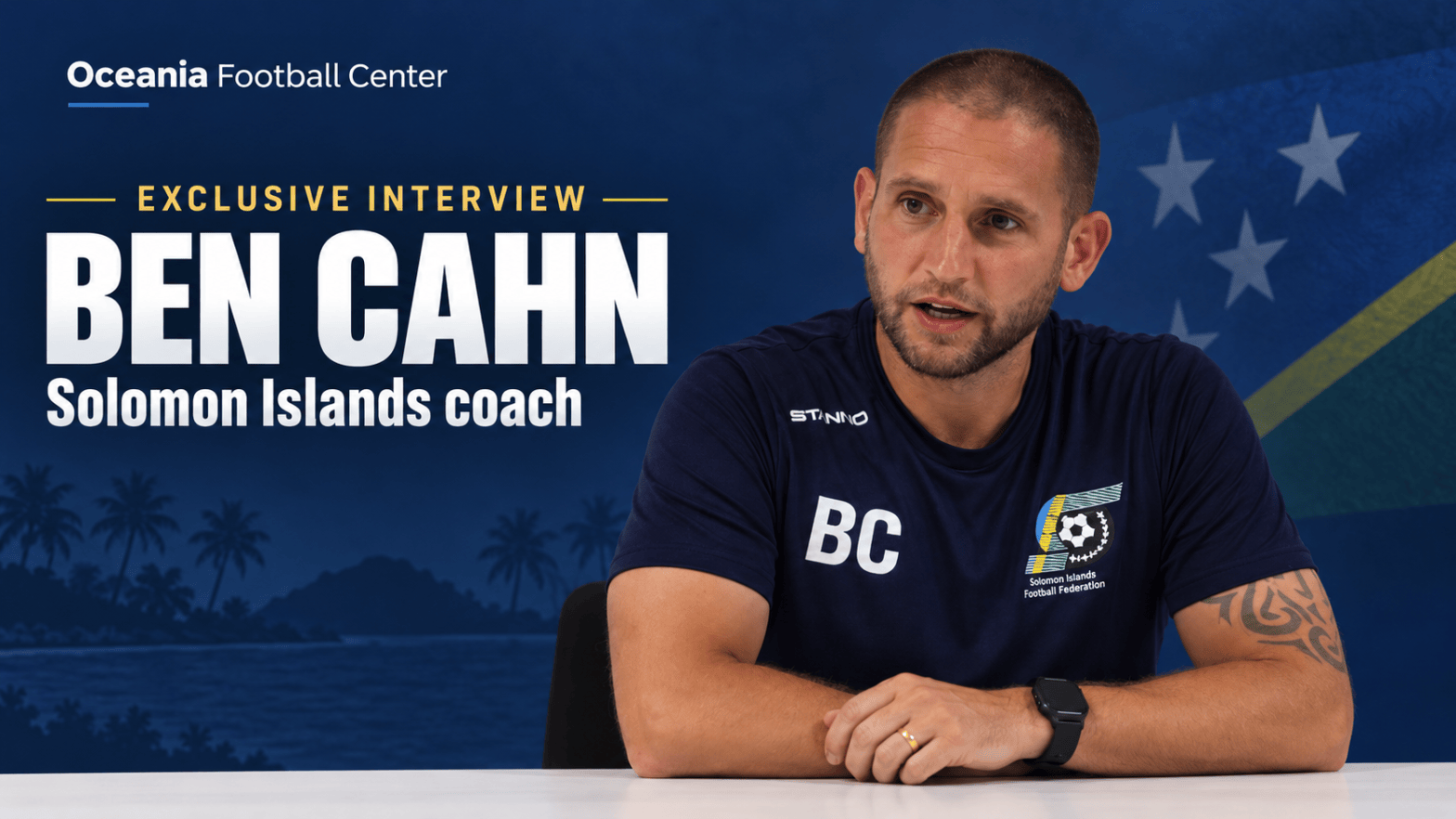
Before Ben Cahn began working in Solomon Islands football, he was told there was a style that simply would not work: possession football.
The argument was that island players might possess individual flair, speed and attacking talent, but building a team capable of controlling matches consistently through the ball was another matter.
A full season with Solomon Kings has changed Cahn’s view completely.
“When I took the job, people told me you can’t play possession-based football with islands players. We showed they are very capable,” the Solomon Islands national coach told Oceania Football Center in an exclusive interview.
That statement goes to the heart of what Cahn is attempting to construct with the Bonitos.
His ambition is not simply to select the best Solomon Islands players and organise them for individual international windows. He wants the national team to develop a recognisable football identity built around intensity without the ball and control with it.
“I want to bring the passion for football in the Solomon Islands alive on the pitch. I want to play with intensity and aggression out of possession, but I want us to dominate the ball, control the game with possession and let the players show how good they are.”
For Cahn, that philosophy is also connected to player development.
“I have a responsibility to develop the players and give them opportunities to progress their careers. I believe that can only happen by playing and training in the way that we do.”
His introduction to the senior national team provided a difficult reality check.
Solomon Islands faced Bulgaria and St Kitts and Nevis during the FIFA Series, matches Cahn says revealed weaknesses extending far beyond tactical organisation.
He does not want to discuss everything that happened around that period publicly, describing it as a difficult time for both players and the wider group, but believes the lessons were important.
“The lessons that were learnt were more off the pitch. We’re working very hard to build a better programme to support the players and close the gap with bigger nations within the resources we have.”
Cahn said the Bulgarian coaching staff and senior players offered encouraging feedback about the way Solomon Islands attempted to play despite the scoreline.
“As hard as it is to believe with the scoreline, we actually dominated 25 minutes of that game. But there was a big gap in terms of game management, quality in both boxes and depth. We’re working every day to close that gap.”
Game management has become one of the central themes of his assessment of Solomon Islands football.
The first OFC Pro League season gave many Solomon Islands players something they had rarely experienced before: a professional environment, regular matches against quality opposition and fixtures arriving every few days.
Cahn believes Solomon Kings demonstrated that players from the country are fully capable of playing technically demanding football. The problem is reproducing that level consistently and learning how to convert good periods into victories.
“The gaps are in game management, deeply understanding the game and how to win matches, and being able to be at their best consistently, especially in the Pro League where the games come every few days. But the only way to close the gap is more games and more experience.”
His dual connection with Solomon Kings and the national team naturally raises another question: how much should one become an extension of the other?
Cahn does not avoid the relationship.
“It’s an inescapable fact that the two organisations will be intertwined. The Kings are a great resource for the national team. It’s very rare for any national team to have a large group of players together in a full-time environment.”
But he insists that playing for Kings will not become an automatic route into the national team.
“National team selection won’t be a certainty for Kings players, and players at other clubs will be monitored closely.”
That is particularly important because an increasing number of Solomon Islands players are competing overseas, especially in Fiji and Australia.
For Cahn, simply moving abroad does not automatically make a footballer more valuable to the national team.
“The quality of the competition is an important factor. Potential of the player, current form, current condition and, importantly, we only want players with the right character.”
One of the most interesting cases is John Orobulu.
The striker has been producing goals in Fiji and had previously worked under Cahn’s observation while playing for Hekari United in the OFC Pro League. He is not currently in the Solomon Islands squad, but Cahn made clear that the door remains open.
“John is on the radar. I watched him closely in the Pro League for Hekari. It’s not my place to comment on past issues.”
What happens next is up to the player.
“If he can continue the form he’s had in Fiji and produce those numbers consistently in the Pro League, he has every chance of being involved moving forward.” Recently, Orobulu talked to Oceania Football Center about being left out of the squad; the striker said he respects the decision and is ready to prove his worth to comeback to the national team.
The coach is also looking further down the age structure.
Jayroll Patty and Danford Fiumae are the two young players Cahn currently believes are closest to making the next step.
“They are both making great progress, and we will manage them carefully while they build the condition and consistency to play 60 minutes at international and professional level.”
Behind them is another generation already beginning to appear.
Cahn revealed that six U-16 players trained with the senior environment during the pre-tournament camp.
“There are a lot of other good young boys coming through. We had six U-16s training with us in our pre-tournament camp. Very, very exciting players. But we have to be patient. Lots of potential, but also lots of development needed.”
That patience sits alongside an ambitious target.
Cahn has spoken about the 2030 World Cup as the long-term objective for Solomon Islands, but he does not believe reaching that level will depend primarily on discovering another gifted attacker.
Asked what the country must improve collectively, his answer was deliberately broad.
“We want to improve everything, from professionalism, standards off the pitch, resources to support the team, along with the many tactical areas that we are consistently trying to improve. The answer is everything, always.”
The largest changes required before 2030, in his view, may not happen during matches at all.
“The biggest changes are off the pitch. This group is at a good age. There are top young players coming through. They need to be supported to give them every chance of succeeding.”
Cahn knows Solomon Islands has talent. That has rarely been the question.
His project is about creating the environment in which talent becomes a functioning international team — one capable of controlling matches, managing difficult moments and producing the same standards repeatedly.
And he intends to push that project far beyond the current MSG Prime Minister’s Cup.
“I will keep fighting for them, keep fighting to improve football in Solomon Islands as a whole and keep fighting to do everything I can to make the dream a reality.”
The dream is 2030.
The work required to reach it has already started.
Discover more from Oceania Football Center
Subscribe to get the latest posts sent to your email.


One thought on “Ben Cahn: “You can play possession-based football with islands players” — the plan to reshape Solomon Islands”