
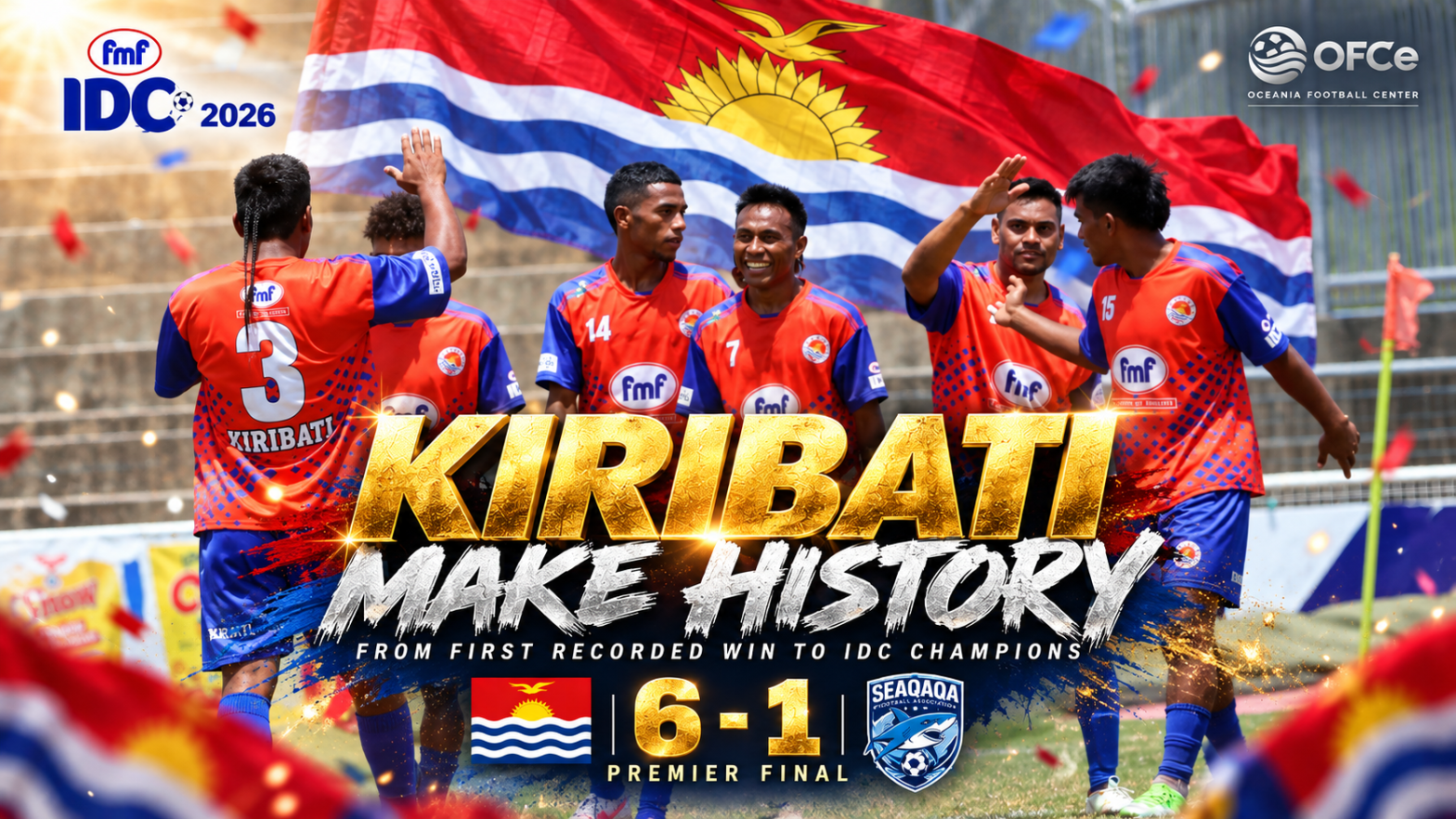
Kiribati have completed one of the most extraordinary campaigns in recent Oceanian football history, defeating Seaqaqa FC 6-1 to win the Premier Division title at the 86th FMF Inter-District Championship on Sunday, October 11. Playing in the tournament for the first time, the Pacific island nation’s senior national team lifted the trophy at HFC Bank Stadium in Suva, just five days after losing 4-2 to the same opposition in their opening match. For a country that had never recorded a victory with its senior national team before this week’s competition, the achievement represents a remarkable transformation.
The final began with Kiribati showing the attacking confidence that had developed throughout the tournament. Nabetari Itiata Ioera opened the scoring in the 26th minute, but Seaqaqa responded almost immediately through Apenisa Dulukobau, who equalised four minutes later. The sides went into half-time level at 1-1, leaving the championship undecided between a Kiribati team chasing an unprecedented title and a northern Fijian district that had already beaten them during the group stage.
The decisive moment arrived in the 59th minute when Dulukobau was shown a red card, reducing Seaqaqa to ten players. Kiribati took full advantage of the dismissal, with Ioera restoring their lead three minutes later. Peter Diehm extended the advantage in the 72nd minute before substitute Kiniore Siu made it 4-1 five minutes later. Bauro Martin Jr added a fifth in the 80th minute, and Diehm completed his double in the 89th to seal an emphatic 6-1 victory. Five goals in the final 28 minutes transformed what had been a closely contested championship decider into an overwhelming triumph.
The result was especially significant considering how Kiribati’s campaign had started. Their opening defeat against Seaqaqa on October 6 exposed defensive weaknesses, and head coach Pine George Holomoana Iosefa acknowledged that his players had struggled with aspects of the opposition’s game. Nevertheless, scoring twice against an established Fijian district provided encouragement that the team could compete at a higher level.
Speaking exclusively to Oceania Football Center after that opening match, Iosefa expressed his surprise at his team’s attacking capabilities.
“We did not expect to score against one of the top teams in Fiji. It was amazing for us to see that we can reach the standard of football in the Pacific region and even go beyond,” the Kiribati coach said.
Only days later, his players had gone considerably further than simply demonstrating they could compete.
Kiribati’s second match produced a result that changed the country’s football history. A 6-0 demolition of Nadroga, inspired by a hat-trick from Bauro Martin Jr, became the first recorded victory achieved by the Kiribati senior national team since its international football history began in 1979. The result also secured qualification for the Premier Division semi-finals, where Kiribati faced Fiji’s Under-17 national team, a squad preparing for the FIFA U-17 World Cup.
Rather than allowing their historic first victory to remain an isolated achievement, Kiribati followed it with another impressive performance. Goals from Peter Diehm, Martin Jr and Nabetari Itiata secured a 3-1 victory over Fiji U-17 at Buckhurst Park, sending the islanders into their first IDC final. There they faced the same Seaqaqa side that had defeated them at the beginning of the competition, providing an opportunity to demonstrate just how much progress they had made.
Across four matches, Kiribati scored 17 goals, winning three consecutive games after their opening defeat. Martin Jr emerged as one of the tournament’s most influential players, scoring six goals during the campaign, including his hat-trick against Nadroga and another important contribution in the final. Diehm also played a decisive role in the knockout stages, finding the net against Fiji U-17 before scoring twice in the championship decider.
The scale of the achievement becomes clearer when considering Kiribati’s football history. Before the IDC, the national team had played just 11 recorded senior international matches, all at editions of the Pacific Games or South Pacific Games between 1979 and 2011, without registering a victory. Its last appearance at that level had come 15 years earlier in New Caledonia. Kiribati are also not FIFA members and remain associate members of the Oceania Football Confederation, limiting their access to international tournaments and regular high-level competition.
There is an important distinction: Kiribati’s victories in Fiji do not count as official senior international wins because they came against Fijian district clubs and a national youth selection. Nevertheless, the IDC has provided the senior national team with its first documented competitive victories and now a championship trophy, milestones that remain significant regardless of their classification in international records.
The achievement also reflects the obstacles faced by Kiribati footballers at home. The country has limited suitable football infrastructure, and many players develop their skills on sandy surfaces rather than conventional grass pitches. Earlier in the tournament, Kiribati attacker and team captain Teweia Butibara explained the situation to Oceania Football Center, emphasising that the lack of proper facilities remains a major difficulty for football development.
“In Kiribati there are plenty of good players, but the pitch is not good. The pitch that we use to play on is sand,” Butibara said.
Despite those limitations, a 19-player squad assembled by the Kiribati Islands Football Federation has demonstrated that the country possesses players capable of competing successfully beyond its borders. Their performances also provide encouragement for the federation’s ambition of securing full OFC membership and eventually joining FIFA, although those objectives will depend on continued institutional and football development.
Fiji’s decision to invite Kiribati into one of its oldest and most established domestic tournaments has therefore produced an outcome extending well beyond the Premier Division championship. It has given players who rarely experience sustained international competition the opportunity to compete, improve and ultimately win silverware against opposition from a stronger domestic football environment.
The historical connection between the two countries makes the occasion particularly meaningful. Kiribati’s first recorded senior international was against Fiji at the 1979 South Pacific Games. Forty-seven years later, it is again on Fijian soil that the country’s national team has experienced a defining moment in its development.
Kiribati arrived at the IDC hoping to measure their standard against Fijian football. They leave Suva as champions, having overturned an opening defeat, recorded three successive victories and scored six goals in a final. For a national team that had spent decades without a recorded win, their first appearance at the tournament has ended with a trophy and a powerful demonstration of what their footballers can achieve when given the opportunity to compete.
Discover more from Oceania Football Center
Subscribe to get the latest posts sent to your email.

