Cook Islands football continues to strive for development in football; counting on various players currently based in New Zealand – such as Harlem Simiona and Ishaq Nazeem who repersent the men’s national team – the 17,000 people self-governing island country hopes for better results in the sport. The Cook Islands are well known because of their fantastic tourist attractions and their good performances in rugby sevens tournaments, but their success in OFC-level football could be bigger if they could rely on a well-known attacker who has already represented the country at U-17 level, but he still needs to be covered by the senior national team. His name is Maro Bonsu-Maro.
Maro has played for clubs in the Cook Islands, where his mother comes from, including Puiakura and Tupapa Maraerenga in previous editions of the OFC Champions League. Maro’s father is from Ghana, but he grew up in New Zealand and it gives him the possibility to represent three national teams: Cook Islands, Ghana and New Zealand. Most recently, the striker also played in the OFC Champions League, but in a far more famous side: Auckland City. In the 2019 edition of the regional tournament, Maro met his former club Tupapa Maraerenga and helped his side to in a massive 15-0 win in by scoring four goals coming from the bench.
Maro Bonsu-Maro representing Auckland City – ACFC Media
Maro is a product of Auckland City’s Youth Academy, but he also played for other New Zealand clubs such as Central United. The reigning New Zealand champions currently compete for their tenth continental title as they qualified for the knockout stage of 2020 OFC Champions League.
Bonsu-Maro already represented the Cook Islands on an international level, as mentioned above. It was at the OFC U17 Championship in 2013 that the striker scored two goals for his side and helped the Cook Islands advance from the first qualifying round to the group stage. Although Maro’s only international experience has been representing the Cook Islands, the player is not cap-tied to the green-white team – in return he must be capped for the senior side at an official tournament.
Since Ghana seems to be an unrealistic goal for Maro, he may only have New Zealand and the Cook Islands to choose from, but whether he will represent either side is still uncertain. Recently, the player showed some doubts about his availability for the Cook Islands – ready to wait for a possible All Whites call-up. He is just 23 and he must wait a little more to analyse his career and then decide which side he is going to represent at senior level.
Despite all uncertainties, it is obvious that Maro’s inclusion in the Cook Islands squad would rise the national team’s expectations for the upcoming challenges, and the national football association – CIFA – has an important role to play at this stage on convincing him to represent the islander team.
Solomon Islands rising star Charles Mani is a hard worker. It has been one year since the 18-year-old forward move to New Zealand to pursue his dream to become a successful footballer. He was recently approved to join Hibiscus Coast AFC from NRFL2 Division after impressing the coaching staff during his trial period.
He did not have the opportunity to make his official debut for his new club due to the COVID-19 pandemic that postponed winter football season’s beginning in New Zealand. However he stayed focused during this period to get better and better to fight for his space at his new club – “Practice makes perfect. Anyway because of the lockdown the training of the club and school squad still locked up so I decided to do my own training […] when I do my own training the contact with the ball is bit better,” he said.
Charles also studies at Long Bay College so the young forward has a hard routine. He needs to train with two different teams – the school’s team and Hibiscus Coast. While the football activities are currently suspended in the school, he is already back to training with his new club once Hibiscus’ activities resumed last week – “The club training has started […] Keeping my own training helped me to stay fit and prepare for the winter league,” pointed Mani – “I want to do what I love the most. I keep doing my own and having fun with football, because that is what I love the most,” he added.
He was part of the Solomon Islands youth team that made history by representing Oceania in the FIFA U17 World Cup held in Brazil last year. Charlie is proving his quality day in day out and the combinig talent with hard working will surely help him in his chase to become a professional footballer.
While many countries are slowly resuming their football activities and scheduling dates to resume the local leagues, the situation in Vanuatu remains unknown. The country needs to deal with the COVID-19 threat as they are trying to recover from Tropical Cyclone Harold that devastated some islands.
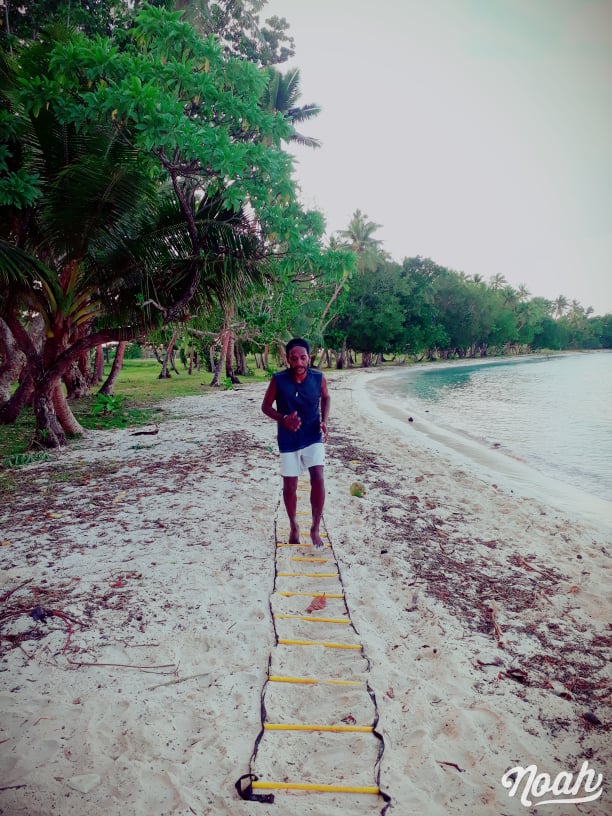
However it is not a problem for football players from Port Vila keep their training routine to stay fit. One of these dedicated players that are working hard during this “forced offseason” is Erakor Golden Star’s captain Jackson Tasso. The 26-year-old midfielder is following a strict routine of exercises as he waits for the return of 2019-20 Port Vila Premier League season.
Training on sand is a trend for footballers. Beach training is considered ideal for developing not only strength but also proprioception, that is, being aware of the space your body occupies. It also increases metabolic demand of training and reduces muscle soreness.
Erakor Golden Star is currently in the fourth position in the 2019-20 Port Vila Premier League six points behind league leaders Ifira Black Bird. You can check the current league standings by clicking here.
The wait is close to come to an end in Fiji. The Vodafone Premier League is currently scheduled to resume in July. Fiji Football Association (FFA) is still waiting for government’s advisory but it is expected that local schools will open up on June 15 which means that all activities must be allowed to resume from this day on.
FFA has amended the Vodafone Premier League’s calendar to get along the date mentioned above. If there is no surprising scenarios with the COVID-19 pandemic, the next league’s match must take place in July as the national league’s sixth matchweek must begin on July 18.
The 6th matchweek is scheduled to begin on July 18
However the first clash must kick-off before July 18. Current league champions Ba FC have their matches postponed before the COVID-19 pandemic in order to extend their preparation for 2020 OFC Champions League. They played only one match in the current Vodafone Premier League season and they must play all their late matches before July 18.
The Men in Black will face Lautoka, Suva, Nadi and Navua before the sixth matchweek’s beginning. You can check the current standings by clicking here.
Uncertainty still hangs over Fijian football as there is no scheduled date to resume the national football leagues. However it does not mean that everything is stopped outside the pitch – the local teams can look for new players to strenghten their squads.
According to reliable sources, Rewa got his International Transfer Certificate (ITC) right before the beginning of COVID-19 pandemic, so the Brazilian forward might be joining the Fijian side when football actitivies are cleared to resume.
Matheus has some European experience in his curriculum – he has already played in Moldavia and Romania. He has also played for Brazilian clubs at regional level.
While some countries are still facing strict restrictions due to COVID-19 pandemic, other countries are resuming their activities. However both situations converge at a common point: We miss football.
Most football players are trying to stay fit during the pandemic so they could be ready to play as soon as possible and it is not different in Papua New Guinea that the 2019-20 National Soccer League season must resume in July. Players and staff are excited to return to the pitch and work hard as a team, but a legendary footballer is more than ready for the battle: David Muta.
The legendary player from Hekari United kept himself active during this “forced offseason”. Now that the restrictions are getting loose in Papua New Guinea he is finally able to come back to the pitch and train on the sacred ground of footballers –“I feel an endless need to learn and improve. To evolve not only to please the coach or the fans, but also to feel satisfied with myself,” he expressed on social media – “There is no limit to learn […] no matter what our age,” he added.
Despite being 32 years old, he is still a key player for Hekari United and he needs to work the extra mile alongside his teammates and coaching staff to win the National Soccer League. Hekari is currently in the third position with 23 points, two points behind current leaders Vitiaz United. You can check the current league standings by clicking here.
Seiloni Iaruel is one of the most important footballers from Vanuatu. Currently playing for Galaxy FC, the 24-year-old goalkeeper started to show his talent when he represented his country in the 2011 OFC U17 Championship when he was just 15.
His incredible quality for a goalkeeper from a Pacific Island’s country really impressed and he made his debut for the National Football Team at senior level when he was just 17. He was called-up to represent his country at the 2012 OFC Nations Cup held in Solomon Islands. Iaruel played only one match in the tournament – the 5-0 win against Samoa.
While he was making his debut for the National Team, an European club was already watching him closely. Earlier this year Iaruel was part of Vanuatu U23 squad that played the OFC Olympic Qualifier held in New Zealand. The Ni-Van side spent a while in Australia training and playing some friendly matches before departing to New Zealand. The goalkeeper had great performances in these matches which put him on the radar “The last friendly match in Australia, I only played the first half and had to leave with Stoke City representative to go to another stadium for a test,” he said in a talk show back in 2012.
Iaruel called the attention of Stoke City from England
Andrew Parkes was the one who discovered Iaruel for European football. The Stoke City’s agent in Australia also expressed his optimism about taking the Ni-Vanuatu goalkeeper for a trial in England – “I am personally very excited for him and do hope he makes us all very proud,” he told to Vanuatu Football Federation’s media.
Iaruel left his country on August 2. After flying to Australia and Singapore, he finally arrived in Europe to pursue his dream of becoming a professional footballer. He was received there by Stoke City FC Academy Recruitment Manager Kevin Scott and David Jarvies – “We are very happy to have a player from the Pacific Islands […] He can play in Europe if he do well in his trial with our goalkeeper coach,” said Scott.
Iaruel arrived in England in August 2012 for trials.
He had the opportunity to train and play with the U18 squad of Stoke City. His first challenge was a friendly match against Brentford Youth Team. The Ni-Van goalkeeper had a good performance and helped his side to win by 4-1 – “I enjoyed my first game with Stoke and I think I made some good saves […] I am so glad to be here on trial, it’s a great club and the staff, coaches, volunteers and fans are great. They have made me feel at home even though I am far away from Vanuatu,” he said after the match.
Iaruel really impressed in this match and he was offered an extension to his trial period which meant that he remained in the English club for one more month – “We are happy to have a Pacific Island boy with us and if he works hard enough we will decide if we can sign him,” revealed Kevin Scott.
Iaruel playing against Brentford
Unfortunately Iaruel did not have the opportunity to sign a contract with the English club and he returned to his country. However he surely became a better player after his stint in England as he had the opportunity to have access to good facilities and good staff – “He did really well. He was great size and very athletic goalkeeper […] A player with great attitude and very hard working,” said Kevin Scott to Oceania Football Center. Scott left Stoke City a couple of years ago. He currently works as an independent fit all consultant with clubs from the whole world.
Since then, Iaruel stayed in Vanuatu representing local clubs. He played for Tafea and Amicale and now he is the starting goalkeeper of Galaxy. Despite playing at his homeland, he keeps the good level as one of the top keepers from his country. His last official appearence was a couple of months ago in the 2020 OFC Champions League before the football activities in Oceania have been suspended due to COVID-19 pandemic.
Iaruel was Galaxy’s captain in 2020 OFC Champions League
Iaruel stayed away from the Vanuatu national team from 2016 to 2019. Last year he was called up for a friendly match against Solomon Islands in March. However, he must be included in the upcoming call-up if he keeps his level when football resumes.
Ten years ago, one of the most important moments in oceanic football took place when Papua New Guinea was brought to the top of Oceania by Hekari United. The Port Moresby-based side became the first non-Australian or New Zealander side ever to win the OFC Champions League trophy. Led by Jerry Allen, the team counted on the likes of Henry Fa’arodo, David Muta and Koriak Upaiga on their way to the final.
Earlier in the month, on 2 May to be precise, Hekari United celebrated ten years of their greatest memory, when they lost 2-1 away from home to New Zealand champions Waitakere United, a result that benefited the Papua New Guinea side who had won the first leg in Port Moresby 3-0. Star striker Kema Jack was crucial for Hekari United in both of these matches – Jack scored three of Hekari’s four goals in the finals.
The star Kema Jack – FIFA
While Group A of the 2009/10 OFC Champions League featured two New Zealand representatives – Auckland City and Waitakere United – plus Tahiti’s Manu-Ura and New Caledonia’s AS Magenta, Hekari did not have to play against a New Zealand side to qualify for the finals. The Port Moresby-side had Lautoka’s Fijian side, Ni-Vanuatu champions Tafea and Solomon Islands’ Marist FC in their group. The groups were played in a round robin system with home and away matches – a total of six matches for each team were played to determine the champions of each group.
Both finalists had to fight hard to qualify for the final: Waitakere United had the same number of points of Auckland City int standings, but the red-and-white team came out on top in the goal difference – +9 against +8 from Auckland City. Hekari led the group by just one point over Lautoka, the Papua New Guineans had won four games, drawn once and lost only one – the Fijians were the only team to beat Hekari in the group stage.
David Muta, Kema Jack, Henry Fa’arodo and Tumaisi Manuca celebrate after scoring in the finals – FIFA
After securing a historic title, Hekari travelled to the United Arab Emirates to take part in the FIFA Club World Cup. Although they lost in the play-off match against local champions Al-Wahda, Hekari made Papua New Guinea and Oceania proud of their efforts to represent their region in the world stage tournament.
The current year 2020 also marks the return of Hekari United after a four-year break in the OFC Champions League. The club finished as runners-up in the PNG National Soccer League in 2019 and earned a place in the regional tournament. Unfortunately, Hekari United were unable to advance to the knockout rounds even at home in the year that marks the tenth anniversary of the club’s most important title. The team, which was grouped with Eastern Suburbs of New Zealand, Hienghène Sport of New Caledonia and ABM Galaxy of Vanuatu, finished third in the group to complete their return to the competition.
Hekari United remained the only team from neither Australia nor New Zealand to win the competition until Hienghène Sport, one of Hekari’s opponents in the 2020 OFC Champions League, won the 2019 edition of the regional competition.
Oceania’s most successful national futsal team does not have a sports arena to call home. The Kurukuru, as the Solomon Islands’ national futsal team is known, enjoyed the region’s greatest fame after defeating New Zealand in the grand final of last year’s OFC Futsal Nations Cup. Success in the regional competition qualified Solomon Islands for their fourth consecutive FIFA Futsal World Cup – which, following the postponement, will now be held in 2021 in Lithuania.
The latest futsal tournament in Solomon Islands, the 2020 SIPA Futsal Championship, ended in March this year with Marist FC as champions after beating KF Gold in the grand final. The competition was held in Honiara’s Multi-Purpose Hall, a venue that does not match the quality of the players who took part in the competition – players like Elliot Ragomo, who has experience of playing futsal in Brazil, and the well-known George Stevenson certainly deserve better facilities.
Extended highligts of the grand final match between Marist and KF Gold – SIPA Futsal League
Several key Solomon Islands players have already complained about the situation on the country’s courts; a national team taking part in a FIFA Futsal World Cup for the fourth time really needs a better environment to develop talent and continue the legacy of the golden generation led by players like Jack Wetney, Micah Lea’alafa and Elliot Ragomo.
In 2017, “The Solomon Islands Prime Minister, Manasseh Sogavare, pledged to build a proper facility for futsal development last year, as part of the country’s preparations to host the Pacific Games in 2023. The Solomon Islands Football Federation signed a contract in October with the government and FIFA to build the stadium in Honiara“, as told by RNZ. The article also mentioned that construction would begin at the end of 2017 – something that Solomon Islanders are still waiting for.
As mentioned above, Honiara will host the Pacific Games in 2023, which will force the Solomon Islands government to improve the country’s sports facilities to meet the criteria for hosting the Games.
The Honiara’s Multi-Purpose Hall – SIPA Futsal League
In 2016, former Kurukuru head coach Juliano Schmeling said that “Solomon Islands futsal coach Juliano Schmeling says it’s a “miracle” the country will finally get a proper facility to develop the sport in the country. FIFA has pledged financial support for the construction of a new Futsal court in Panatina in Honiara” as told by RNZ.
The Solomon Islands futsal community is urging officials to provide appropriate facilities for the development of the game in the country. Solomon Islands were severely challenged by New Zealand in the last OFC Futsal Nations Cup grand final – they only beat the Futsal Whites on penalties – and their reign in the region could not go so far if they cannot maintain the level of recent years.
In the next chapters of this story we will learn how futsal will develop in Solomon Islands, but one thing we can already be sure of: in Solomon Islands, from shore to shore, there is plenty of talent to work for.
Questa è settimana molto speciale per gli appassionati di calcio di Vanuatu perché tre anni fa, per la prima volta nella storia dell’arcipelago oceaniano, una loro nazionale di calcio ha avuto l’occasione di affrontare il resto del mondo in una competizione ufficiale FIFA. Si tratta della Coppa del Mondo U-20 giocata in Corea del Sud e che ha visto trionfare l’Inghilterra. Nonostante i vanuatini abbiano perso tutte le partite, l’impegno che hanno dimostrato ha reso orgogliosi tutti i loro connazionali.
Vanuatu è riuscito a prenotare un posto per questa competizione dopo aver raggiunto la finale del Campionato OFC U20 del 2016. In quella squadra giocavano tra gli altri Bong Kalo, Godine Tenene, Ronaldo Wilkins e Jason Thomas. Però il giocatore che più si è messo in mostra è stato Frederick Massing, che ha segnato un gol al 94° minuto nella semifinale contro la Nuova Caledonia, che ha permesso alla squadra di raggiungere la finale contro la Nuova Zelanda. “Sono così felice di segnare il gol vincente per Vanuatu“, queste le parole di Massing rilasciate ai media dell’OFC dopo quella partita.
Il torneo oceaniano si è giocato a Vanuatu e questo ovviamente ha influito molto sulle prestazioni della nazionale di casa. Avere al proprio fianco i propri supporters non è mai cosa da poco. La finale non è andata bene, perché la Nuova Zelanda è stata implacabile, ma il secondo posto ha comunque concesso la possibilità a Vanuatu di toccare il cielo con un dito e di avere addosso gli occhi del mondo. Un’opportunità rarissima per loro.
I giocatori di Vanuatu festeggiano il raggiungimento della Coppa del Mondo U20 del 2017
La federazione calcistica di Vanuatu ha pensato di investire molti soldi in strutture e persone per preparare al meglio questo evento. Come allenatore è stato ingaggiago Dejan Gluščević, allenatore montenegrino che aveva già lavorato con le nazionali giovanili di Singapore. Questo gli ha permesso di far giocare la giovane nazionale vanuatina contro le rappresentative U23 e U20 della nazione asiatica: “Ci stiamo preparando alla Coppa del Mondo giocando tutte le partite di fila a Singapore. Qui saremo in grado di conoscere meglio i giocatori e di selezionare quelli che ritengo più idonei per affrontare questi mondiali “, queste le parole che aveva rilasciato prima di partire per Singapore.
Avere un allenatore straniero e un buon staff, composto anche da nutrizionisti e preparatori atletici di primo livello, è qualcosa che non si vede spesso in Oceania ma che garantirebbe un grande salto di qualità. La sua presenza e la sua esperienza hanno aiutato i giovani giocatori ad affrontare l’emozione e l’ansia di un Mondiale FIFA in modo del tutto differente. “Sono così felice di gicare contro le grandi squadre. Penso che la Germania sarà la più difficile da affrontare perché sono davvero bravi a giocare a calcio, ma sono pronto. Voglio godermi questa esperienza fino in fondo“, le parole di Ronaldo Wilkins in un’intervista poche settimane prima dell’inizio del mondiale.
A Vanuatu tutti aspettavano con ansia la prima partita contro il Messico. La nazione centroamericana ha messo subito in chiaro le cose segnando 2 goal nel primo tempo. Durante l’intervallo le parole di coach Gluščević hanno sorbito il loro effetto perché i ragazzi oceaniani sono entrati in campo con grande determinazione tanto da segnare 2 goal ed agguantare un miracoloso pareggio. I marcatori sono stati Bong Kalo e Ronaldo Wilkins.
Wilkins (sinistra) e Kalo (destra) celebrano un goal contro il Messico
Il sogno di guadagnare un punto al loro primo appuntamento mondiale sembrava realizzarsi più passava il tempo. Il Messico non aveva più le forze per controbattere e anzi la nazionale di Vanuatu è andata più volte vicina a segnare il 3 goal. Ma come spesso succede nel calcio le favole sono destinate a interrompersi bruscamente. Sugli sviluppi di un calcio d’angolo il difensore messicano Edson Álvarez ha segnato al 94° minuto e ha risvegliato tutto il popolo vanuatino dal proprio sogno. Tuttavia una sconfitta ottenuta in questo modo è stato motivo di orgoglio per la gente di Ni-Vanuatu: “So che loro (i tifosi) sono tutti molto orgogliosi di noi, per come abbiamo recuperato la partita dopo essere andati sotto 2-0. La gente ha guardato la partita a casa o insieme nei bar o nelle piazze sono e hanno festeggiato la sconfitta“, ha detto Bong Kalo dopo la partita.
Viste le premesse tutti speravano di poter vincere almeno una partita. Purtroppo la seconda partita contro il Venezuela ha smorzato le speranze dopo che la squadra sudamericana ha vinto ampiamente per 7-0. Dopo quella sconfitta si è presentato al campo Lambert Maltock, presidente della Federazione Calcio Vanuatu (VFF) e attuale presidente della Oceanic Football Confederation (OFC): “Sapevamo già che il football sudamericano è a un livello superiore al nostro. Riescono a modificare durante la partita le tattiche che avevano preparato e così hanno disorientato i nostri ragazzi. Adesso tutti sanno dove siamo sulla mappa del mondo“, ha spiegato.
Lambert Maltock è il presidente della VFF e della OFC
Il terzo e ultimo incontro della fase di gruppo era il più proibitivo di tutto. Vanuatu doveva confrontarsi con la Germania, una delle nazioni guida del calcio mondiale. La squadra del Ni-Vanuatu è riuscita a tenere testa ai suoi avversari nei primi minuti, poi la Germania ha preso il sopravvento e ha segnato 2 gol nel primo tempo e il 3° all’inizio del secondo. Si stava per materializzare un’altra pesante sconfitta, ma i giocatori oceaniani non si sono arresi.
Dopo un errore difensivo tedesco, l’attacco di Vanuatu ha recuperato il pallone , che è arrivato a Bong Kalo che l’ha depositato in fondo al sacco. Il goal ha decuplicato le forze dei giovani vanuatini che hanno avuto ancora il tempo di accorciare ulteriormente le distanze con un’altra rete di Kalo che ha segnato direttamente su calcio di punizione al 77′, portando il suo score complessivo nel torneo a 3 goal e fissando il risultato sul 3-2 per la Germania.
Vanuatu ha lasciato il torneo con tre sconfitte in tre partite, ma con la consapevolezza di aver disputato un torneo al di sopra delle aspettative. “Come capitano, dico sempre ai ragazzi prima di ogni partita che siamo lontani da casa e che dobbiamo portare qualcosa con noi“, ha spiegato Kalo. Potete controllare il video con tutti e quattro i gol segnati da Vanuatu nel torneo cliccando qui.
Celebrazione di uno dei goal di Bong Kalo contro la Germania
Questa esperienza li ha resi migliori come calciatori e come persone. Il coach Gluščević ha spiegato che le loro prestazioni hanno superato le aspettative – “Abbiamo fatto quello che siamo andati a fare lì […] Come loro allenatore, sono contento che i miei ragazzi abbiano superato questo test alla grande”, ha detto alla manifestazione di benvenuto post-torneo.
La rassegna mondiale è stato speciale soprattutto per Bong Kalo e Ronaldo Wilkins. Entrambi i hanno avuto l’opportunità di trovare un ingaggio all’estero.
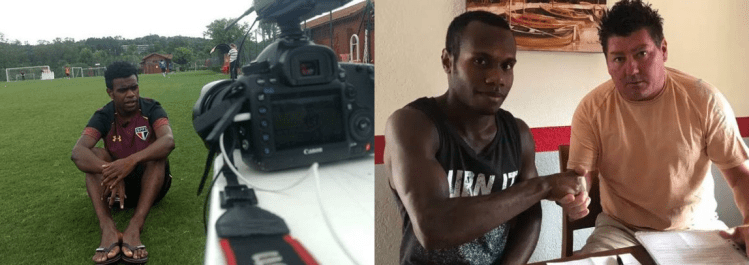
Ronaldo Wilkins ha fatto uno stage di quindici giorni in Brasile con la squadra giovanile del São Paulo FC, una delle più grandi squadre di calcio del Sud America, conosciuta in tutto il mondo per il l’ottimo settore giovanile.
Bong Kalo è andato in Europa e ha firmato con l’FC Ascona, squadra svizzera che milita nella seconda divisione regionale. Ha giocato per tre mesi nel club svizzero e ha segnato un gol in otto partite ufficiali, poi, dopo aver fatto un provino in Spagna con il Leganes, è tornato in patria nel Nalkutan FC.
Ronaldo Wilkins (sinistra) durante il suo soggiorno in Brasile e Bong Kalo (destra) mentre firma il suo contratto con la FC Ascona
Molti dei giocatori di questa U-20 fanno ora parte della squadra nazionale senior e hanno la possibilità di rendere di nuovo orgogliosi tutti i loro connazionle. Siamo di fronte a una delle nazionali più forti della storia oceaniana. Dall’alto di una età media di 23 anni si apprestano a dominare la scena dei prossimi anni?







 Oceania Football Center